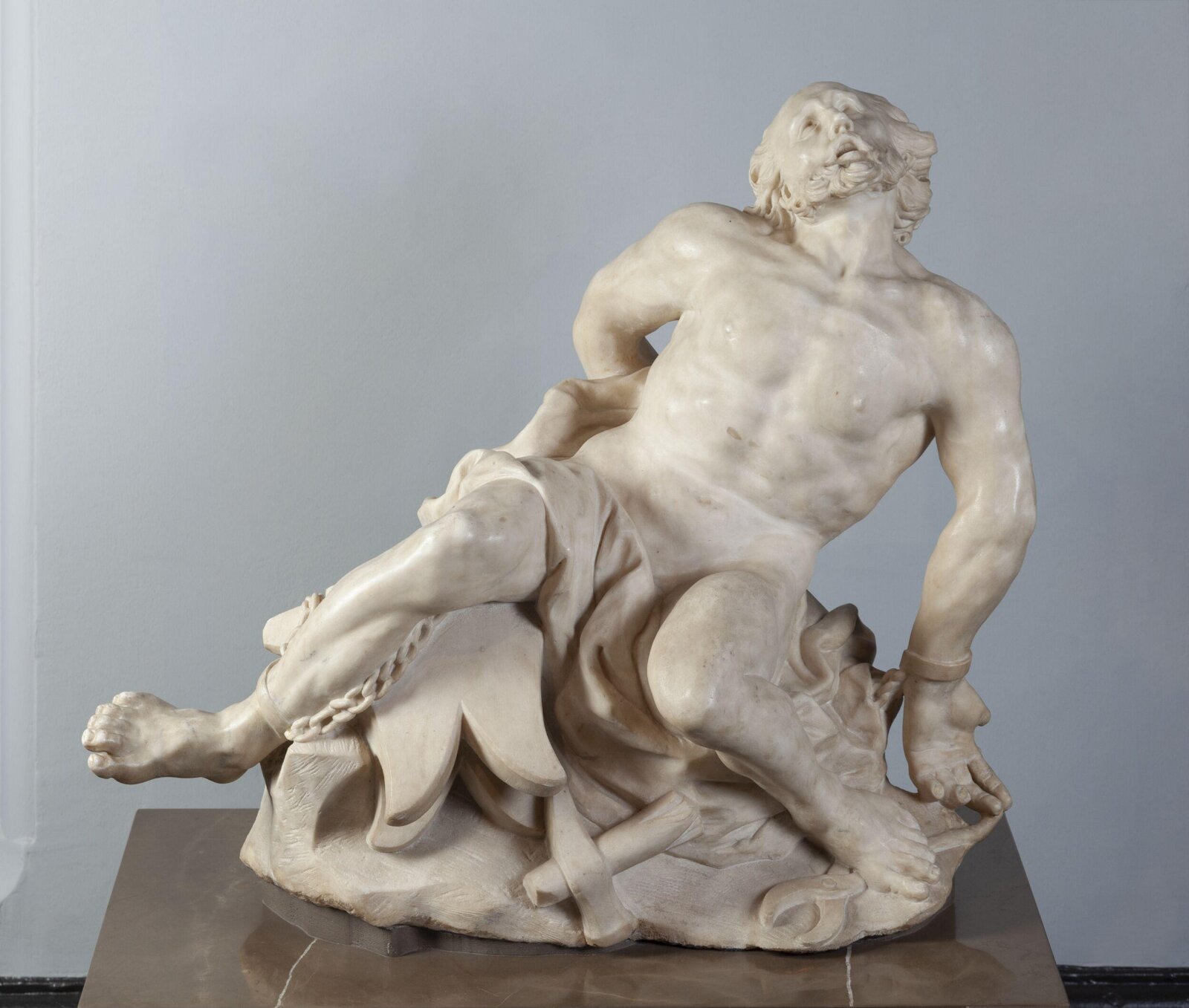
Vulcan (or possibly Prometheus) chained to a rock
Peut-on la voir ?
Oui, exposée actuellement
Où est « Vulcan (or possibly Prometheus) chained to a rock » aujourd’hui ? Victoria and Albert Museum, Sculpture, Room 22, The Dorothy and Michael Hintze Galleries, Londres. Oui, exposée actuellement. Vérifié 25 septembre 2026.

Londres, Royaume-Uni
SalleSculpture, Room 22, The Dorothy and Michael Hintze Galleries
Fermé· ouvre demain à 10:00
Présentée au public.
- Vérifié
- Dans cet état depuis
- Source
- Le musée
À propos de la sculpture
The figure is closely related to David's statue of St Bartholomew in the church of S. Maria di Carignano in Genoa, Italy. Malcolm Baker has suggested that it's one of the few free-standing sculptures of mythological figures to have been executed by a sculptor working in England in the first half of the 18th century'.
Lire plus
Although traditionally thought to represent the mythical Prometheus, chained to a rock by the god Jupiter, the figure probably represents Vulcan. The diary of Sir Matthew Decker, who saw the piece in its original setting in 1728, provides an explanation of its symbolism. Placed on the landing half-way up the main staircase, the figure was intended to be accompanied by a further figure of William III, as part of an allegorical representation of how William's arrival in England and the Glorious Revolution of 1688 had averted a civil war. 'Vulcan is accordingly represented as chained, rather than fashioning the instruments of war.'
Victoria and Albert Museum
Notice
- Numéro d’inventaire
- A.3-1981
Ce qu’elle montre
Au catalogue
Sources
- Victoria and Albert Museum
- Image : Victoria and Albert Museum — © Victoria and Albert Museum, London




![[Die Auferweckung des Lazarus; The Raising of Lazarus. Small Plate; Résurrection de Lazare], Rembrandt, 1642](https://diglib.hab.de/varia/haum/rembrandt-v3-4562/max/000001.jpg)
![[Die kleine Löwenjagd mit zwei Löwen; The Small Lion Hunt with Two Lions; Chasse aux lions], Rembrandt, 1629](https://diglib.hab.de/varia/haum/rembrandt-v3-4599/max/000001.jpg)