Edward Burne-JonesRoyaume-Uni, 1833–1898
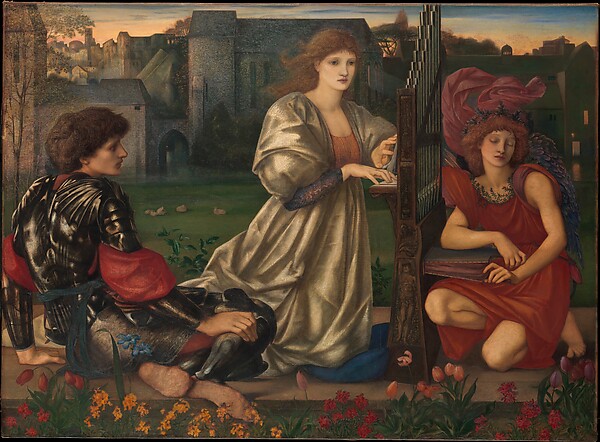
Vespertina Quies
Peut-on la voir ?
Inconnu
Où est « Vespertina Quies » aujourd’hui ? Collection: National Gallery, Londres. Inconnu.

Londres, Royaume-Uni
Le propriétaire est connu ; on ignore si l’œuvre est exposée aujourd’hui.
- Dans cet état depuis
- Source
- Le musée
À propos du tableau
Vespertine Quies (Latin: "Evening Quiet") is an oil-on-canvas painting created in 1893 by Sir Edward Coley Burne-Jones. The work is part of the collection of Tate Britain, London.
Notice
- Numéro d’inventaire
- NG5176
Au catalogue
Sources
- Wikidata
- Image : National Gallery — Edward Burne-Jones · Public domain · Wikimedia Commons
Dans la vie de Edward Burne-Jones
La vie entière1891
“The Star of Bethlehem” is exhibited
The huge watercolour, painted for the corporation of Birmingham and dated 1890, was exhibited in 1891.
winter 1892 – 1893
New Gallery exhibition after a long illness
A long illness checked his work for a time; when he resumed, he was mostly occupied with decorative projects. In the winter of 1892–1893 an exhibition of his work was held at the New Gallery in London; his comparatively few portraits belong to this period.
1892–1898
Designs books for the Kelmscott Press
Between 1892 and 1898 he designed books for the Kelmscott Press; among the books with his illustrations is “The Works of Geoffrey Chaucer” (1896).
1893
Resigns as an Associate of the Royal Academy
Elected an Associate of the Royal Academy in 1885, Burne-Jones gave up the title in 1893.
1894
Sets and costumes for “King Arthur” at the Lyceum
Henry Irving commissioned him to design the sets and costumes for J. Comyns Carr’s “King Arthur”, with Irving as Arthur and Ellen Terry as Guinevere. Burne-Jones accepted with enthusiasm but was disappointed with much of the result, confiding to his friend May Gaskell that he hated the stage.
3 May 1894
Created a baronet
In November 1893 he was sounded out about a baronetcy on the recommendation of the outgoing Prime Minister, Gladstone; in February 1894 he legally changed his name to Burne-Jones, and on 3 May he was created a baronet of Rottingdean and of the Grange. The honour made him unhappy, disgusted his socialist friend Morris and was scorned by his wife; only his son Philip, who would inherit the title, truly wanted it.