ART WIKI32 963 en salle
CarteCollectionArtistesMuséesExpositionsJournal
Connexion

ART WIKI

Où est accroché le chef-d’œuvre, et quand on vous laisse entrer.

Collections : Art Institute of Chicago, Cleveland Museum of Art, Galerie Tretiakov, Hirshhorn Museum and Sculpture Garden, J. Paul Getty Museum, Metropolitan Museum of Art, Minneapolis Institute of Art, Musée de l'Ermitage, Musée des Beaux-Arts Pouchkine, Musée du Louvre, musée national d'art asiatique, Musée russe, Musées d'Art de Harvard, Museum of Modern Art, National Gallery of Art, National Portrait Gallery, Rijksmuseum Amsterdam, Smithsonian American Art Museum, Statens Museum for Kunst, Victoria and Albert Museum, Villa Getty, Whitney Museum of American Art, Catalogue d’État du fonds muséal de Russie (274 musées), Europeana (19 musées), Wikidata (6 musées), Paris Musées (12 musées) et Joconde, la base des musées du ministère de la Culture (495 musées). Les images appartiennent à leurs ayants droit.

Rubriques

  • Carte
  • Recherche
  • Collection
  • Chefs-d’œuvre
  • Exposées en ce moment
  • Artistes

Et aussi

  • Musées et galeries
  • Expositions
  • Journal
  • D’où viennent les données
  • Confidentialité et cookies
AccueilCarteCatalogue
  1. Collection/
  2. Musée d'Orsay/
  3. Vairumati
Vairumati, Paul Gauguin, 1897
Paul Gauguin, portraitPaul GauguinFrance, 1848–1903

Vairumati

1897 · Painting · 73 × 94 cm

Peut-on la contempler ?

Inconnu

Musée d'Orsay

Paris, France

Le propriétaire est connu ; on ignore si l’œuvre est exposée aujourd’hui.

Dans cet état depuis
29 sept. 2026
Source
Le musée
Sur la cartePage du musée

À propos du tableau

Vairumati est un tableau du peintre français Paul Gauguin réalisé en 1897. Cette huile sur toile est conservée au musée d'Orsay, à Paris.

Wikipédia · CC BY-SA

Notice

1897 · à 49 ans
18481903
Numéro d’inventaire
RF 1959 5

Au catalogue

PeinturesPeinture françaiseImpressionnismeXIXe siècle

Sources

  • Wikidata
  • Image : Musée d'Orsay — Paul Gauguin · Public domain · Wikimedia Commons

Pendant ce temps, chez Paul Gauguin

La vie entière
  1. 1891–1901 · Lieu de travail

    Tahiti

  2. February – April 1895

    Failed Auction and the Oviri Scandal

    In February 1895 Gauguin tried to repeat the Hôtel Drouot auction, but without success; in April he submitted the large ceramic sculpture Oviri to the salon of the Société Nationale des Beaux-Arts, whose reception caused a scandal, and wrote an indignant letter on the state of modern ceramics in Le Soir.

  3. 28 June 1895

    Final Departure for Oceania

    On 28 June 1895 Gauguin sailed once more for Tahiti — Eugène Carrière arranged cheap passage for him — arriving in September; he never saw Europe again. He spent the next six years mostly near Papeete, building a spacious house at Punaauia.

  4. April 1897

    News of the Death of His Daughter Aline

    In April 1897 Gauguin received news that his beloved daughter Aline had died of pneumonia; the same month he learned that he had to vacate his house, and, taking out a bank loan for a new one, by the end of the year he was on the brink of ruin and despair.

  5. c. 1898

    Suicide Attempt

    After finishing Where Do We Come From? What Are We? Where Are We Going?, Gauguin attempted suicide by taking arsenic, but the dose proved too large, and a violent fit of vomiting saved his life.

  6. 1899

    Birth of a Son by Pahura

    In 1899 the artist's Tahitian lover Pahura bore him a son; the painting Women by the Sea (Maternity) is associated with this event.

Autres œuvres : Paul Gauguin

Toutes les œuvres
Tahitian Landscape, Paul Gauguin, 1891

Tahitian Landscape

1891 · Minneapolis Institute of Art

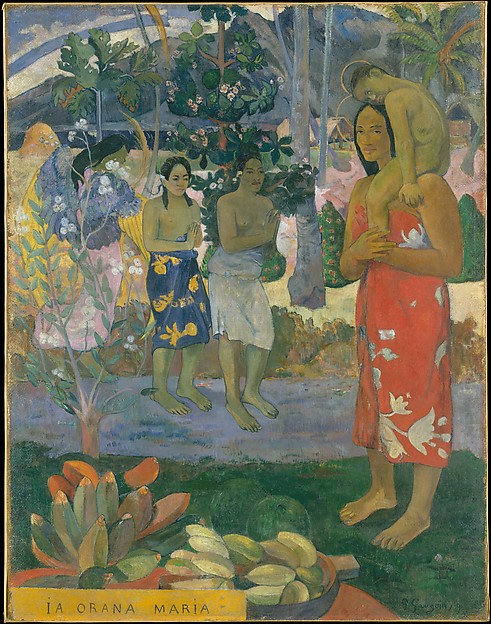
Ia Orana Maria (Hail Mary), Paul Gauguin, 1891

Ia Orana Maria (Hail Mary)

1891 · Metropolitan Museum of Art

Emile Gauguin (1874–1955), the artist's son, Paul Gauguin, ca. 1877–78

Emile Gauguin (1874–1955), the artist's son

ca. 1877–78 · Metropolitan Museum of Art

Madame Alexandre Kohler, Paul Gauguin, 1887/1888

Madame Alexandre Kohler

1887/1888 · National Gallery of Art

Breton Girls Dancing, Pont-Aven, Paul Gauguin, 1888

Breton Girls Dancing, Pont-Aven

1888 · National Gallery of Art

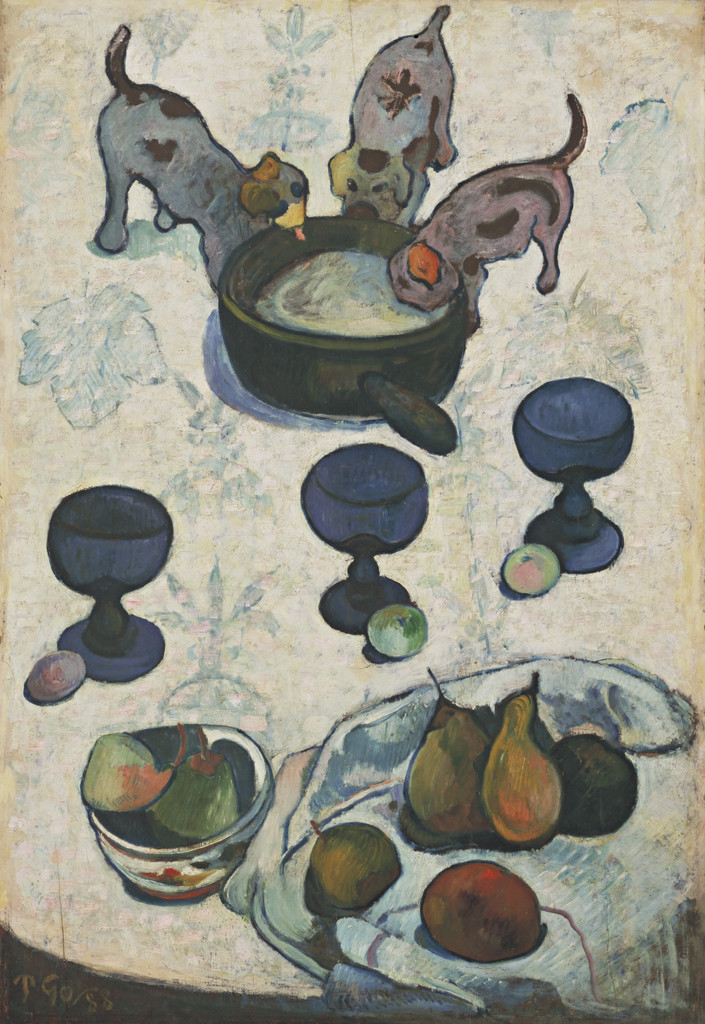
Still Life with Three Puppies, Paul Gauguin, 1888

Still Life with Three Puppies

1888 · Museum of Modern Art

Walking stick with a female nude and a Breton sabot on the handle, Paul Gauguin, ca. 1888–90

Walking stick with a female nude and a Breton sabot on the handle

ca. 1888–90 · Metropolitan Museum of Art

Pair of Wooden Shoes (Sabots) [left], Paul Gauguin, 1889/1890

Pair of Wooden Shoes (Sabots) [left]

1889/1890 · National Gallery of Art