ART WIKI32 963 en salle
CarteCollectionArtistesMuséesExpositionsJournal
Connexion

ART WIKI

Où est accroché le chef-d’œuvre, et quand on vous laisse entrer.

Collections : Art Institute of Chicago, Cleveland Museum of Art, Galerie Tretiakov, Hirshhorn Museum and Sculpture Garden, J. Paul Getty Museum, Metropolitan Museum of Art, Minneapolis Institute of Art, Musée de l'Ermitage, Musée des Beaux-Arts Pouchkine, Musée du Louvre, musée national d'art asiatique, Musée russe, Musées d'Art de Harvard, Museum of Modern Art, National Gallery of Art, National Portrait Gallery, Rijksmuseum Amsterdam, Smithsonian American Art Museum, Statens Museum for Kunst, Victoria and Albert Museum, Villa Getty, Whitney Museum of American Art, Catalogue d’État du fonds muséal de Russie (274 musées), Europeana (19 musées), Wikidata (6 musées), Paris Musées (12 musées) et Joconde, la base des musées du ministère de la Culture (495 musées). Les images appartiennent à leurs ayants droit.

Rubriques

  • Carte
  • Recherche
  • Collection
  • Chefs-d’œuvre
  • Exposées en ce moment
  • Artistes

Et aussi

  • Musées et galeries
  • Expositions
  • Journal
  • D’où viennent les données
  • Confidentialité et cookies
AccueilCarteCatalogue
  1. Collection/
  2. Art Institute of Chicago/
  3. Untitled (Harlequin)
Untitled (Harlequin), Joseph Cornell, 1935/38
JJoseph CornellÉtats-Unis, 1903–1972

Untitled (Harlequin)

1935/38 · Mixed Media

À propos de l’œuvre

Cornell’s early transition from collage into three-dimensional assemblage and his experiments with the possibilities of movement were often, as here, accompanied by a theatrical element. “Shadow Boxes,” as Cornell called some of his constructions of this period, were among the categories of objects named on the cover of the announcement for Cornell’s Exhibition of Objects at Julien Levy’s in December of 1940. Among the scattered illustrations on this cover is an image of Jean Antoine Watteau’s Gilles (c . 1718, Paris Musée du Louvre; Humphrey Wine. Watteau, London, 1992, pp.56–57, ill.), cut up and arranged to look like an articulated marionette, in a manner similar to the marionette in this box.

Lire la suite

Toy shadow-box theaters were popular in the United States in the latter part of the nineteenth century and were a simpler version of the miniature toy theaters that were especially popular in Europe. As Lynda Hartigan explained,

"sold in sets or as separate sheets of hand-colored prints of characters, scenery, and the stage itself, miniature theaters were marketed as educational toys and pastimes to be cut out and assembled at home. The shadow-box toy was less complicated than the miniature theater in structure and frequently included [as in this box by Cornell] single figures of performers and animals that could be manipulated to create a sense of action" (Lynda Roscoe Hartigan, in Washington, D. C. 1982–83, p. 29).

Halfway between a box and a collage, this work similarly combines elements of a game and of a stage. The pattern of the colored wrapping paper covering the outside of the box and visible along the edges of the glass front is reminiscent of Roman and Italian Renaissance mosaic floors. It creates an optical illusion of cubes that read either as convex or concave and also resembles the diamond-patterned costume of Harlequin from the commedia dell ‘arte.

The inside walls of the box are covered with colored paper of a more muted, leafy pattern. A mat board, at the center of which has been cut a large opening, is placed directly behind the glass to create the effect of a stage, its edges decorated with paper cutouts of rococo swirls and acanthus leaf patterns appropriate to the romantic theater. The articulated marionette inside the box is suspended from a string extending out of a tiny hole in the top of the box. Pulling the string changes the marionette’s position, which may be secured using a tiny wood shim lodged in the hole. The marionette is articulated at shoulders, hips, and knees, while its head and trunk remain rigid. The figure is constructed of pieces of fiberboard; Cornell covered some of these with photostated paper, others with paper bearing geometric designs in ink of his own making.

There is some disagreement about the identity of the Marionette; often described as Harlequin, because of its diamond costume, it also has the flounced collar and cone shaped hat of Pierrot, a clown, or a Punchinello figure. Harlequin is typically depicted wearing a black tricorn, The conflation of these two characters may derive from a jack-in-the-box toy. Cornell may also have intended some reference to the revival of commedia dell ‘arte imagery in the work of European artists like Pablo Picasso and Gino Severini during the 1920s, which was seen as part of a reaction against modernism and a return to a classical tradition. Although aware of this, Cornell is more likely, in a manner typical or his multi-layered references to art history and his personal memories, to have had in mind the stock figures of the Italian theater as they became part of popular tradition during the eighteenth and nineteenth centuries, from Watteau’s Gilles to the shadow-box theater.

Notice

1935/38 · à 32 ans
19031972
Numéro d’inventaire
1982.1843

Autres œuvres : Joseph Cornell

Toutes les œuvres

Dans la même salle · Gallery 397, Art Institute of Chicago

Page du musée

— Entry, Dawn Ades, Surrealist Art: The Lindy and Edwin Bergman Collection at the Art Institute of Chicago, 1997, p.34-35.

Art Institute of Chicago · CC BY 4.0

Peut-on la contempler ?

Oui, elle reçoit

Art Institute of Chicago

Chicago, États-Unis

Salle397

Présentée au public. Qui s’en porte garant est indiqué ci-dessous.

Vérifié
il y a 3 jours
Dans cet état depuis
19 août 2026
Source
Le musée
Sur la cartePage du musée

Au catalogue

ModernismeXXe siècleÉtats-Unis

Sources

  • Art Institute of Chicago
  • Image : Art Institute of Chicago — © the artist or rights holder
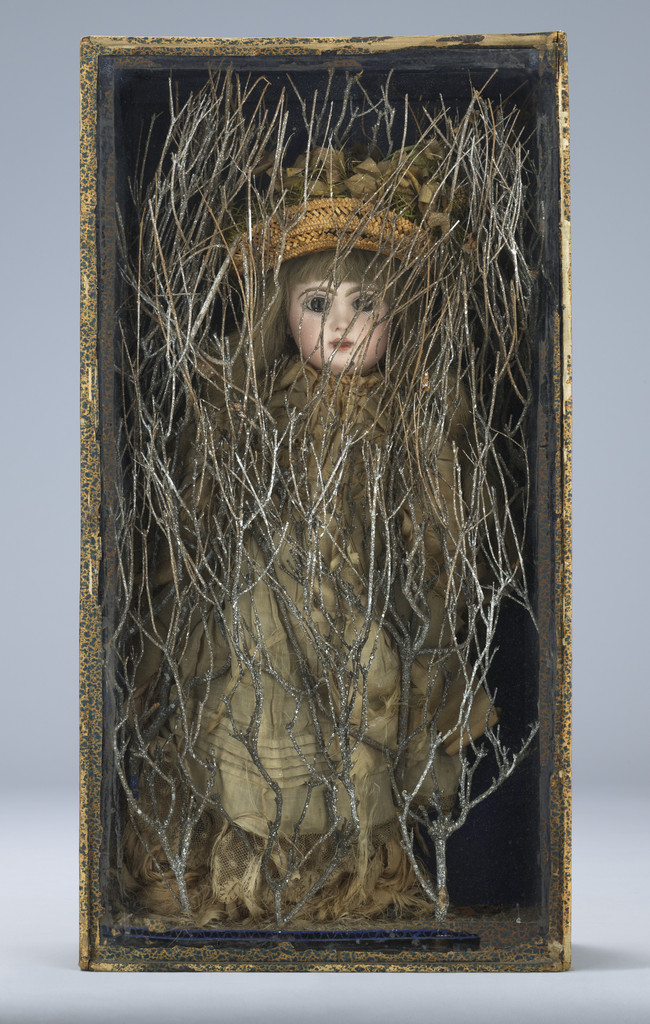
Untitled (Bébé Marie), Joseph Cornell, early 1940s

Untitled (Bébé Marie)

early 1940s · Museum of Modern Art

Paolo and Francesca, Joseph Cornell, 1943-1948

Paolo and Francesca

1943-1948 · National Gallery of Art

Untitled (Swan Box), Joseph Cornell, c. 1945

Untitled (Swan Box)

c. 1945 · National Gallery of Art

Sand Fountain, Joseph Cornell, 1948

Sand Fountain

1948 · National Gallery of Art

Untitled (Medici Prince), Joseph Cornell, c. 1952

Untitled (Medici Prince)

c. 1952 · National Gallery of Art

Untitled (Medici Prince), Joseph Cornell, c. 1953

Untitled (Medici Prince)

c. 1953 · National Gallery of Art

Untitled (Grand Hotel Bon Port, Ostend Hotel), Joseph Cornell, 1954

Untitled (Grand Hotel Bon Port, Ostend Hotel)

1954 · National Gallery of Art

Les constellations voisines du pôle, Joseph Cornell, 1961

Les constellations voisines du pôle

1961 · National Gallery of Art

Juan Soriano De Lacandón, Leonora Carrington, 1964

Leonora Carrington

Juan Soriano De Lacandón, 1964

Untitled (Butterfly Habitat), Joseph Cornell, c. 1940

Joseph Cornell

Untitled (Butterfly Habitat), c. 1940

Untitled, Balthus, c. 1972

Balthus

Untitled, c. 1972

Untitled (For Trista), Joseph Cornell, c. 1969

Joseph Cornell

Untitled (For Trista), c. 1969

Untitled (Satie and Ravel), Joseph Cornell, March 14, 1968–early September 1969

Joseph Cornell

Untitled (Satie and Ravel), March 14, 1968–early September 1969

The Tiara, Joseph Cornell, 1966/67

Joseph Cornell

The Tiara, 1966/67

Untitled (L'Abeille), Joseph Cornell, April 7, 1966

Joseph Cornell

Untitled (L'Abeille), April 7, 1966

Now, Voyager, Joseph Cornell, 1966

Joseph Cornell

Now, Voyager, 1966