ART WIKI32 963 en salle
CarteCollectionArtistesMuséesExpositionsJournal
Connexion

ART WIKI

Où est accroché le chef-d’œuvre, et quand on vous laisse entrer.

Collections : Art Institute of Chicago, Cleveland Museum of Art, Galerie Tretiakov, Hirshhorn Museum and Sculpture Garden, J. Paul Getty Museum, Metropolitan Museum of Art, Minneapolis Institute of Art, Musée de l'Ermitage, Musée des Beaux-Arts Pouchkine, Musée du Louvre, musée national d'art asiatique, Musée russe, Musées d'Art de Harvard, Museum of Modern Art, National Gallery of Art, National Portrait Gallery, Rijksmuseum Amsterdam, Smithsonian American Art Museum, Statens Museum for Kunst, Victoria and Albert Museum, Villa Getty, Whitney Museum of American Art, Catalogue d’État du fonds muséal de Russie (274 musées), Europeana (19 musées), Wikidata (6 musées), Paris Musées (12 musées) et Joconde, la base des musées du ministère de la Culture (495 musées). Les images appartiennent à leurs ayants droit.

Rubriques

  • Carte
  • Recherche
  • Collection
  • Chefs-d’œuvre
  • Exposées en ce moment
  • Artistes

Et aussi

  • Musées et galeries
  • Expositions
  • Journal
  • D’où viennent les données
  • Confidentialité et cookies
AccueilCarteCatalogue
  1. Collection/
  2. Art Institute of Chicago/
  3. Untitled (Black Hunter)
Untitled (Black Hunter), Joseph Cornell, c. 1939
JJoseph CornellÉtats-Unis, 1903–1972

Untitled (Black Hunter)

c. 1939 · Mixed Media

Peut-on la contempler ?

Oui, elle reçoit

Art Institute of Chicago

Chicago, États-Unis

Salle397

Présentée au public. Qui s’en porte garant est indiqué ci-dessous.

Vérifié
il y a 3 jours
Dans cet état depuis
19 août 2026
Source
Le musée
Sur la cartePage du musée

À propos de l’œuvre

The secretive character of this box and its kinetic elements render it particularly resistant to reproduction. Cornell chose four photographic images of a man shooting a gun, presumably taken in quick sequence, as in early photographic experiments in investigating motion, which he photostated and arranged vertically. They are slightly tilted into an arc, with the size of the image reduced toward the top, giving an impression of recession.

Lire la suite

The movement within this box is clearly related to film. Cornell wrote two movie scenarios, one of which, Monsieur Phot (1933), was published in Julien Levy’s Surrealism (New York, 1936, pp. 77–88). Monsieur Phot shows a sophisticated sense of film’s potential for transforming its material and creating a kind of technical fantasy through such devices as montage and dissolve. Its atmosphere is an ambiguous mixture of slapstick and dream, characteristic of such Surrealist films as Un Chien Andalou by Salvador Dalí and Luis Bunuel (1929). The scenes shift swiftly; Diane Waldman summarized one sequence, in which the reflection of chandeliers in a mirror

"becomes the chandeliers, in the interior of a ‘large, sumptuous glass and china establishment’ … through which a pheasant of gorgeous plumage flies as if through the ‘branches of his native wood.’ Suddenly, in a dream scene of considerable symbolic significance, revolver shots ring out, shattering the glass into a million crystal fragments … The suggestions of action, especially the sequences involving the pheasant and revolver shots, coalesce in a concentration of 1939, Black Hunter, one of Cornell’s earliest experiments with movement" (Waldman 1977, p. 18; quotations within quotation from Monsieur Phot, in Levy 1936, pp. 83–84).

Both the scenario and the box itself echo Rene Clair’s Dada film Entr’acte of 1924, especially in the latter’s “hunting sequence,” where the target continually and magically changes. In its imagery of birds, balls, glass, and mirrors, Monsieur Phot also prefigured many of Cornell’s later themes and materials. The enclosed blackness or the box evokes the dark interior of the cinema, Cornell’s and the Surrealists’ favorite lieu d’enchantment (place of enchantment). The touches or brilliant red provide a theatrical and fittingly violent note.

Julien Levy, who first met Cornell in November of 1931, when the artist brought a sheaf of his collages to Levy’s gallery, remembered suggesting on this occasion that Cornell might

"try working in the round? Maybe add some motion, some mobility? Look. Here’s a photograph of a man with a gun.’ I pointed to one of the sepia prints on the wall behind me. ‘and here’s a partridge. One could paste them at two ends of a shadow box. Build a little sloping alley and let a bullet, or a ball bearing roll between them.’ I glanced at him, but you would never know from his expression whether he was considering or resenting another’s idea (Julien Levy, Memoirs of an Art Gallery, New York, 1977, p.78).

Whether or not Cornell took the idea of the box with movable parts at this moment from Levy is impossible to say; certainly Levy’s suggestion does seem to foreshadow the construction of this box.

— Entry, Dawn Ades, Surrealist Art: The Lindy and Edwin Bergman Collection at the Art Institute of Chicago, 1997, p. 36-37.

Art Institute of Chicago · CC BY 4.0

Notice

c. 1939
19031972
Numéro d’inventaire
1982.1844

Au catalogue

ModernismeXXe siècleÉtats-Unis

Sources

  • Art Institute of Chicago
  • Image : Art Institute of Chicago — © the artist or rights holder

Autres œuvres : Joseph Cornell

Toutes les œuvres
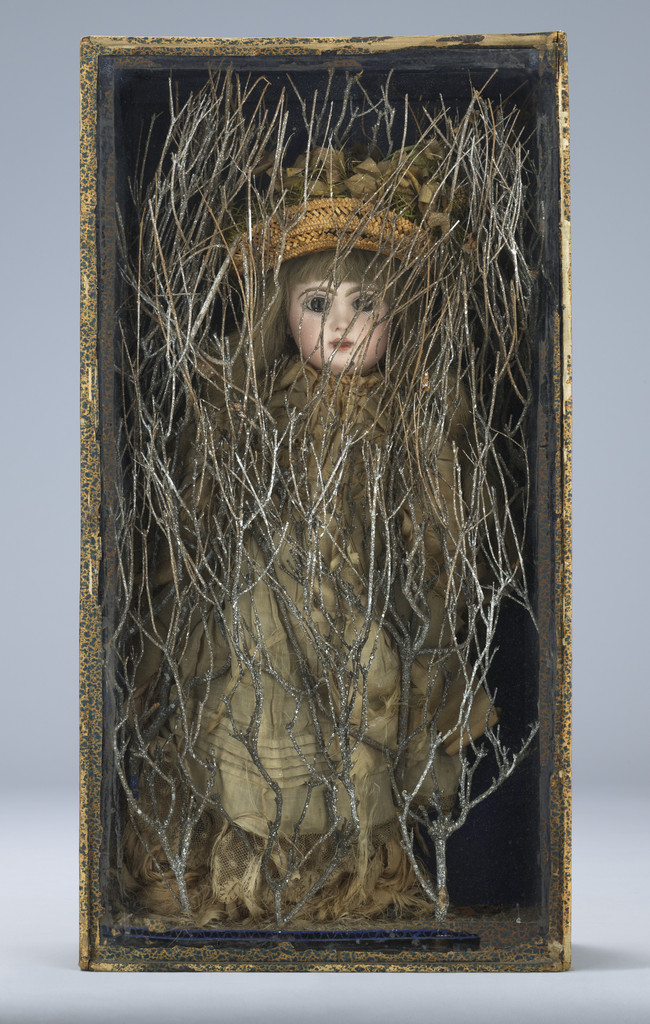
Untitled (Bébé Marie), Joseph Cornell, early 1940s

Untitled (Bébé Marie)

early 1940s · Museum of Modern Art

Paolo and Francesca, Joseph Cornell, 1943-1948

Paolo and Francesca

1943-1948 · National Gallery of Art

Untitled (Swan Box), Joseph Cornell, c. 1945

Untitled (Swan Box)

c. 1945 · National Gallery of Art

Sand Fountain, Joseph Cornell, 1948

Sand Fountain

1948 · National Gallery of Art

Untitled (Medici Prince), Joseph Cornell, c. 1952

Untitled (Medici Prince)

c. 1952 · National Gallery of Art

Untitled (Medici Prince), Joseph Cornell, c. 1953

Untitled (Medici Prince)

c. 1953 · National Gallery of Art

Untitled (Grand Hotel Bon Port, Ostend Hotel), Joseph Cornell, 1954

Untitled (Grand Hotel Bon Port, Ostend Hotel)

1954 · National Gallery of Art

Les constellations voisines du pôle, Joseph Cornell, 1961

Les constellations voisines du pôle

1961 · National Gallery of Art

Dans la même salle · Gallery 397, Art Institute of Chicago

Page du musée
Juan Soriano De Lacandón, Leonora Carrington, 1964

Leonora Carrington

Juan Soriano De Lacandón, 1964

Untitled (Butterfly Habitat), Joseph Cornell, c. 1940

Joseph Cornell

Untitled (Butterfly Habitat), c. 1940

Untitled, Balthus, c. 1972

Balthus

Untitled, c. 1972

Untitled (For Trista), Joseph Cornell, c. 1969

Joseph Cornell

Untitled (For Trista), c. 1969

Untitled (Satie and Ravel), Joseph Cornell, March 14, 1968–early September 1969

Joseph Cornell

Untitled (Satie and Ravel), March 14, 1968–early September 1969

The Tiara, Joseph Cornell, 1966/67

Joseph Cornell

The Tiara, 1966/67

Untitled (L'Abeille), Joseph Cornell, April 7, 1966

Joseph Cornell

Untitled (L'Abeille), April 7, 1966

Now, Voyager, Joseph Cornell, 1966

Joseph Cornell

Now, Voyager, 1966