 Giovanni Antonio AmadeoItalie, 1447–1522
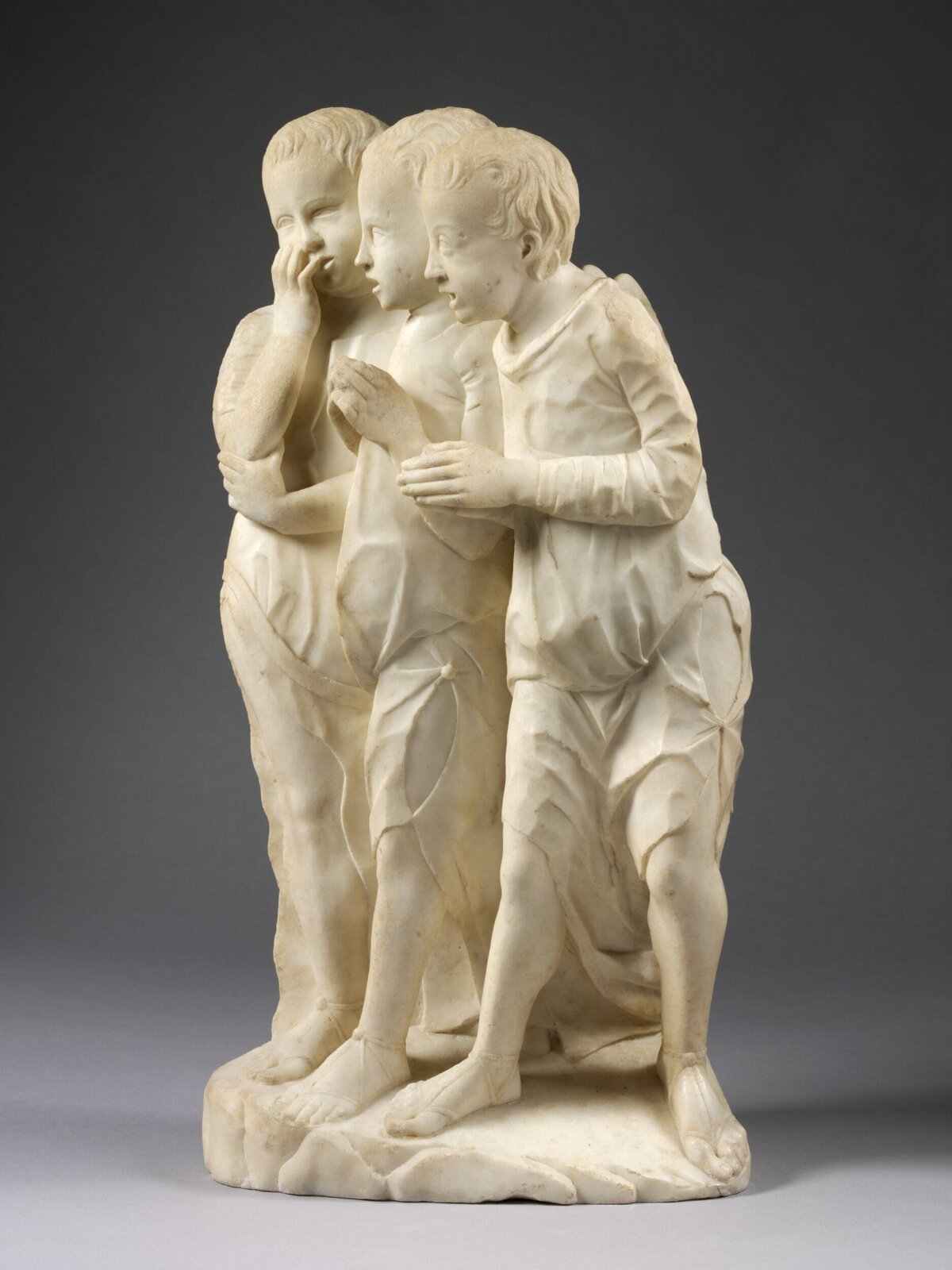
Three Adoring Angels
Peut-on la contempler ?
Oui, elle reçoit

Victoria and Albert Museum
Londres, Royaume-Uni
SalleMedieval & Renaissance, Room 64, The Wolfson Gallery
Présentée au public. Qui s’en porte garant est indiqué ci-dessous.
- Vérifié
- Dans cet état depuis
- Source
- Le musée
À propos de la sculpture
This is a relief group Three Adoring Angels by Giovanni Antonio Amadeo, made in the Lombard region in about 1490-1520. The expressions of grief on the faces suggest that this relief formed part of a Lamentation group with mourning figures gathered around the body of Christ. The jagged, clinging drapery style is typical of several Lombard sculptors. It is sometimes referred to as ‘cartaceous’ drapery because it resembles crumpled paper (Latin ‘carta’).
Giovanni Antonio Amadeo (1447-1522) was a sculptor and architect, mainly active in Milan, Pavia, Bergamo and Cremona. His professional success, in terms of the architectural and sculptural commissions and official appointments that he received, was far greater than that of any of his contemporaries in Lombardy in the late 15th century, including Bramante.
Lire la suite
With most Lombard sculptors it is almost impossible to say with any certainty which artist was responsible for carving an object. The structure of Lombard workshop was much more varied and complex than that of the Tuscan counterparts and each master organised the division of labour in a different way. Giovanni Antonio Amadeo was particularly complicated in that respect. Not only was he the master of his own workshop, with a large number of assistants, but he also formed partnerships with other masters and their workshops, as well as overseeing the large fabbriche at the Duomo and the Ospedale Maggiore in Milan and the Certosa di Pavia, among others.
Regarding the Certosa di Pavia alone, he had stipulated a contract with four other sculptors: Lazzaro Palazzi, Giovanni Giacomo Dolcebuono, Giovanni Antionio Piatti and Angelo da Lecco. The commission for the façade of the Certosa was then given to both Amadeo and the Mantegazza brothers, and each party was responsible for half of the façade.
He worked in close partnership with Piatti, Dolcebuono and Benedetto Briosco on a variety of projects that were too large for a single workshop.
From the 1490s onwards he was awarded many large-scale architectural and sculptural projects, and he was mostly responsible for designing and overseeing the project rather than sculpting many pieces himself. He would have carved only key objects such as portraits or important relief scenes.
The present relief formed the decorative frame of some sculpture and would have probably been designed by Amadeo, but executed by a skilled assistant under close supervision, judging from the high quality of the carving. The master would perhaps have given it the finishing touches or adjusted any mistakes, rather than carve the entire sculpture himself.
Victoria and Albert Museum
Notice
- Numéro d’inventaire
- 450-1869
Ce qu’elle montre
Au catalogue
Sources
- Victoria and Albert Museum
- Image : Victoria and Albert Museum — © Victoria and Albert Museum, London