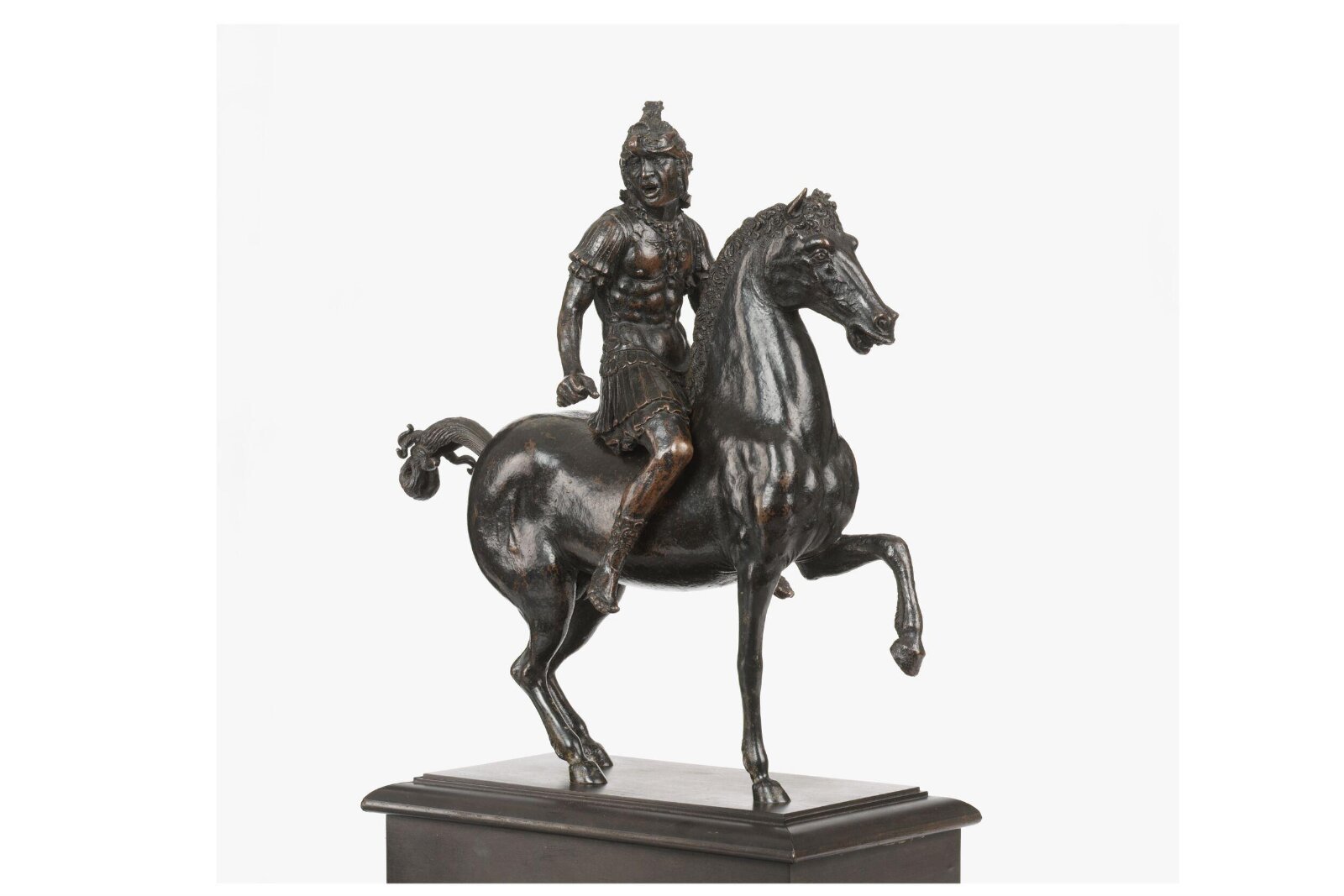
The Shouting Horseman
Peut-on la voir ?
Oui, exposée actuellement
Où est « The Shouting Horseman » aujourd’hui ? Victoria and Albert Museum, Medieval & Renaissance, Room 64, The Wolfson Gallery, Londres. Oui, exposée actuellement. Vérifié 25 septembre 2026.

Londres, Royaume-Uni
SalleMedieval & Renaissance, Room 64, The Wolfson Gallery
Fermé· ouvre demain à 10:00
Présentée au public.
- Vérifié
- Dans cet état depuis
- Source
- Le musée
À propos de la sculpture
The warrior is shown wearing classical armour and riding bare-back, apparently crying out in the heat of battle. In his right hand he holds the hilt of a sword (the blade is missing), and his left may originally have held a spear or shield.
This bronze was repaired and repatinated some time before 1893, while in the collection of Frédéric Spitzer in Paris. Spitzer was probably responsible for making copies of the rider, as all other known versions are late casts, displayed on a variety of horses. This horse and rider, however, are unique, having been cast separately using the direct lost-wax technique, whereby the original model is lost (so that only one cast is possible).
Lire plus
Riccio (meaning 'Curly-Head') worked primarily in bronze and is acknowledged as the master of the bronze statuette during the late 15th and early 16th centuries. He was active in the humanist circle of the University of Padua, in north-east Italy, and the tense, nervous energy of the horse suggests a connection with a passage on that subject in the treatise on sculpture by Riccio's friend Pomponius Gauricus, published in 1504. Gauricus also describes this type of light cavalry, and Riccio appears to have combined these literary references with his own observations of the Venetian cavalry. Similar riders are seen in Riccio's relief of the Victory of Constantine (Galleria Giorgio Franchetti alla Ca' d'Oro, Venice) of about 1500, but the decorative detail relates it to the Paschal Candelabrum which Riccio made for the church of the Santo in Padua, between 1507 and 1515.
Victoria and Albert Museum
Notice
- Numéro d’inventaire
- A.88:1, 2-1910
Ce qu’elle montre
Au catalogue
Sources
- Victoria and Albert Museum
- Image : Victoria and Albert Museum — © Victoria and Albert Museum, London


![The Watering Place (Horses Bathing) [L'abreuvoir (chevaux au bain)], Pablo Picasso, 1906](https://api.nga.gov/iiif/bbac782b-88ea-4477-97a5-4369aa47b98a/full/!2400,2400/0/default.jpg)