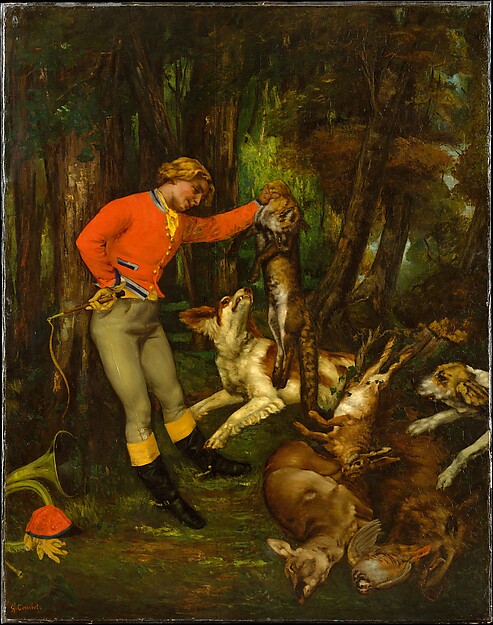
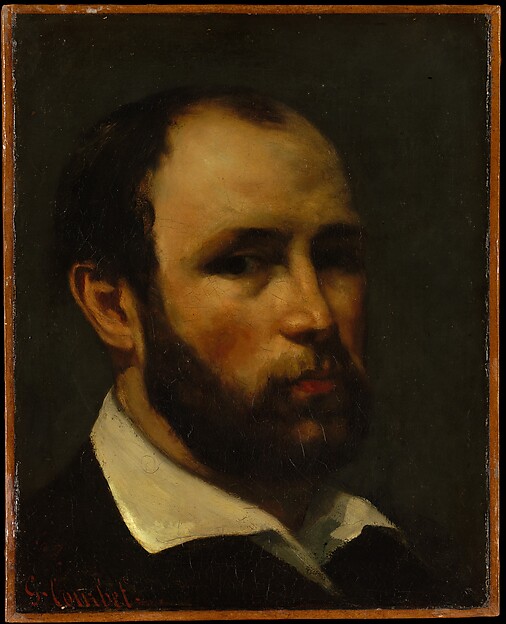
Gustave CourbetFrance, 1819–1877
L'Atelier du peintre
The Painter's Studio
Peut-on la contempler ?
Inconnu

Paris, France
Le propriétaire est connu ; on ignore si l’œuvre est exposée aujourd’hui.
- Dans cet état depuis
- Source
- Le musée
À propos du tableau
L'Atelier du peintre est une huile sur toile de Gustave Courbet. Son titre complet est: L’Atelier du peintre. Allégorie Réelle déterminant une phase de sept années de ma vie artistique (et morale). Exécutée en 1855, elle est exposée depuis 1986 au musée d'Orsay, rez-de-chaussée, dans la salle Courbet (grands formats).
Refusée à l’Exposition universelle de 1855 alors que onze de ses œuvres sont acceptées, l’œuvre est dévoilée au public lors d'une exposition personnelle de l’artiste au Pavillon du Réalisme (édifice provisoire qu'a fait édifier Courbet à ses frais avenue Montaigne presque en face de l'Exposition universelle), sous le numéro 1.
Lire plus
Juliette Courbet, sœur de l'artiste, met la toile en vente, rachetée plus tard par Victor Antoine Desfossés et, conservée par la veuve de ce dernier jusqu'en 1919, elle sert de toile de fond au théâtre amateur de l'hôtel Desfossés (6 rue Galilée à Paris).
Elle est acquise en 1920 par le musée du Louvre pour 700 000 francs, somme offerte en partie par les Amis du Louvre, complétée par une souscription publique et une contribution de l’État.
Une restauration publique dans l'enceinte du musée débute le 24 novembre 2014 avec le soutien de 1 334 particuliers pour plus de 150 000 euros collectés par le biais d'un financement participatif et complété par un mécénat de 450 000 euros.
Notice
- Numéro d’inventaire
- RF 2257
Au catalogue
Sources
- Wikidata
- Image : Musée d'Orsay — Gustave Courbet · Public domain · Wikimedia Commons
Pendant ce temps, chez Gustave Courbet
La vie entière1855
Stages the “Pavilion of Realism”
Refusing to accept the jury's decision, Courbet asked museums and private owners to lend his paintings, had a separate building erected and showed about forty canvases there, without state permission, under the Second Empire. The public was baffled and laughed at the “crude art”, and the critics mocked him; the paintings were appreciated by Delacroix and Baudelaire.
1855
The “Realist Manifesto” in the exhibition catalogue
The catalogue of the Pavilion of Realism opened with a manifesto in which Courbet claimed the right to artistic freedom and the right to show his works to the public on his own. He defined his aim as conveying the customs, ideas and appearance of his time, to be not only a painter but a man as well: to “create living art”.
1855
The Exposition Universelle jury turns down three paintings
Courbet submitted fourteen paintings to the Salon of 1855, part of the Exposition Universelle; three were rejected “for lack of space”, among them the monumental “A Burial at Ornans” and “The Artist's Studio”.
1855
Empress Eugénie before “The Bathers”
According to Proudhon's recollection, Empress Eugénie, visiting the Pavilion of Realism, stopped before Courbet's “Bathers”, with its robustly peasant-like nude body shown without the usual idealization, and exclaimed, “Is this a Percheron too?” She had just been looking at Rosa Bonheur's “Horse Fair”.
1857
Salon of 1857: “Young Ladies on the Banks of the Seine”
At the Salon of 1857 Courbet showed six paintings, among them “Young Ladies on the Banks of the Seine (Summer)”, painted the year before, and the first of his many hunting scenes. Modern women casually displaying their undergarments caused a scandal; pairing sensational works with hunting scenes secured Courbet both notoriety and sales.