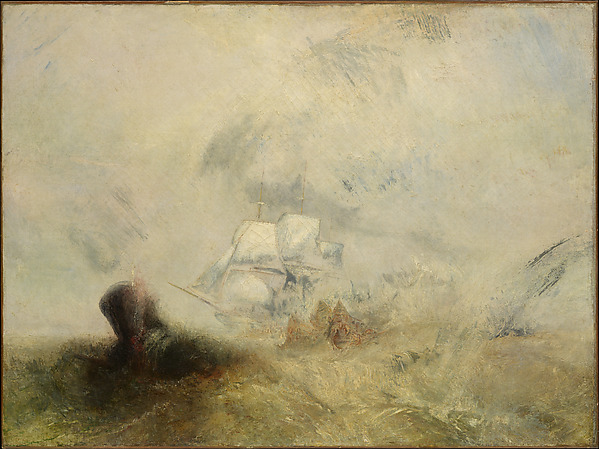
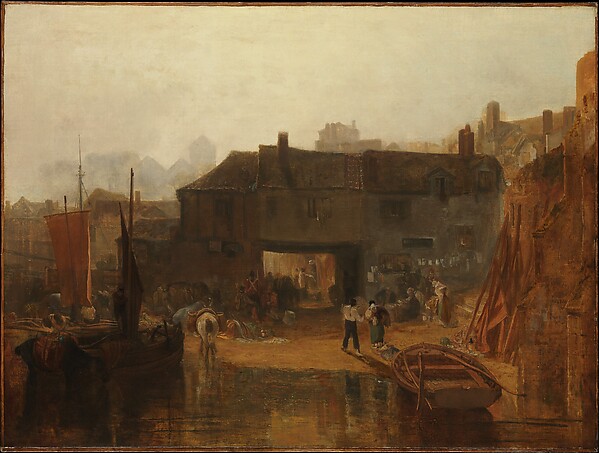
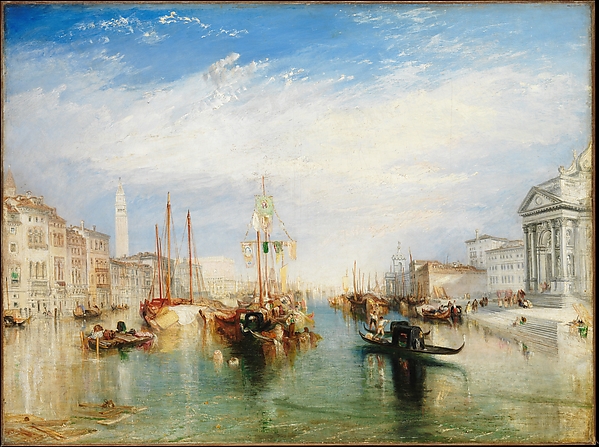
Joseph Mallord William TurnerRoyaume-Uni, 1775–1851
The Evening Star
Peut-on la voir ?
Inconnu
Où est « The Evening Star » aujourd’hui ? Collection: National Gallery, Londres. Inconnu.

Londres, Royaume-Uni
Le propriétaire est connu ; on ignore si l’œuvre est exposée aujourd’hui.
- Dans cet état depuis
- Source
- Le musée
À propos du tableau
The Evening Star is an 1830 landscape painting by the British artist J.M.W. Turner. It features a coastal scene on a beach with a boy with a shrimping net wading out of the water to be greeted by his dog. It gained its title several decades after Turner painted it due to the presence of a single star visible in the sky.
The painting was exhibited with other works by Turner at the Tate Gallery in 1906, where critics compared it to more recent works by James McNeill Whistler. It is in the possession of the National Gallery in London, having been part of the Turner Bequest of 1856.
Notice
- Numéro d’inventaire
- NG1991
Au catalogue
Sources
- Wikidata
- Image : National Gallery — J. M. W. Turner · Public domain · Wikimedia Commons
Dans la vie de Joseph Mallord William Turner
La vie entière1820s
Print series for publishers
In the 1820s he worked on several topographical print commissions: “Picturesque Views on the Southern Coast of England” (1814–1826) and “The Rivers of England” (1822–1826) for the Cooke brothers, “Picturesque Views in England and Wales” (1824–1838) for Charles Heath and “The Ports of England” (1825–1828) for Thomas Lupton.
1829
The death of his father
His father, who had lived with him for thirty years and worked as an assistant in his studio, died in 1829; the loss strongly affected Turner, who began to suffer fits of depression afterwards, and he finally abandoned his own gallery.
1829
Paris, Normandy and Brittany
In the twenty-year period from 1821 to 1844 he visited several European countries, studying the old masters and taking long hikes into the countryside: in 1829 Paris, Normandy and Brittany, and three years later Paris for the second time.
1830–1840s
Criticism in the 1830s–1840s and Ruskin’s defence
His innovative works, bordering on abstraction, gave him a reputation for madness: the Victorian public preferred realism and sentimentality, and Queen Victoria refused to knight him. John Ruskin came to his defence, calling him “the greatest artist of all time”.