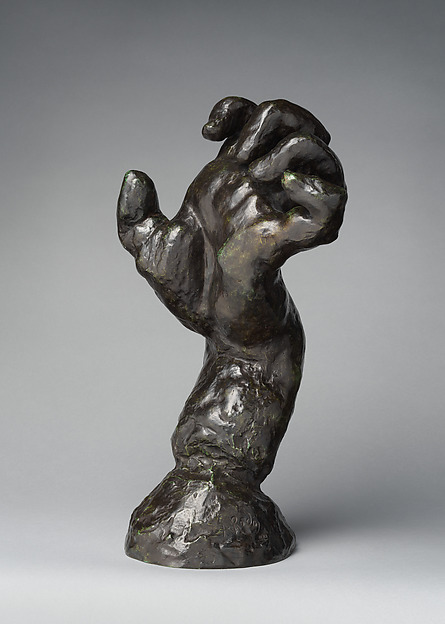
Auguste RodinFrance, 1840–1917
The Call to Arms
Peut-on la voir ?
Oui, exposée actuellement
Où est « The Call to Arms » aujourd’hui ? Musées d'Art de Harvard, Gallery 2100, floor 2, European and American Art, 17th–19th century, Cambridge. Oui, exposée actuellement. Vérifié 29 septembre 2026.

Cambridge, États-Unis
Salle2100, floor 2, European and American Art, 17th–19th century
Présentée au public.
- Vérifié
- Dans cet état depuis
- Source
- Le musée
À propos de la sculpture
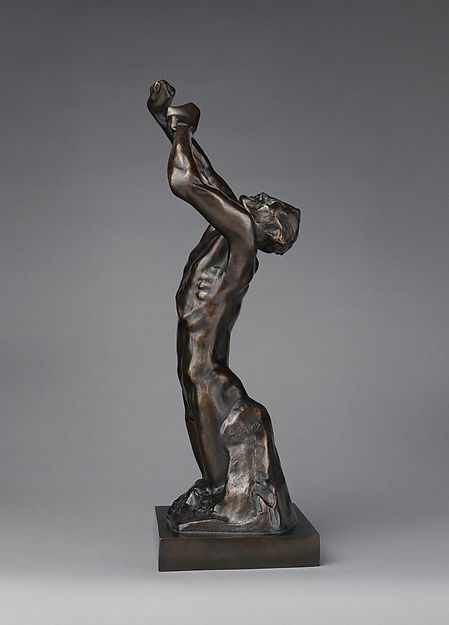
Rodin submitted this design for a public monument commemorating the defense of Paris during the Franco-Prussian War (1870–71). It was roundly rejected, which Rodin later attributed to its portrayal of violence: “Despite all my efforts, despite the life which, I believe, animates my group . . . I was not even considered. . . .[It] must have appeared too violent, too intense.”
Lire plus
The composition features a wounded soldier falling to the ground, gazing up at the Genius of War. Her wings, outstretched arms, and bare breasts recall ancient sculptures of Victory, while her Phrygian bonnet— a conical cap— alludes to the triumph of the French Revolution (1789–99) and symbolizes liberty. Though inspired by many precedents, Rodin’s group specifically recalls François Rude’s relief on the side of the Arc de Triomphe, March of the Volunteers of 1792 (La Marseillaise), 1833–36, which is also surmounted by a winged figure of war.
Musées d'Art de Harvard
Notice
- Numéro d’inventaire
- 1943.1138
Au catalogue
Sources
- Musées d'Art de Harvard
- Image : Musées d'Art de Harvard — © President and Fellows of Harvard College
Dans la vie de Auguste Rodin
La vie entière1877
Back in Paris after six years in Belgium
Rodin and Rose settled in a small flat on the Left Bank; his mother was dead and his father blind and senile. Rodin's father and his eleven-year-old son Auguste, whom he had essentially abandoned for six years, moved in with the couple, and Rose looked after them.
1877–1878
Accused of casting “The Age of Bronze” from life
The figure looked so lifelike that Rodin was accused of casting it from a live model. He wrote to the newspapers, produced photographs of the model and demanded an inquiry, and a committee of sculptors cleared him; later many of his works were deliberately made larger or smaller than life.
1880
Receives the commission for “The Gates of Hell”
His first state commission was a sculptural portal for a planned Museum of Decorative Arts; with it Rodin received two studios on the Rue de l'Université. The museum was never built and “The Gates of Hell” remained unfinished: they were first cast in bronze after the master's death.
1880
The 1880 Salon: third prize
Rodin showed “St. John the Baptist”, which won third prize. In the same Salon “The Age of Bronze” was exhibited a second time, now cast in bronze.
c. 1880 – 1881
Juliette Adam's salon and first recognition
Rodin was received at the salon of the writer Juliette Adam, where he was presented to Gambetta; Gambetta recommended him to Antonin Proust, the minister of fine arts, who bought “St. John the Baptist” for the state. It was the first recognition to reach a sculptor who was already forty.
1881
London: meeting William Ernest Henley
Rodin's friend Alphonse Legros introduced him in London to the poet William Ernest Henley, who did more than anyone to win him a British audience. Through Henley Rodin met Robert Louis Stevenson and Robert Browning.