Rockwell KentÉtats-Unis, 1882–1971
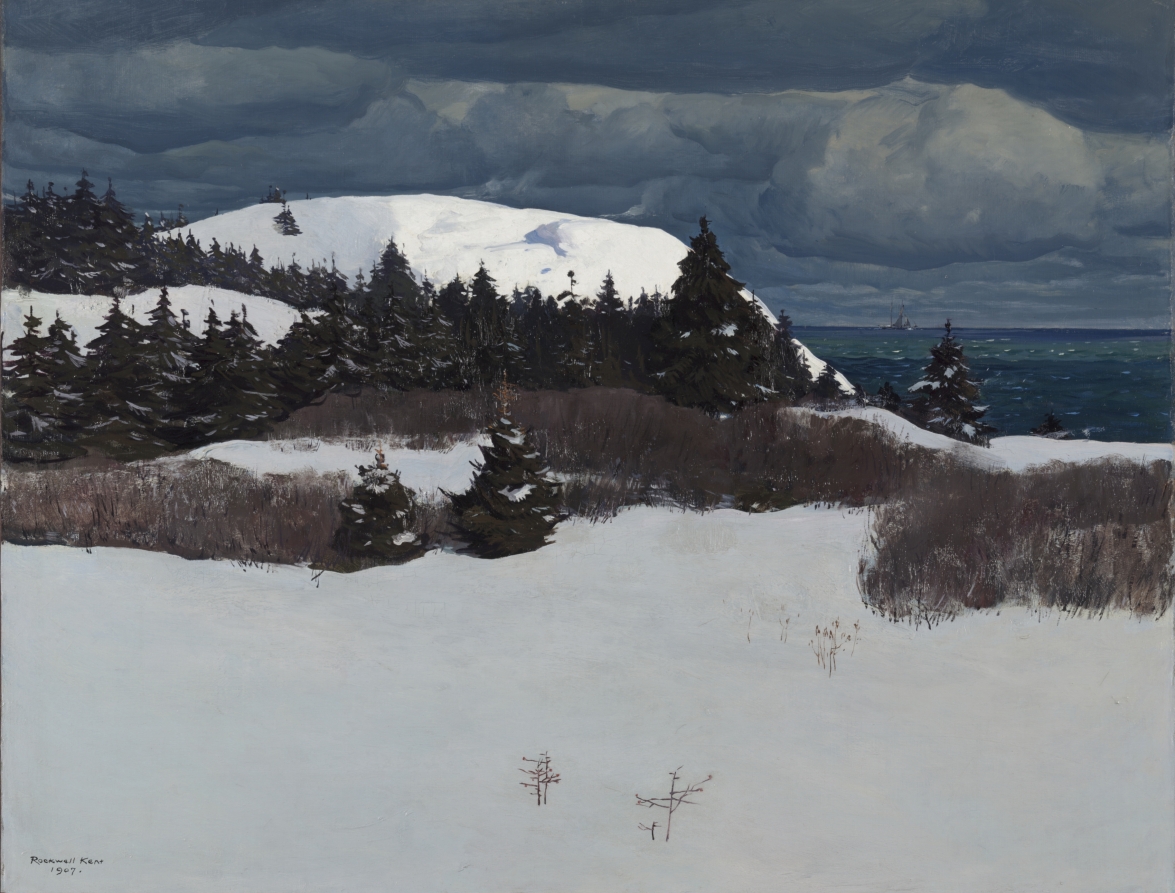
Squall. Greenland
Peut-on la voir ?
Pas exposée actuellement
Où est « Squall. Greenland » aujourd’hui ? Collection: Musée de l'Ermitage, Saint-Pétersbourg. Pas exposée actuellement. Vérifié 29 août 2026.

Saint-Pétersbourg, Russie
Elle appartient à la collection, mais n’est pas présentée en ce moment.
- Vérifié
- Dans cet état depuis
- Source
- Le musée
Notice
- Numéro d’inventaire
- ГЭ-9933
Au catalogue
Sources
- Musée de l'Ermitage
- Image : Musée de l'Ermitage — © State Hermitage Museum
Dans la vie de Rockwell Kent
La vie entière1926–1930
Illustrations for "Moby-Dick"
The publisher R. R. Donnelley offered Kent Dana's Two Years Before the Mast to illustrate, but the artist chose Melville's Moby-Dick instead. The three-volume limited edition of 1930 with his pen drawings (1,000 copies) sold out instantly; Random House issued a trade edition.
summer 1929
First Voyage to Greenland
In the summer of 1929 he set out on a painting expedition to Greenland (including a shipwreck off its coast), recounted in the bestseller N by E (1930). After meeting the Danish polar explorers Peter Freuchen and Knud Rasmussen, he resolved to return to Greenland to paint and draw.
1931–1932
Wintering at Igdlorssuit
He lived above the Arctic Circle in the tiny fishing settlement of Igdlorssuit (Illorsuit), where he conceived some of the largest and most celebrated paintings of his career; his book Salamina (1935) is devoted to this first Arctic winter.
1934–1935
Third Stay in Greenland
He visited Greenland for the third time and lived there at length, closely studying the everyday culture and traditions of the local Eskimos.
1936
Role in Founding the American Artists' Congress
He took part in the American Artists' Congress from its founding, and later served as an officer of the Artists Union of America and the Artists League of America.
1937
Washington Post Office Murals with a Hidden Message
Commissioned by the U.S. Treasury, he painted two murals for the new Post Office Department building in Washington. Into one of them, in tiny letters in an Alaska Native language, he inserted a message to Puerto Ricans in support of decolonization, which caused a scandal.