Rogier van der WeydenFlandre, 1399–1464
Saint George and the Dragon
Peut-on la voir ?
Oui, exposée actuellement
Où est « Saint George and the Dragon » aujourd’hui ? National Gallery of Art, Salle 39 · Bâtiment ouest, étage principal, Washington. Oui, exposée actuellement. Vérifié 29 septembre 2026.

Ouvert· jusqu’à 17:00
Présentée au public.
- Vérifié
- Dans cet état depuis
- Source
- Le musée
À propos du tableau
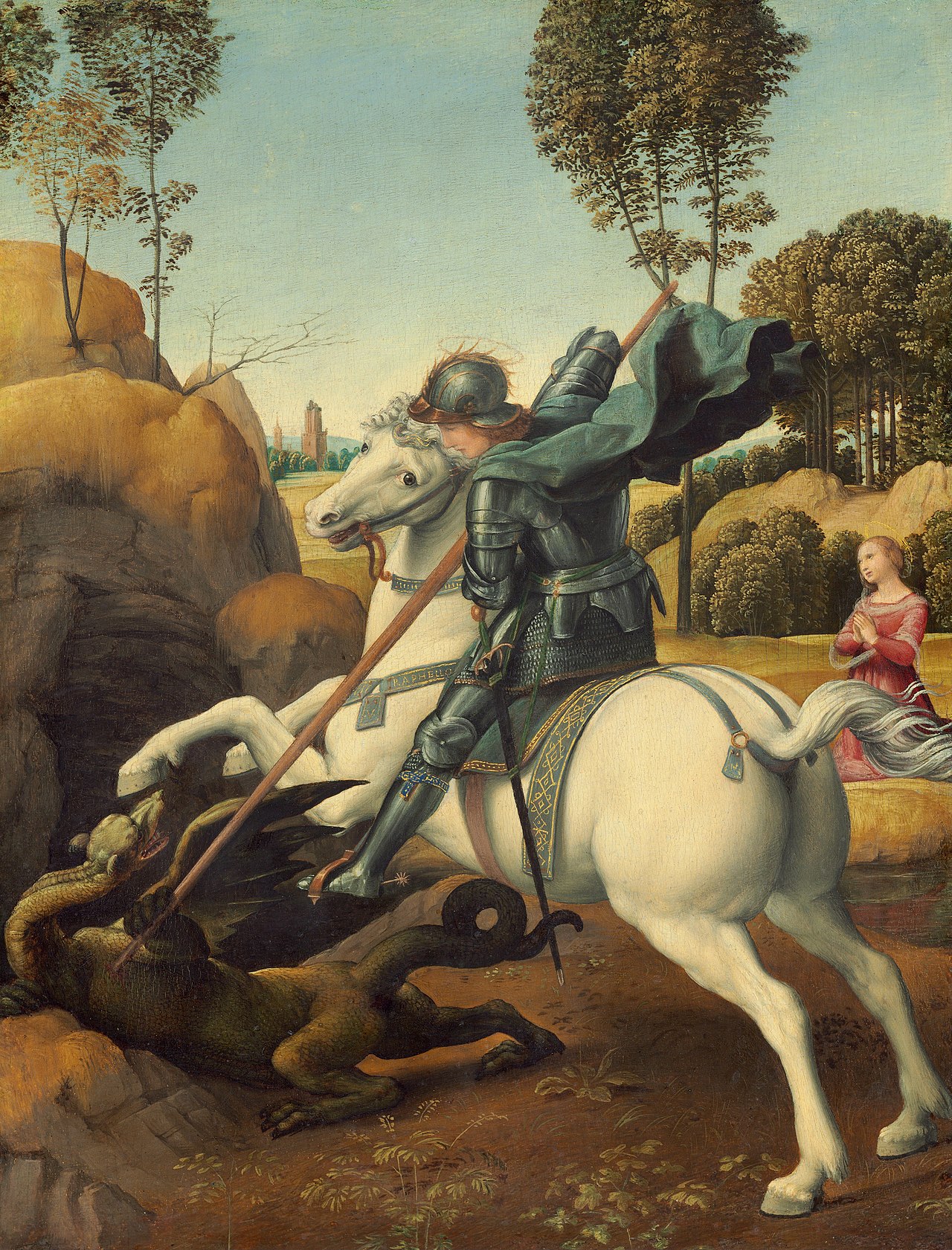
Saint George and the Dragon is a small c. 1432-35 oil-on-wood panel by the Early Netherlandish painter Rogier van der Weyden, held at the National Gallery of Art in Washington DC. It depicts the Christian martyr Saint George impaling a dragon, while Princess Cleodolinda watches and kneels in prayer. The background consists of a contemporary Belgian walled city and castle in the distance. The realism typically found in Early Netherlandish art is blended with elements of fantasy as seen in the fantastical cliff beneath the castle. The use of light and reflections, particularly from Saint George's black armour, indicates Jan van Eyck's influence.
Lire plus
Painted on a small 14.3 by 10.5 centimetres (5.6 in × 4.1 in) panel and set into a slightly larger 15.2 by 11.8 centimetres (6.0 in × 4.6 in) panel, the painting may have been intended as a devotional piece or part of a now-separated diptych. Art historians estimate that it was executed sometime in the early to mid-1430s.
Notice
- Numéro d’inventaire
- 1966.1.1
Ce qu’elle montre
Au catalogue
Sources
- National Gallery of Art
- Image : National Gallery of Art — Museum open access
Dans la vie de Rogier van der Weyden
La vie entière1427–1432 · Lieu de travail
Tournai
1 August 1432
Master of the Guild of St Luke in Tournai
On 1 August 1432 he obtained the title of master (maistre) painter and was admitted to the Guild of St Luke in Tournai, five years after entering Campin’s workshop.
1432–1435 · Lieu de travail
Tournai
by 21 October 1435
He moves to Brussels and takes a new name
By 21 October 1435 he and his family were living in Brussels — one of Europe’s largest cities and the chief residence of the Dukes of Burgundy; Dutch was spoken there, and Roger de la Pasture became Rogier van der Weyden.
1435–1464 · Lieu de travail
Brussels
2 March 1436
Painter to the town of Brussels
From 2 March 1436 he held the prestigious title of “painter to the town of Brussels” (stadsschilder): the post was created especially for him, was meant to lapse on his death and was tied to a huge commission — four justice scenes for the “Golden Chamber” of the town hall.




![Chalice of Saint John the Evangelist [reverse], Hans Memling, c. 1470/1475](https://api.nga.gov/iiif/1a761edd-c52e-47c0-b422-df074e14c803/full/!2400,2400/0/default.jpg)
![Saint Veronica [obverse], Hans Memling, c. 1470/1475](https://api.nga.gov/iiif/8788f9a6-142d-40b7-953b-a9a208ff2eef/full/!2400,2400/0/default.jpg)