Jean-Léon GérômeFrance, 1824–1904
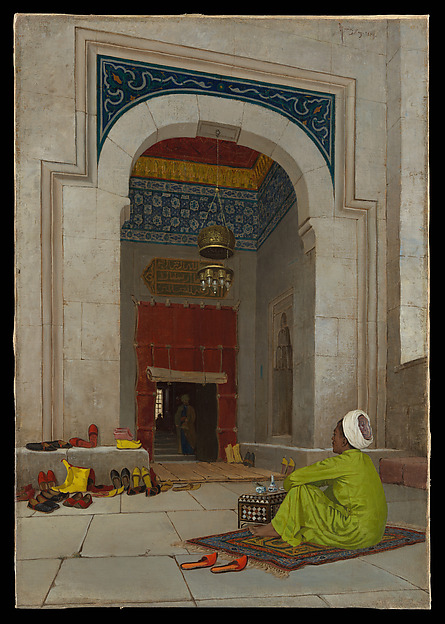
Prière à la mosquée
Prayer in the Mosque
Peut-on la voir ?
Oui, exposée actuellement
Où est « Prière à la mosquée » aujourd’hui ? Metropolitan Museum of Art, Salle 803, New York. Oui, exposée actuellement. Vérifié 29 septembre 2026.

New York, États-Unis
Fermé· ouvre demain à 10:00
Présentée au public.
- Vérifié
- Dans cet état depuis
- Source
- Le musée
À propos du tableau
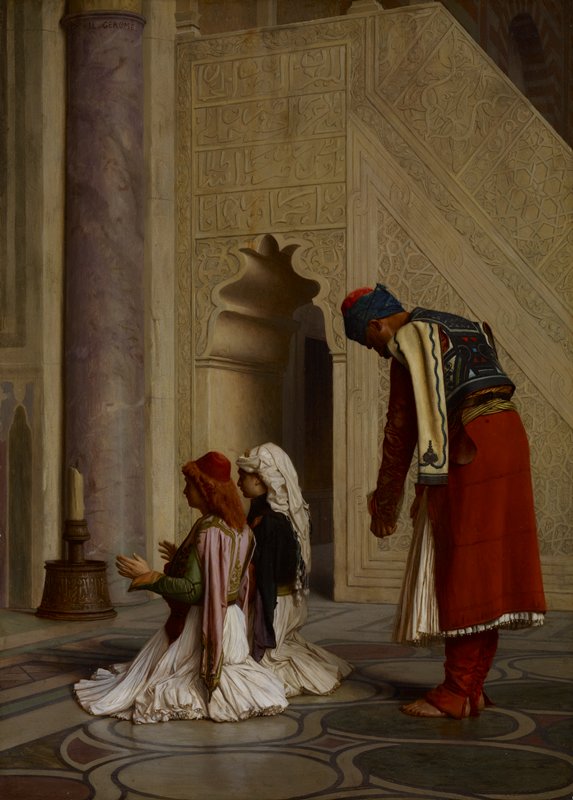
La prière à la mosquée est une peinture réalisée vers 1871 par l'artiste français Jean-Léon Gérôme. réalisée à la peinture à l'huile sur toile, le tableau représente l'intérieur d'une mosquée égyptienne dans laquelle des fidèles prient. La peinture, typiquement orientaliste, est conservée dans la collection du Metropolitan Museum of Art de New York.
Notice
- Numéro d’inventaire
- 87.15.130
Ce qu’elle montre
Au catalogue
Sources
- Metropolitan Museum of Art
- Image : Metropolitan Museum of Art — Open Access (CC0)
Dans la vie de Jean-Léon Gérôme
La vie entière1864–1904
The studio everyone wanted to join
Places in Gérôme’s atelier were limited and keenly sought: only the best students were admitted. Students progressed from drawing after antique works and casts to drawing from the live model and only then were allowed to paint in oils; he attended every Wednesday and Saturday and was known as a severe critic, but helped his students outside the school too, inviting them to his own studio and recommending them to the Salon.
1870s
Rising popularity in the United States
In the 1870s Gérôme’s works were particularly sought after by wealthy Americans: over his career he sold American patrons 144 paintings, nearly a quarter of his output; among his American students was Thomas Eakins.
1871–1873
Turkey, then Algeria by way of Spain
He kept travelling actively: in the winter of 1871 he visited Turkey, and in 1873, with Boulanger and three students, he went to Algeria by way of Spain, where he liked it much less than in Egypt.
1874
A gold medal of the Salon that he turned down
The 1874 Salon jury unanimously awarded Gérôme a gold medal, which outraged Parisian critics: genre painters, they said, should not be given medals. The artist, then in Holland (he spent the whole of 1874 in the Netherlands studying Frans Hals), telegraphed that he refused the award, but the jury stood on principle too and would not accept the refusal, so the medal had to be handed over to the École des Beaux-Arts.
1875
Walks his colleagues out of Corot’s funeral
At Camille Corot’s funeral the priest began a sermon on the “immoral life of artists”, whereupon Gérôme led all the colleagues present out of the church. He sat on committees helping infirm artists and their widows and always attended his colleagues’ funerals.
c. 1875
Small genre pictures and “harem” scenes
After the fall of the Empire history painting lost value, and after 1875 Gérôme switched mainly to small genre compositions — terse and needing no explanation. This was also when the series of “harem” pictures with nudes appeared (“The Slave Sale”, “Odalisque”, “The Moorish Bath”); from the 1870s he also painted genuine women of the East, especially almehs, Egyptian dancers, giving one of them a cigarette to underline the Europeanisation of Egypt.