 Edgar DegasFrance, 1834–1917
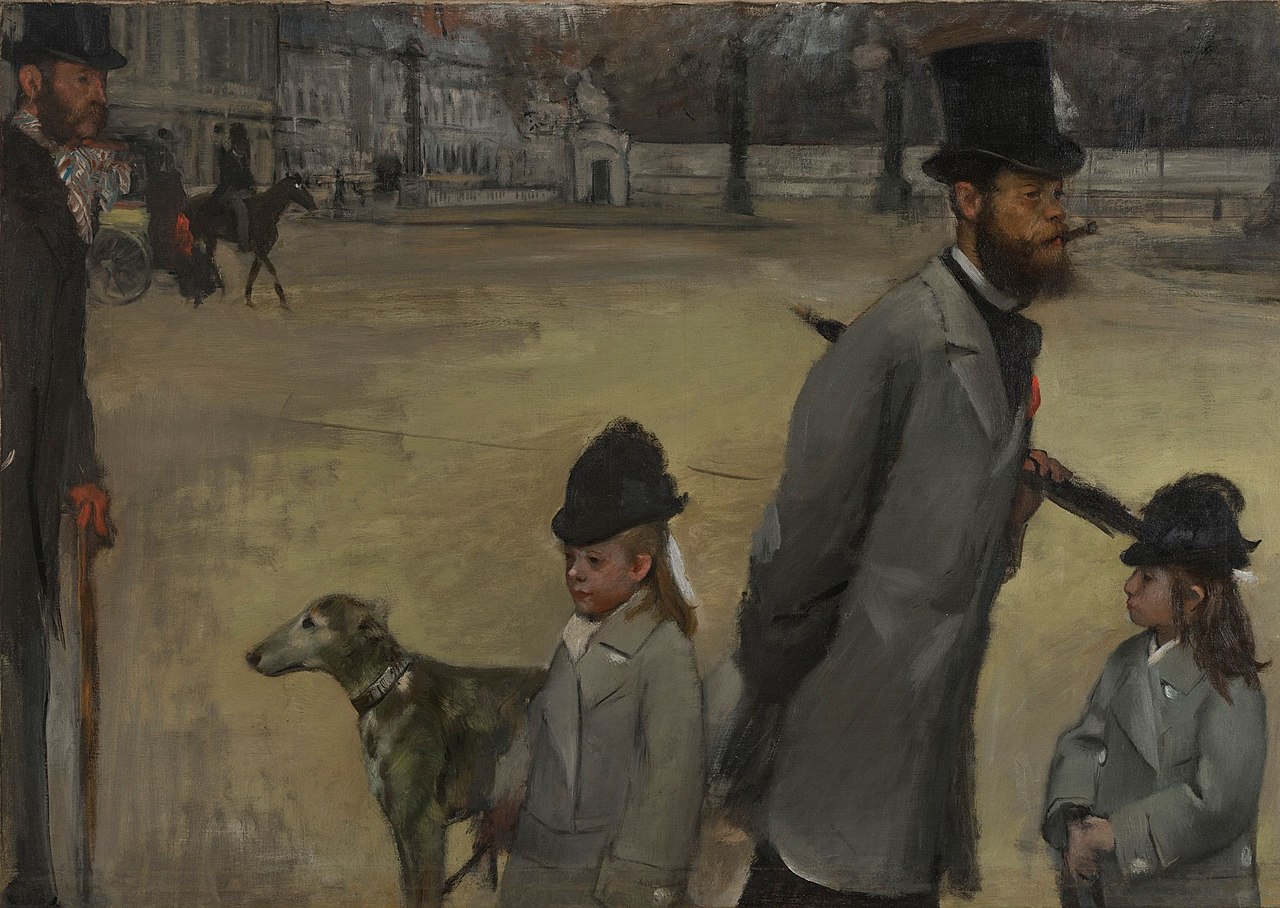
Place de la Concorde
Peut-on la contempler ?
Oui, elle reçoit

Musée de l'Ermitage
Salle404Saint-Pétersbourg, Russie
Présentée au public. Qui s’en porte garant est indiqué ci-dessous.
- Vérifié
- Dans cet état depuis
- Source
- Les données de collection du musée lui-même
À propos du tableau
La Place de la Concorde, ou encore Le Vicomte Lepic et ses filles traversant la place de la Concorde, est un tableau d'Edgar Degas composé en 1875 et conservé au musée de l'Ermitage de Saint-Pétersbourg.
Il représente au début de l'automne l'élégant vicomte Ludovic-Napoléon Lepic (1839-1885) en haut-de-forme fumant le cigare et traversant la place de la Concorde avec ses deux filles et son lévrier. Un homme avec une canne observe la scène sur le côté gauche du tableau. Au fond, on remarque le jardin des Tuileries derrière son mur. Certains historiens d'art estiment que ce tableau a été inspiré par la photographie à cause des personnages regardant au hasard dans différentes directions et à cause de l'agencement de l'espace.
Lire la suite
Cette œuvre a été considérée comme perdue depuis la Seconde Guerre mondiale, jusqu'à ce que les autorités russes la montrent au public en 1995 à l'Ermitage. Ce tableau faisait auparavant partie de la collection d'Otto Gerstenberg à Berlin et participe aux dédommagements de guerre.
Notice
- Numéro d’inventaire
- ГЭ-10622
Au catalogue
Sources
- Musée de l'Ermitage : les données ouvertes du musée · obtenue 29 août 2026
- Image : Musée de l'Ermitage — Museum open access
Pendant ce temps, chez Edgar Degas
La vie entièreearly 1870s
Meets Durand-Ruel
Degas met the dealer Durand-Ruel, later the most prominent of the trusted dealers with whom he planned his strategy at auctions.
1870s
From “de Gas” back to plain “Degas”
The archives disproved the legend of an ancient noble line: the artist's paternal ancestors were bakers, and the name “de Gas” was invented by his father, who commissioned a false genealogy. In the 1870s Edgar returned to the plain spelling, Degas.
octobre 1872 – mars 1873 · Résidence
New Orleans
1873–1874
His brother's debts: he sells his house and collection
After his father's death Degas learned that his brother René had run up enormous business debts. To save the family's reputation he sold his house and an inherited art collection and for the first time in his life depended on sales of his own work.
1874
The first Impressionist exhibition
Disenchanted with the Salon, Degas joined a group of young artists organizing an independent exhibiting society. He took a leading role in organizing the eight shows of 1874–1886 and exhibited in all but one, despite constant conflicts with the group.
1877
Friendship with Mary Cassatt
Degas invited Mary Cassatt to show in the third Impressionist exhibition, having admired her portrait “Ida” at the Salon of 1874. He introduced her to pastel and engraving, while she helped him sell paintings and promoted his reputation in the United States.