ART WIKI32 979 en salle
CarteCollectionArtistesMuséesExpositionsJournal
Connexion

ART WIKI

Où est accroché le chef-d’œuvre, et quand on vous laisse entrer.

Collections : Art Institute of Chicago, Cleveland Museum of Art, Galerie Tretiakov, Hirshhorn Museum and Sculpture Garden, J. Paul Getty Museum, Metropolitan Museum of Art, Minneapolis Institute of Art, Musée de l'Ermitage, Musée des Beaux-Arts Pouchkine, Musée du Louvre, musée national d'art asiatique, Musée russe, Musées d'Art de Harvard, Museum of Modern Art, National Gallery of Art, National Portrait Gallery, Rijksmuseum Amsterdam, Smithsonian American Art Museum, Statens Museum for Kunst, Victoria and Albert Museum, Villa Getty, Whitney Museum of American Art, Catalogue d’État du fonds muséal de Russie (274 musées), Europeana (19 musées), Wikidata (6 musées), Paris Musées (12 musées) et Joconde, la base des musées du ministère de la Culture (495 musées). Les images appartiennent à leurs ayants droit.

Rubriques

  • Carte
  • Recherche
  • Collection
  • Chefs-d’œuvre
  • Exposées en ce moment
  • Artistes

Et aussi

  • Musées et galeries
  • Expositions
  • Journal
  • D’où viennent les données
  • Confidentialité et cookies
AccueilCarteCatalogue
  1. Collection/
  2. Cleveland Museum of Art/
  3. Peasant Couple Dancing
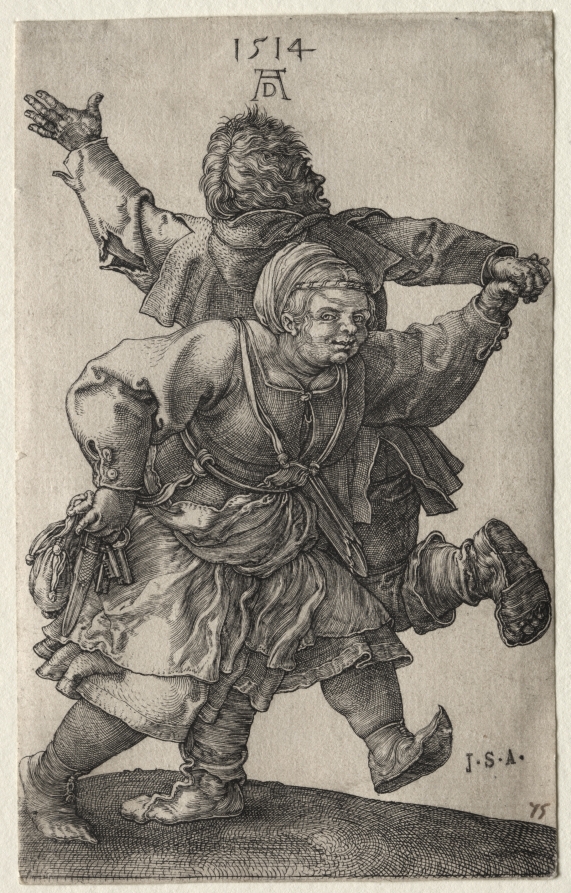
Peasant Couple Dancing, Albrecht Dürer, 1514
Albrecht Dürer, portraitAlbrecht DürerAllemagne, 1471–1528

Peasant Couple Dancing

1514 · Print

À propos de l’œuvre

Since the 1400s, scenes of country peasants celebrating and dancing were common in northern art; such images often pictured the rural classes as rowdy, uncivilized, and prone to indulgence. In contrast, Dürer presented the country folk displayed here as monumental figures in extraordinary detail, thus elevating the subject. Dürer’s depictions are commentaries on social order and demonstrate his interests in humanity as well as the study of human proportion. Even though the role of gender in Dürer’s peasant scenes is scarcely discussed, he clearly locates the woman as the focal point of this engraving. As her companion hollers and waves his arm in reckless abandon, the stout woman appears deliberate in her movements. She gazes assertively at the viewer while drawing attention to the keys, purse, and knife at her waist—symbols of authority and power.

Cleveland Museum of Art

Notice

1514 · à 43 ans
14711528
Numéro d’inventaire
1993.190

Pendant ce temps, chez Albrecht Dürer

La vie entière
  1. 1507–1528 · Lieu de travail

    Nuremberg

  2. 1512

    Emperor Maximilian I becomes his chief patron

    From 1512 Emperor Maximilian I was Dürer's chief patron. For him Dürer and his workshop produced the Triumphal Arch, a giant woodcut 295 × 357 cm printed from 192 blocks and modelled on the triumphal arches of ancient Rome.

  3. 3 January 1512

    Nuremberg's privilege against forgeries

    Nuremberg's city council granted Dürer a privilege for the sale of his prints, with penalties for anyone who forged them.

  4. 1513–1516

    Three years without painting

    Complaining that painting did not pay enough to justify the time compared with his prints, Dürer produced no paintings from 1513 to 1516.

  5. 1514

    Death of his mother

    In the year of Melencolia I and St Jerome in His Study, the artist's mother, Barbara Holper, died.

  6. 1515

    A life pension from the emperor

    The perpetually cash-strapped Maximilian could not pay on time and offered to exempt the artist from city taxes, which the Nuremberg Council opposed. At Dürer's request the emperor granted him a life pension of 100 guilders a year from the sums Nuremberg paid into the imperial treasury.
Autres œuvres : Albrecht Dürer

Toutes les œuvres

Sous le même toit : Cleveland Museum of Art

Page du musée

Sur le même thème · Dancer

Toutes les œuvres sur ce thème

Peut-on la contempler ?

Elle ne reçoit pas en ce moment

Cleveland Museum of Art

Cleveland, États-Unis

Elle appartient à la collection, mais n’est pas présentée en ce moment.

Vérifié
il y a 3 jours
Dans cet état depuis
29 sept. 2026
Source
Le musée
Sur la cartePage du musée

Ce qu’elle montre

DancerCostumeDancersPeasantsFigures

Au catalogue

EstampesGravure au burinRenaissanceXVIe siècleGermanScène de genreAllemagne

Allées et venues

  1. Non exposée en ce moment

    Cleveland Museum of Art · 29 sept. 2026 — aujourd’hui · Vérifié

  2. Non exposée en ce moment

    National Gallery of Art · 29 sept. 2026 — 29 sept. 2026 · Vérifié

  3. Non exposée en ce moment

    Cleveland Museum of Art · 28 sept. 2026 — 29 sept. 2026 · Vérifié

  4. Non exposée en ce moment

    National Gallery of Art · 28 sept. 2026 — 28 sept. 2026 · Vérifié

  5. Non exposée en ce moment

    Cleveland Museum of Art · 27 sept. 2026 — 28 sept. 2026 · Vérifié

  6. Non exposée en ce moment

    National Gallery of Art · 26 sept. 2026 — 27 sept. 2026 · Vérifié

  7. Non exposée en ce moment

    Cleveland Museum of Art · 26 sept. 2026 — 26 sept. 2026 · Vérifié

  8. Non exposée en ce moment

    National Gallery of Art · 25 sept. 2026 — 26 sept. 2026 · Vérifié

  9. Non exposée en ce moment

    Cleveland Museum of Art · 19 août 2026 — 25 sept. 2026 · Vérifié

Sources

  • Cleveland Museum of Art
  • Image : Cleveland Museum of Art — Museum open access
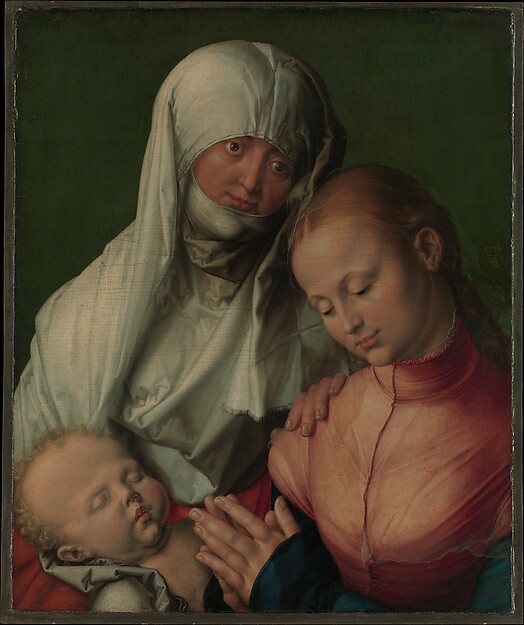
Virgin and Child with Saint Anne, Albrecht Dürer, probably 1519

Virgin and Child with Saint Anne

probably 1519 · Metropolitan Museum of Art

Madonna and Child [obverse], Albrecht Dürer, c. 1496/1499

Vierge à l'Enfant

c. 1496/1499 · National Gallery of Art

Lot and His Daughters [reverse], Albrecht Dürer, c. 1496/1499

Lot and His Daughters [reverse]

c. 1496/1499 · National Gallery of Art

The Martyrdom of Saint Catherine, Albrecht Dürer, ca. 1498

The Martyrdom of Saint Catherine

ca. 1498 · Metropolitan Museum of Art

Nemesis (The Great Fortune), Albrecht Dürer, c. 1501/1502

Nemesis (The Great Fortune)

c. 1501/1502 · Cleveland Museum of Art

Large Horse, Albrecht Dürer, 1505

Large Horse

1505 · Cleveland Museum of Art

The Lamentation, Albrecht Dürer, 1507

The Lamentation

1507 · Cleveland Museum of Art

The Virgin and Child on a Crescent with a Starry Crown, Albrecht Dürer, 1508

The Virgin and Child on a Crescent with a Starry Crown

1508 · Cleveland Museum of Art

The Red Kerchief, Claude Monet, c. 1868–73

Claude Monet

The Red Kerchief, c. 1868–73

Melencolia I, Albrecht Dürer, 1514

Albrecht Dürer

Melencolia I, 1514

The Virgin and Child with the Pear, Albrecht Dürer, 1511

Albrecht Dürer

The Virgin and Child with the Pear, 1511

The Nativity, Albrecht Dürer, probably c. 1509/1510

Albrecht Dürer

The Nativity, probably c. 1509/1510

The Virgin and Child on a Crescent with a Starry Crown, Albrecht Dürer, 1508

Albrecht Dürer

The Virgin and Child on a Crescent with a Starry Crown, 1508

The Lamentation, Albrecht Dürer, 1507

Albrecht Dürer

The Lamentation, 1507

Large Horse, Albrecht Dürer, 1505

Albrecht Dürer

Large Horse, 1505

Nemesis (The Great Fortune), Albrecht Dürer, c. 1501/1502

Albrecht Dürer

Nemesis (The Great Fortune), c. 1501/1502

Salomé, Pablo Picasso, 1905, published 1913

Pablo Picasso

Salomé, 1905, published 1913

Non exposée · National Gallery of Art

The Barbaric Dance (Before Salomé and Hérod) [La danse barbare (devant Salomé et Hérode)], Pablo Picasso, 1905, published 1913

Pablo Picasso

The Barbaric Dance (Before Salomé and Hérod) [La danse barbare (devant Salomé et Hérode)], 1905, published 1913

Non exposée · National Gallery of Art

Homage to Carpeaux (Hommage à Carpeaux), Pablo Picasso, 1934

Pablo Picasso

Homage to Carpeaux (Hommage à Carpeaux), 1934

Non exposée · National Gallery of Art

Salomé, Pablo Picasso, 1905, published 1913

Pablo Picasso

Salomé, 1905, published 1913

Non exposée · National Gallery of Art

Liza Minnelli, Martha Graham, Bob Colacello, Victor Hugo, Benjamin Liu, Paulette Goddard and Unidentified Woman, Andy Warhol, n.d.

Andy Warhol

Liza Minnelli, Martha Graham, Bob Colacello, Victor Hugo, Benjamin Liu, Paulette Goddard and Unidentified Woman, n.d.

Non exposée · National Gallery of Art

Dance of Cupids, Marcantonio Raimondi after Raphael, c. 1517-1520

Raphael

Dance of Cupids, c. 1517-1520

Non exposée · National Gallery of Art

Dance of the Gods of Love, Sebald Beham, after Marcantonio Raimondi, after Raphael

Raphael

Dance of the Gods of Love

Non exposée · National Gallery of Art

Spanish Scene (Scène espagnole), Jules-Ferdinand Jacquemart after Francisco Goya, 1863

Francisco de Goya

Spanish Scene (Scène espagnole), 1863

Non exposée · National Gallery of Art