PasiphaéPas de photographie
 Gustave MoreauFrance, 1826–1898
Pasiphaé
Peut-on la contempler ?
Inconnu
Musée Gustave-Moreau
Paris, France
Le propriétaire est connu ; on ignore si l’œuvre est exposée aujourd’hui.
- Dans cet état depuis
- Source
- Le musée
Notice
- Numéro d’inventaire
- Cat. 192
Au catalogue
Sources
- Musée Gustave-Moreau
- Image : Musée Gustave-Moreau — © R.G. Ojeda ; Réunion des musées nationaux - utilisation soumise à autorisation; Ministère de la Culture (France), base Joconde
Pendant ce temps, chez Gustave Moreau
La vie entière1841–1857 · Lieu de travail
Paris
1846–1849 · Formation
Beaux-Arts de Paris
1848–1849
Failure at the Prix de Rome and departure from the École
Moreau had grand aspirations of winning the Grand Prix de Rome, but when he failed to make the final rounds in 1848 and 1849 he left the École des Beaux-Arts prematurely. His style soon drifted away from the academy’s, though the basics of Beaux-Arts methods and his commitment to history painting stayed with him for life.
1852
Salon debut: the state buys his “Pietà”
In 1852 Moreau took part in the Paris Salon for the first time, presenting a Pietà that the state bought for 600 francs. From the 1850s he exhibited with some regularity and, with his father’s help, secured commissions from the city.
1864
A Salon medal for “Oedipus and the Sphinx”
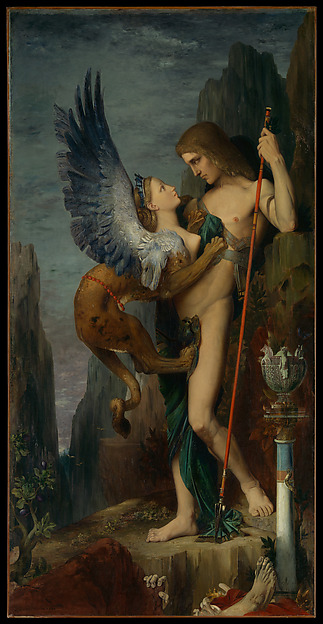
“Oedipus and the Sphinx”, one of Moreau’s first Symbolist paintings, won a medal at the Paris Salon of 1864 and established his reputation. One commentator likened it to a pastiche of Mantegna created by a German student who relaxes from his painting by reading Schopenhauer.
1876
Return to the Salon: “Salome”
After the break Moreau returned to the Salon. That year he completed “Salome Dancing before Herod”, which announced the more painterly style that would characterize his later works.