Utagawa HiroshigeJapon, 1797–1858
Numazu in de avondschemering
Peut-on la voir ?
Inconnu
Où est « Numazu in de avondschemering » aujourd’hui ? Collection: Rijksmuseum Amsterdam, Amsterdam. Inconnu.

Amsterdam, Pays-Bas
Le propriétaire est connu ; on ignore si l’œuvre est exposée aujourd’hui.
- Source
- Le musée
À propos de l’œuvre
Selon le musée — en néerlandais
Reizigers, in de avondschemer, lopend langs een rivier in de richting van het dorp Numazu, bij volle maan; de achterste man draagt een masker van een mythologische tengu op zijn rug.
Rijksmuseum Amsterdam
Notice
- Numéro d’inventaire
- RP-P-1960-375
Ce qu’elle montre
Au catalogue
Sources
- Rijksmuseum Amsterdam
- Image : Rijksmuseum Amsterdam — public domain
Dans la vie de Utagawa Hiroshige
La vie entière1809–1832
Post: dōshin
1828
He declines to succeed Toyohiro
On the death of his master Toyohiro in 1828, Hiroshige declined an offer to succeed him.
1829–1830
The turn to landscape: “Eight Views of Ōmi”
Until then Hiroshige had worked in the usual ukiyo-e themes: book illustrations, beauties and kabuki actors. It was not until 1829–1830 that he began to produce the landscapes he is known for, such as the series “Eight Views of Ōmi”, and he also made an increasing number of bird and flower prints.
1832
Journey to Kyoto along the Tōkaidō
As a fire warden he was entitled to minor privileges reserved for low-ranking samurai, which is how he secured an invitation to join an official procession to Kyoto and travelled the Tōkaidō route linking the two capitals. He sketched the scenery along the way.
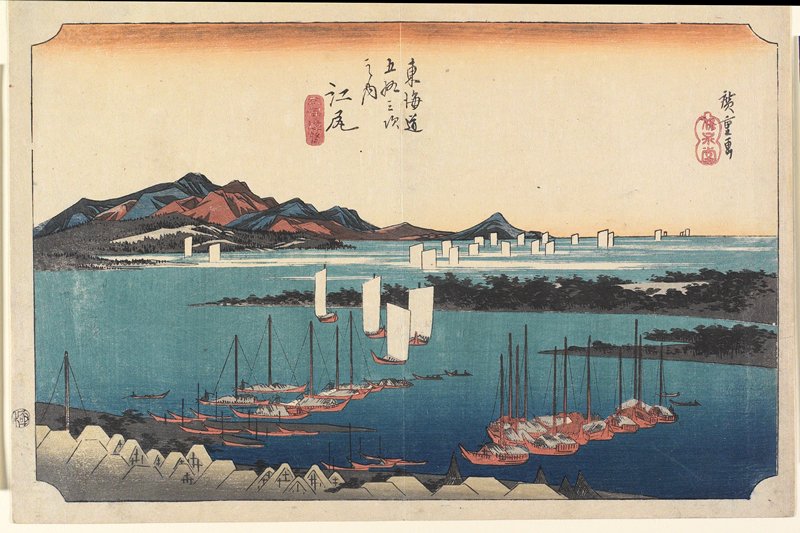
![Shinano Province, Moon Reflected in the Sarashina Paddy-fields, Mount Kyōdai (Shinano, Sarashina tagoto no tsuki, Kyōdaisan), from the series Famous Places in the Sixty-odd Provinces [of Japan] ([Dai Nihon] Rokujūyoshū meisho zue), Utagawa Hiroshige 歌川広重, Edo period, 1853 (Kaei 6, 8th month)](https://nrs.harvard.edu/urn-3:HUAM:CARP04802_dynmc/full/!2400,2400/0/default.jpg)