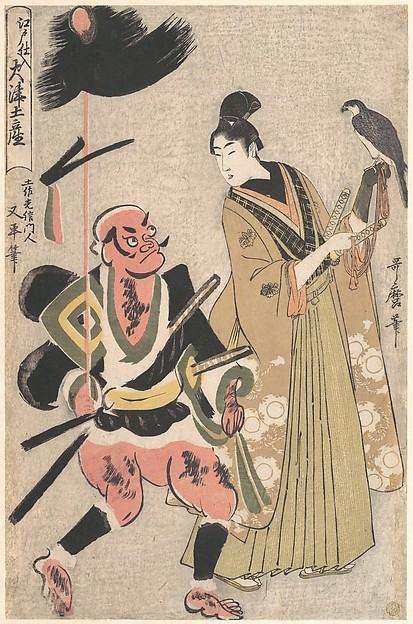
Kitagawa UtamaroJapon, 1754–1806
Nieuwjaar
Peut-on la voir ?
Inconnu
Où est « Nieuwjaar » aujourd’hui ? Collection: Rijksmuseum Amsterdam, Amsterdam. Inconnu.

Amsterdam, Pays-Bas
Le propriétaire est connu ; on ignore si l’œuvre est exposée aujourd’hui.
- Source
- Le musée
À propos de l’œuvre
Selon le musée — en néerlandais
Nieuwjaarsscene. Staande vrouw in feestelijke kimono; in haar handen een tafeltje waarop bonsai boompje, rijstballetjes en een kreeft. Zittende vrouw met sake ketel, kijkend naar jongetje met sake kommetje in de handen en schildpadpatroon op kleding.
Rijksmuseum Amsterdam
Notice
- Numéro d’inventaire
- AK-MAK-1620
Ce qu’elle montre
Au catalogue
Sources
- Rijksmuseum Amsterdam
- Image : Rijksmuseum Amsterdam — public domain
Dans la vie de Kitagawa Utamaro
La vie entière1804
Arrest and fifty days in manacles
In 1804 Utamaro is imprisoned over prints of the sixteenth-century ruler Toyotomi Hideyoshi, depicted, in the authorities' view, “in an improper form”, and then manacled for fifty days, together with Tsukimaro, Toyokuni, Shuntei, Shun'ei and Jippensha Ikku; their publishers are heavily fined. It is probably the most famous case of censorship of the Edo period, and Utamaro appears to have been the most prominent of those punished.
1804
The prints of Hideyoshi that angered the authorities
The trigger was a wave of prints and books based on the “Ehon Taikōki”, an illustrated life of Hideyoshi (1797–1802): the authorities may have taken offence at historical figures being named and shown with their crests, which was prohibited, and at Hideyoshi being depicted with women of the pleasure quarters. Utamaro's censored prints include the daimyō Katō Kiyomasa lustily gazing at a Korean dancer, Hideyoshi holding the hand of his page Ishida Mitsunari in a sexually suggestive manner, and Hideyoshi with his five consorts viewing cherry blossoms at Daigo-ji temple.
1804–1806
Never recovering from the arrest
The arrest and imprisonment are held to have dealt Utamaro a severe psychological trauma: he could not recover from the shock, and the late period of his work is coloured by tragic tones. Soon after his release the artist died.
31 octobre 1806
Died