John Singleton CopleyÉtats-Unis, 1738–1815
Nicholas Boylston (1716-1771)
Peut-on la voir ?
Oui, exposée actuellement
Où est « Nicholas Boylston (1716-1771) » aujourd’hui ? Musées d'Art de Harvard, Gallery 2240, floor 2, European and American Art, 17th–19th century, Cambridge. Oui, exposée actuellement. Vérifié 29 septembre 2026.

Cambridge, États-Unis
Salle2240, floor 2, European and American Art, 17th–19th century
Présentée au public.
- Vérifié
- Dans cet état depuis
- Source
- Le musée
À propos du tableau
John Singleton Copley began his extraordinary transnational painting career in his late teens. Before he and his family left for London in 1775, Copley created luxurious likenesses of prominent Anglo-colonials in Boston. He combined detailed renderings of faces and garments with invented settings to aggrandize the wealth and status of the sitters’ families.
In 1766, Copley was commissioned to paint portraits of the Boylston family. In this portrait of Nicholas Boylston, the sitter is shown wearing a satin negligee cap and a sumptuous, silk brocade “banyan”—a kimono-inspired garment that conveyed cosmopolitan tastes and access to global markets.
Lire plus
The Boylstons had amassed a fortune by trading enslaved Africans, Asian ceramics and textiles, and Peruvian silver to and from London markets and the ports in the empire, through the Boylston and Green Shipping Company. The large ledgers on the table and the company ship in the background allude to the source of the family’s wealth while obscuring the systems of exploitation on which that wealth accrued.
Musées d'Art de Harvard
Notice
- Numéro d’inventaire
- H90
Au catalogue
Sources
- Musées d'Art de Harvard
- Image : Musées d'Art de Harvard — © President and Fellows of Harvard College
Dans la vie de John Singleton Copley
La vie entière1753–1774 · Lieu de travail
Boston
1766
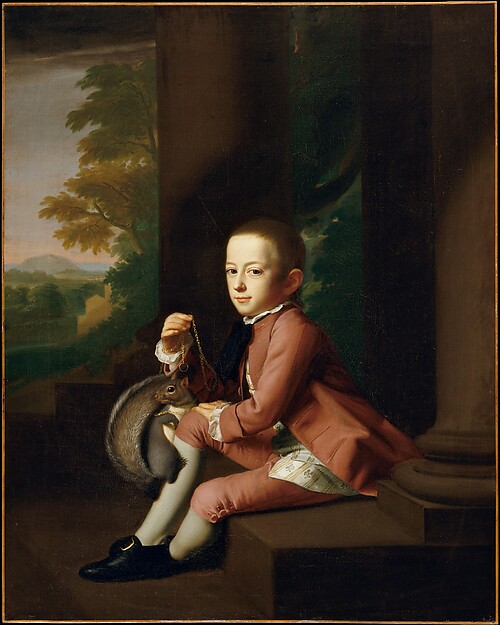
“A Boy with a Flying Squirrel” at the London exhibition
The exhibition of 1766 establishes Copley’s fame in England. Joshua Reynolds speaks warmly of the picture, saying that with a proper artistic education Copley could become a master of world stature.
4 August 1766
West urges Copley to study in Europe
By one account, on receiving the picture without the painter’s name West exclaimed that its colouring was worthy of Titian, and he got it into the exhibition; on 4 August he writes to Copley of Reynolds’s interest and advises a visit to Europe of three or four years. In October and November Copley gladly agrees to send more pictures but laments that no portrait worthy of the name of a picture has been brought to Boston within his memory.
3 September 1766
Elected to the Society of Artists of Great Britain
By vote of 3 September 1766, “A Boy with a Flying Squirrel” makes the young Boston painter a Fellow of the Society of Artists of Great Britain.
17 June 1768
Explains to West why he is not yet coming to Europe
Copley writes that he would go only with a very good prospect of doing as well there as at home: his present income of 300 guineas a year is a fair living in America, and his mother and young brother depend on him. West replies on 20 September that he has talked over Copley’s prospects with London artists, who agree that he has nothing to hazard.
16 novembre 1769
Married: Susannah Farnum Clarke