ART WIKI32 963 en salle
CarteCollectionArtistesMuséesExpositionsJournal
Connexion

ART WIKI

Où est accroché le chef-d’œuvre, et quand on vous laisse entrer.

Collections : Art Institute of Chicago, Cleveland Museum of Art, Galerie Tretiakov, Hirshhorn Museum and Sculpture Garden, J. Paul Getty Museum, Metropolitan Museum of Art, Minneapolis Institute of Art, Musée de l'Ermitage, Musée des Beaux-Arts Pouchkine, Musée du Louvre, musée national d'art asiatique, Musée russe, Musées d'Art de Harvard, Museum of Modern Art, National Gallery of Art, National Portrait Gallery, Rijksmuseum Amsterdam, Smithsonian American Art Museum, Statens Museum for Kunst, Victoria and Albert Museum, Villa Getty, Whitney Museum of American Art, Catalogue d’État du fonds muséal de Russie (274 musées), Europeana (19 musées), Wikidata (6 musées), Paris Musées (12 musées) et Joconde, la base des musées du ministère de la Culture (495 musées). Les images appartiennent à leurs ayants droit.

Rubriques

  • Carte
  • Recherche
  • Collection
  • Chefs-d’œuvre
  • Exposées en ce moment
  • Artistes

Et aussi

  • Musées et galeries
  • Expositions
  • Journal
  • D’où viennent les données
  • Confidentialité et cookies
AccueilCarteCatalogue
  1. Collection/
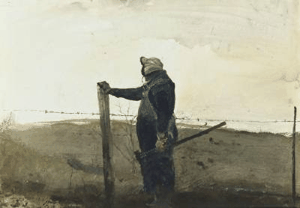
  2. Mending Fences
Mending Fences, Andrew Wyeth, 1960
Andrew Wyeth, portraitAndrew WyethÉtats-Unis, 1917–2009

Mending Fences

1960 · Painting; Watercolor on paper · 22 x 30 in

Peut-on la contempler ?

Non : l’œuvre a été volée et elle est recherchée

Listed in the FBI's National Stolen Art File under no. 00106.

Vérifié
il y a 9 jours· Signalé
Dans cet état depuis
30 sept. 2026
Source
Un registre des œuvres volées
Toutes les œuvres volées et perdues

Notice

1960 · à 43 ans
19172009

Au catalogue

PeinturesPeinture américaineArt d’après-guerreXXe siècle

Sources

  • Le registre des œuvres volées du FBI
  • Image : FBI National Stolen Art File

Pendant ce temps, chez Andrew Wyeth

La vie entière
  1. 1950–1970s

    The Kuerner farm, his subject for 30 years

    His Chadds Ford neighbours Anna and Karl Kuerner and their farm were among Wyeth's chief subjects for nearly 30 years: “I didn't think it a picturesque place. It just excited me, purely abstractly and purely emotionally.” In “Brown Swiss” (1957), named after Karl's cows, there are no cows — only their tracks in the grass.

  2. 1958

    A mill on the Brandywine becomes home and studio

    In 1958 the Wyeths bought an 18th-century mill on the Brandywine River near Chadds Ford and converted it into a home and studio; from then on the artist spent winters in Pennsylvania and summers in Maine, hardly ever leaving the East Coast.

  3. 1960s

    Turning to portraiture

    In the 1960s Wyeth began to paint portraits: his friend Tom Clark (“Garret Room”, 1962), his neighbour Adam Johnson (“Adam”, 1963), his sister Carolyn (“Up in the Studio”, 1965).
Autres œuvres : Andrew Wyeth

Toutes les œuvres
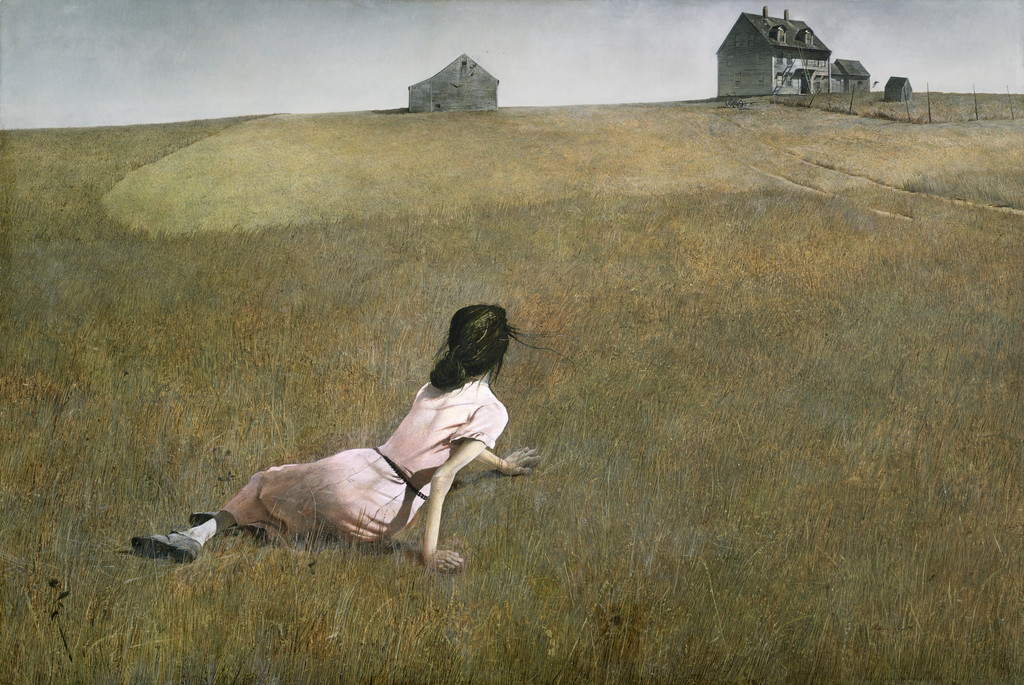
Christina's World, Andrew Wyeth, 1948

Christina's World

1948 · Museum of Modern Art

Wind from the Sea, Andrew Wyeth, 1947

Wind from the Sea

1947 · National Gallery of Art

The Door Step, Andrew Wyeth, 1940s

The Door Step

1940s · Non exposée · National Gallery of Art

Christmas Card, Andrew Wyeth

Christmas Card

Non exposée · National Gallery of Art

Christmas Card, Andrew Wyeth

Christmas Card

Non exposée · National Gallery of Art

Lobsterman's Ledge, Andrew Wyeth, 1939

Lobsterman's Ledge

1939 · Non exposée · National Gallery of Art

The Oak, Andrew Wyeth, 1940-1945

The Oak

1940-1945 · Non exposée · National Gallery of Art

Brandywine Valley, Andrew Wyeth, 1940

Brandywine Valley

1940 · Non exposée · National Gallery of Art