John Singer SargentÉtats-Unis, 1856–1925
Lake O'Hara
Peut-on la contempler ?
Oui, elle reçoit

Cambridge, États-Unis
Salle2700, floor 2, European and American Art, 19th century
Présentée au public.
- Vérifié
- Dans cet état depuis
- Source
- Le musée
À propos du tableau
In this closely cropped view of the Canadian Rockies, John Singer Sargent explored the materiality of paint. With its rough, gestural brushwork, thick layers of pigment, and thin washes, Lake O’Hara exemplifies the artist’s late style. The painting verges on abstraction, and is in stark contrast to the work of earlier painters who freighted their images of the Rockies with symbolism.
Lire plus
Lake O’Hara occupies an important position in the history of the Fogg Museum. When it was acquired in 1916, the painting was the first work by a living artist to enter the museum’s collection. Edward W. Forbes, the Fogg’s director, arranged for the purchase of Lake O’Hara despite his uncertainty about the quality of contemporary painting: “In the past, the policy of the Fogg Museum has been to exhibit the work of men who are dead.” But “Mr. Sargent is usually considered to be the greatest living American painter, and one or two of the greatest if not the greatest of any nationality.”
Musées d'Art de Harvard
Notice
- Numéro d’inventaire
- 1916.496
Au catalogue
Sources
- Musées d'Art de Harvard
- Image : Musées d'Art de Harvard — © President and Fellows of Harvard College
Pendant ce temps, chez John Singer Sargent
La vie entière1895–1919
The “Triumph of Religion” murals for the Boston Public Library
From 1895 through 1919, for almost thirty years, Sargent works on his largest-scale work, the mural decorations “Triumph of Religion” for the Boston Public Library, showing religion's progress from pagan superstition to the ascension of Christianity; he never completes the final mural of the cycle.
1905–1914
Summer journeys with the de Glehns
Between 1905 and 1914 Sargent's frequent travelling companions are the married artist couple Wilfrid de Glehn and Jane Emmet de Glehn; the trio often spend summers in France, Spain or Italy, and all three depict one another in their paintings.
1916
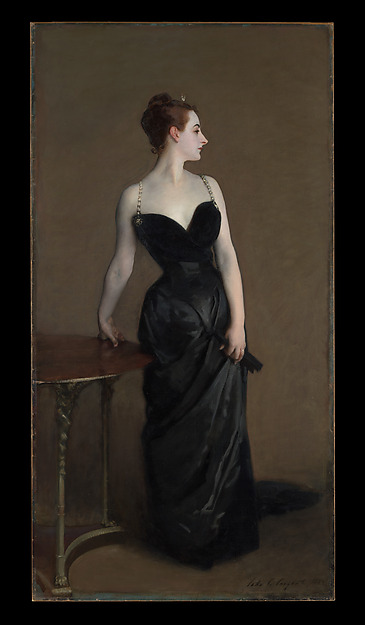
Sells “Madame X” to the Metropolitan Museum
Sargent keeps “Madame X” prominently displayed in his London studio until he sells it in 1916 to the Metropolitan Museum of Art, after moving to the United States and a few months after Gautreau's death.
1916
An honorary degree from Harvard University
In 1916 Harvard University awards Sargent an honorary degree.
1918
Commissioned as a war artist
On his return to England in 1918 after a visit to the United States Sargent is commissioned as a war artist by the British Ministry of Information; he depicts scenes from the Great War in his large painting “Gassed” and in many watercolours.
Good Friday 1918
His niece Rose-Marie killed in the shelling of Paris
On Good Friday 1918 his niece Rose-Marie dies in the shelling of the church of St Gervais in Paris; Sargent is deeply affected by her death.