 Bernard, EmileFrance, 1868–1941
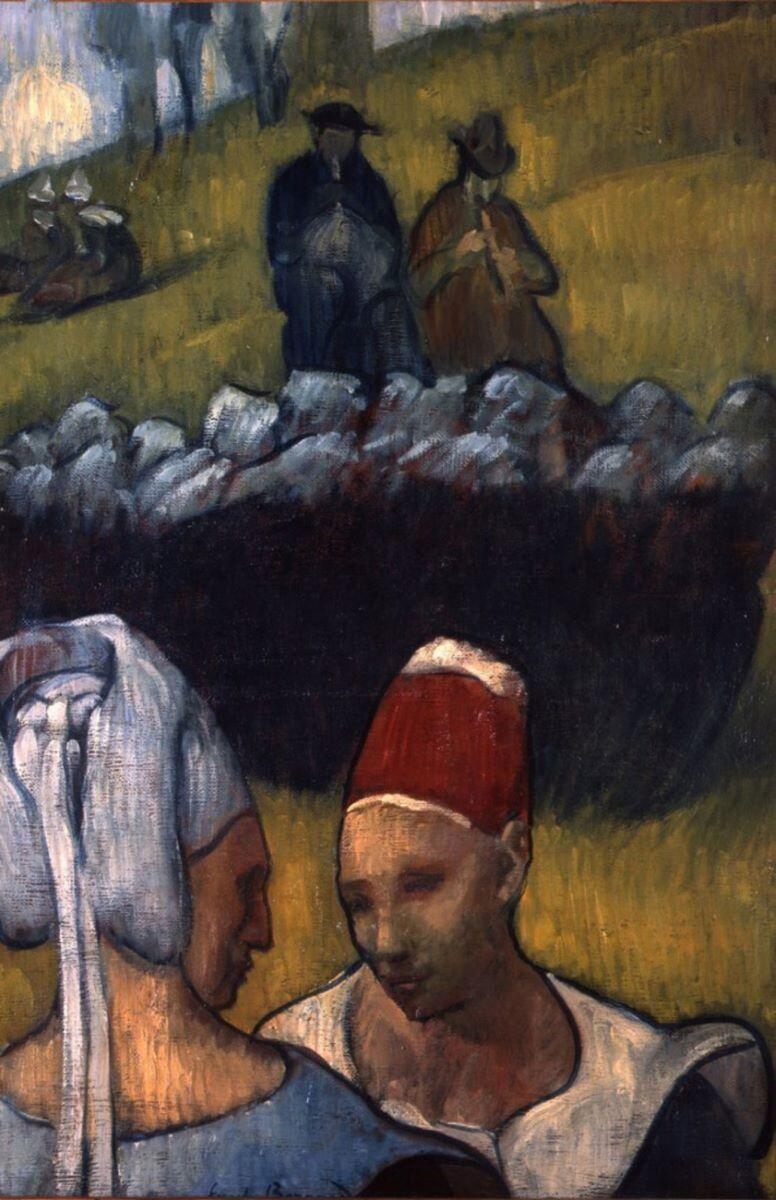
La Ronde bretonne
Peut-on la voir ?
Inconnu
Où est « La Ronde bretonne » aujourd’hui ? Collection: Musée de Pont-Aven, Pont-Aven. Inconnu.
Pont-Aven, France
Le propriétaire est connu ; on ignore si l’œuvre est exposée aujourd’hui.
- Dans cet état depuis
- Source
- Le musée
À propos du tableau
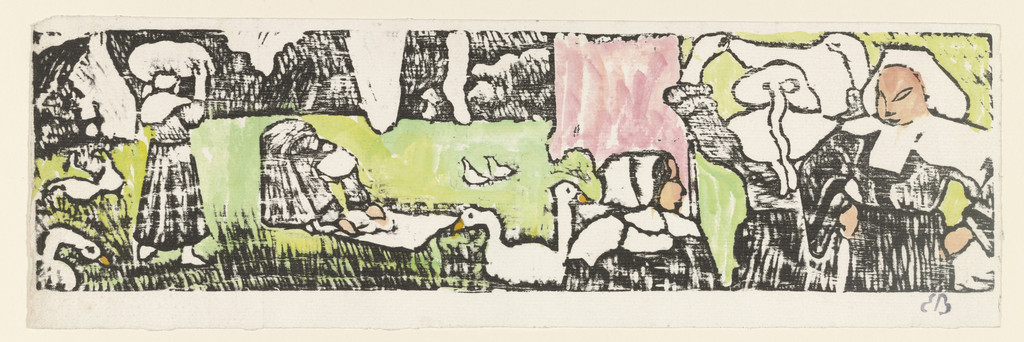
La Ronde bretonne – ou simplement Bretonnes ou Étude de Bretonnes – est un tableau réalisé par le peintre français Émile Bernard entre 1888 et 1890. De format vertical, cette huile sur toile représente deux femmes en costume breton apparaissant en buste au premier plan d'une idylle centrée sur deux musiciens qui jouent pour d'autres Bretonnes, assises devant et derrière eux. Partie des collections du musée d'Orsay, à Paris, l'œuvre se trouve depuis 2024 en dépôt au musée de Pont-Aven, à Pont-Aven, dans le Finistère. Elle était jusqu'alors conservée au musée des Beaux-Arts de Quimper, à Quimper.
Notice
- Numéro d’inventaire
- D 2024.2.1 ; Inv. déposant : AM 2998
Au catalogue
Sources
- Musée de Pont-Aven
- Image : Musée de Pont-Aven — Mathilde Moebs; Ministère de la Culture (France), base Joconde
Dans la vie de Bernard, Emile
La vie entière1886
First meeting with Gauguin in Pont-Aven
In August 1886 in Pont-Aven Bernard meets Gauguin for the first time; they exchange little about art but look forward to meeting again. Looking back, Bernard said his own talent was already fully developed, and he believed that his style played a considerable part in the development of Gauguin's mature style.
1887
Cloisonnism, developed together with Anquetin
In 1887 Bernard and Louis Anquetin develop cloisonnism — bold forms separated by dark contours; in the spring they “turn against Neo-Impressionism”. Many, however, credit Anquetin with the technique, and Bernard was probably also influenced by the works of Cézanne he had seen.
1887–1888
An exhibition in the restaurant on the Avenue de Clichy
Back in Paris, Bernard attends the Académie Julian and meets van Gogh, who is impressed by his work. He finds a restaurant on the Avenue de Clichy where his work is shown alongside that of van Gogh, Anquetin and Toulouse-Lautrec; van Gogh calls the group the “School of the Petit Boulevard”.
1888
On foot to Pont-Aven: friendship with Gauguin
A year later Bernard again sets out for Pont-Aven on foot and sees Gauguin; their friendship and artistic partnership quickly grow strong. Bernard wants an art of the most extreme simplicity, accessible to all and practised collectively, and Gauguin is impressed by his ability to put his ideas into words. Other accounts have him living in Pont-Aven in 1886–1888 and joining the Pont-Aven group.
1890
A religious crisis and a turn to the Middle Ages
In 1890 Bernard goes through a religious crisis and turns to the subjects and themes of medieval art. In the same year he sets out to revive symbolism, which he saw as Christian in essence — the invisible expressed through the visible.
1891
The break with Gauguin
In 1891 Bernard breaks off his friendship with Gauguin. It was always his great frustration that Gauguin never named him as an influence on pictorial symbolism; one writer says his rivalry with Gauguin led him “out of spite” towards classicism.