Bernard, EmileFrance, 1868–1941
La Ronde bretonne
Peut-on la voir ?
Inconnu
Où est « La Ronde bretonne » aujourd’hui ? Collection: Musée d'Orsay, Paris. Inconnu.

Paris, France
Le propriétaire est connu ; on ignore si l’œuvre est exposée aujourd’hui.
- Dans cet état depuis
- Source
- Le musée
À propos du tableau
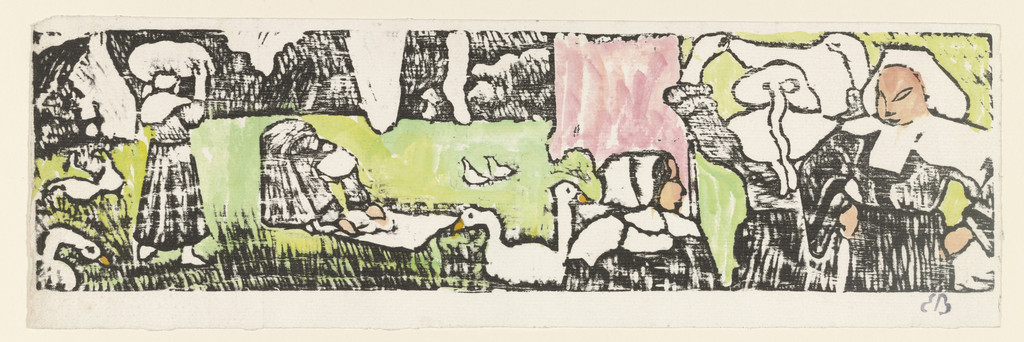
La Ronde bretonne – ou simplement Bretonnes ou Étude de Bretonnes – est un tableau réalisé par le peintre français Émile Bernard entre 1888 et 1890. De format vertical, cette huile sur toile représente deux femmes en costume breton apparaissant en buste au premier plan d'une idylle centrée sur deux musiciens qui jouent pour d'autres Bretonnes, assises devant et derrière eux. Partie des collections du musée d'Orsay, à Paris, l'œuvre se trouve depuis 2024 en dépôt au musée de Pont-Aven, à Pont-Aven, dans le Finistère. Elle était jusqu'alors conservée au musée des Beaux-Arts de Quimper, à Quimper.
Notice
- Numéro d’inventaire
- AM 2998
Au catalogue
Sources
- Wikidata
- Image : Musée d'Orsay — Émile Bernard · Public domain · Wikimedia Commons
Dans la vie de Bernard, Emile
La vie entière1890
A religious crisis and a turn to the Middle Ages
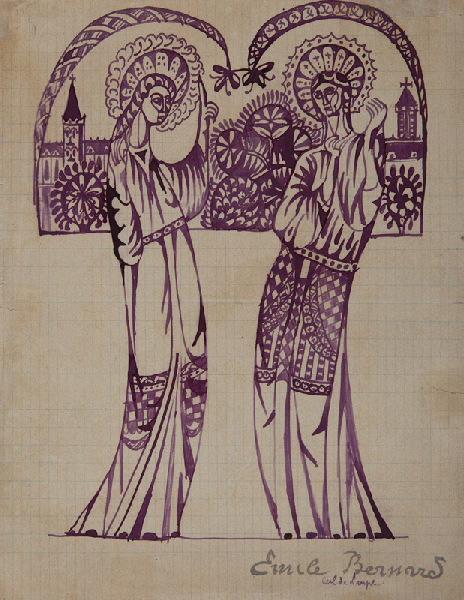
In 1890 Bernard goes through a religious crisis and turns to the subjects and themes of medieval art. In the same year he sets out to revive symbolism, which he saw as Christian in essence — the invisible expressed through the visible.
1891
The break with Gauguin
In 1891 Bernard breaks off his friendship with Gauguin. It was always his great frustration that Gauguin never named him as an influence on pictorial symbolism; one writer says his rivalry with Gauguin led him “out of spite” towards classicism.
1891
Among the Symbolists and the Nabis
In 1891 Bernard joins the group of Symbolist painters that includes Odilon Redon and Ferdinand Hodler, and in the same year becomes a member of the Nabis.
1893–1903
Travel: Egypt
1893–1903
Journeys through Egypt, Italy and Spain
From 1893 to 1903 Bernard travels in Egypt, Italy and Spain, painting mostly religious and Symbolist canvases, and his style grows more eclectic. One writer holds that it was in the Middle East, in a period of great crisis, that he turned to classicism.