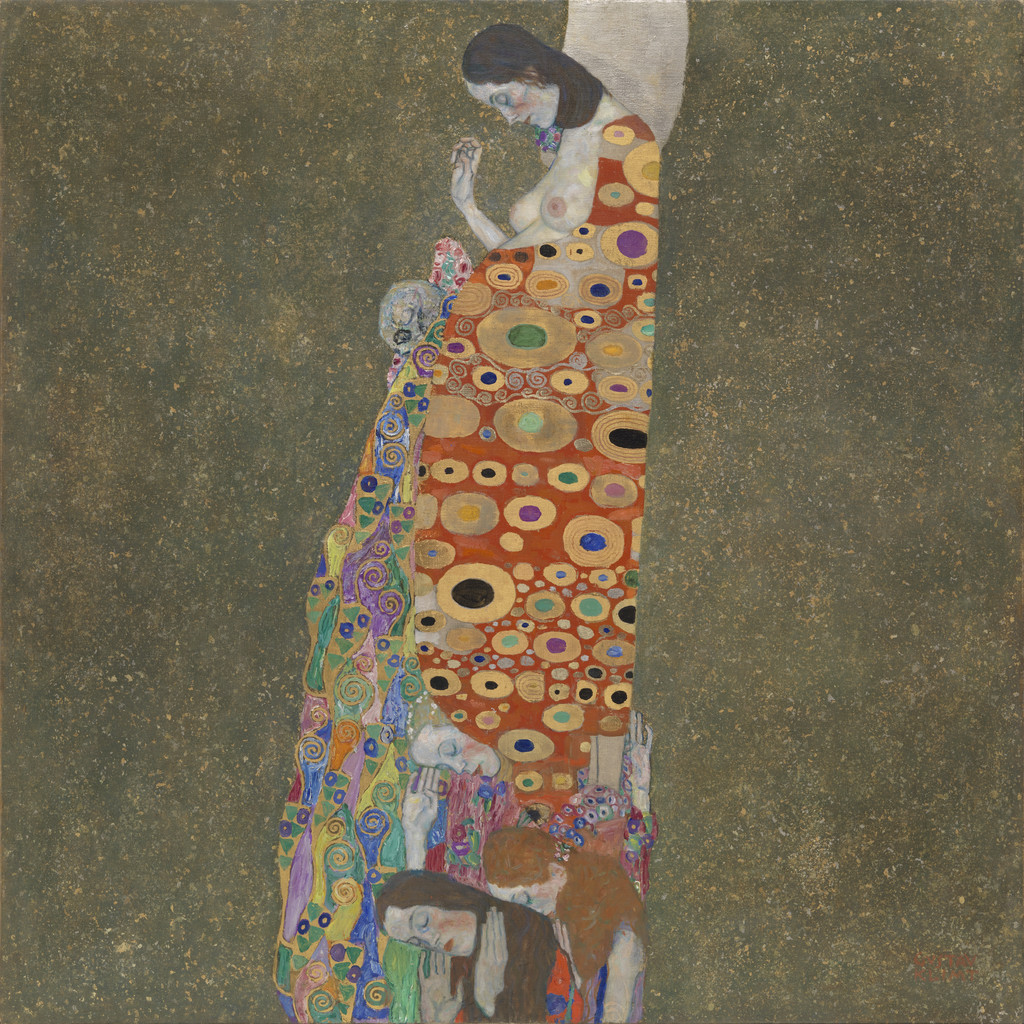
 Gustav KlimtAutriche, 1862–1918
L'Espoir
Hope, II
Peut-on la contempler ?
Oui, elle reçoit

Présentée au public.
- Vérifié
- Source
- Le musée
À propos du tableau
L'Espoir II ou Espoir II (en allemand, Die Hoffnung II) est une peinture du peintre autrichien Gustav Klimt, réalisée en 1907–08. C'était la deuxième œuvre de Klimt à se concentrer sur une femme enceinte, représentant toutes les deux Herma, l'un de ses modèles préférés. Il a été intitulé Vision par Klimt, mais est devenu célèbre sous le nom de Espoir II d'après l'œuvre précédente Espoir, qui est maintenant appelée Espoir I. Espoir II a été acquis par le Museum of Modern Art de New York en 1978.
Notice
- Numéro d’inventaire
- 468.1978
Au catalogue
Sources
- Museum of Modern Art
- Image : Museum of Modern Art — © the artist or rights holder
Pendant ce temps, chez Gustav Klimt
La vie entière1900–1907
He returns the advance and keeps the paintings
The state commission refused to accept the three “Faculty Paintings”; Klimt told the minister he would return the 60,000-krone advance, refused to work for the Austrian state again and kept the pictures. The ministry demanded them, but Klimt did not open the door to the removal men — and the affair ended in his victory.
1905
Klimt and his group leave the Secession
Klimt and his “stylist” followers, who held that art should enter every sphere of life, fell out with the “naturalists”; the decision against Klimt's group was carried by a single vote. For the next three years the group had no joint exhibitions.
1906
The “Kunstschau” group
A year after the split Klimt formed the “Kunstschau” group, or “Klimt group”, which included Carl Moll, Otto Wagner and other leading Austrian artists.
1 June – 16 November 1908
The first Vienna Art Show
For the sixtieth anniversary of Franz Joseph's reign pavilions with 54 rooms were built on a temporary site and over 900 works shown. Room 22, which Peter Altenberg called “the church of modern art named after Gustav Klimt”, held “The Kiss”, “Adele Bloch-Bauer I”, “Danaë” and “The Three Ages of Woman”.
1909
The second Vienna Art Show
The second generation of modernists was represented by Kokoschka and Egon Schiele, and Klimt showed “Judith II” and “Hope II”. The works of Van Gogh, Munch, Gauguin, Vallotton, Bonnard and Matisse gave him the impulse for a new phase, but he never organized exhibitions again.
1910
Klimt at the Venice Biennale
Klimt's exhibition at the 1910 Venice Biennale influenced the artistic scene of Venice; the Italian Liberty artists Galileo Chini and Vittorio Zecchin were among those he influenced.