 Aristide MaillolFrance, 1861–1944
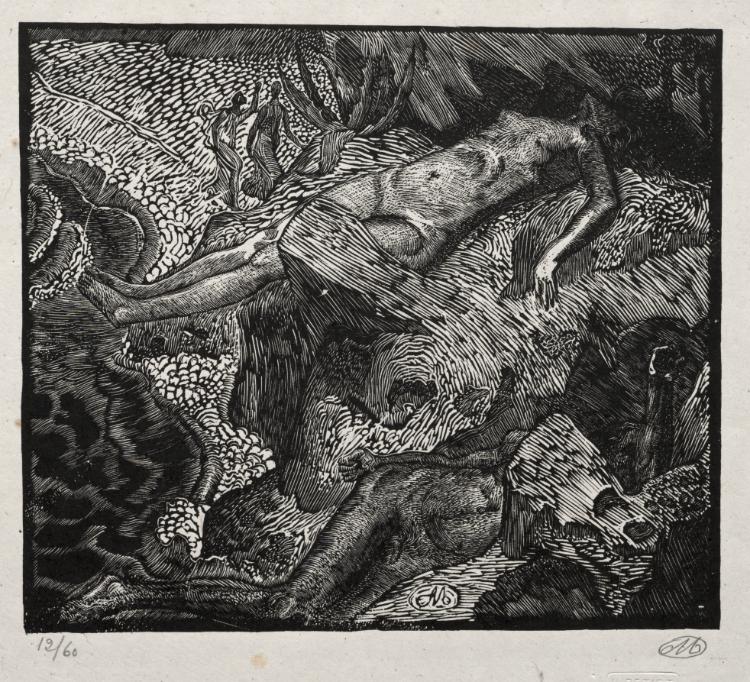
Hero and Leander
Peut-on la contempler ?
Elle ne reçoit pas en ce moment

Cleveland Museum of Art
Cleveland, États-Unis
Elle appartient à la collection, mais n’est pas présentée en ce moment.
- Vérifié
- Dans cet état depuis
- Source
- Le musée
À propos de l’œuvre
Maillol executed Hero and Leander just as he was becoming acquainted with Paul Gauguin, whose contemporaneous woodcuts must have influenced this work. However, unlike Gauguin, Maillol filled the entire surface with intricate detail and pattern. Leander lived on the Asian side of the Hellespont, the strait which separates Asia and Europe. His lover, Hero, lived on the opposite shore. Each night Leander swam across the strait to visit Hero, but one evening during a storm he drowned, the waves bearing his body to the European shore. When Hero learned of his death, she cast herself into the sea and perished.
Cleveland Museum of Art
Notice
- Numéro d’inventaire
- 1992.343
Au catalogue
Sources
- Cleveland Museum of Art
- Image : Cleveland Museum of Art — Museum open access
Pendant ce temps, chez Aristide Maillol
La vie entière1892
Meets Paul Gauguin
Maillol's early painting showed the influence of Puvis de Chavannes; he joined the Nabis and mixed with Bonnard, Vuillard and Maurice Denis. His meeting with Paul Gauguin in 1892 proved decisive.
1893
A tapestry workshop in Banyuls
Gauguin encouraged his growing interest in decorative art, and in 1893 Maillol opened a tapestry workshop in Banyuls, whose technical and artistic quality earned him recognition for renewing the art in France. The medieval tapestries of The Lady and the Unicorn at the Musée de Cluny provided the spark.
1895
First terracottas: the turn to sculpture
In 1895 Maillol began making small terracotta sculptures, and within a few years sculpture had displaced his tapestry work. It was failing eyesight that drove him to sculpture, and by some accounts he first showed his works to the public in 1894.