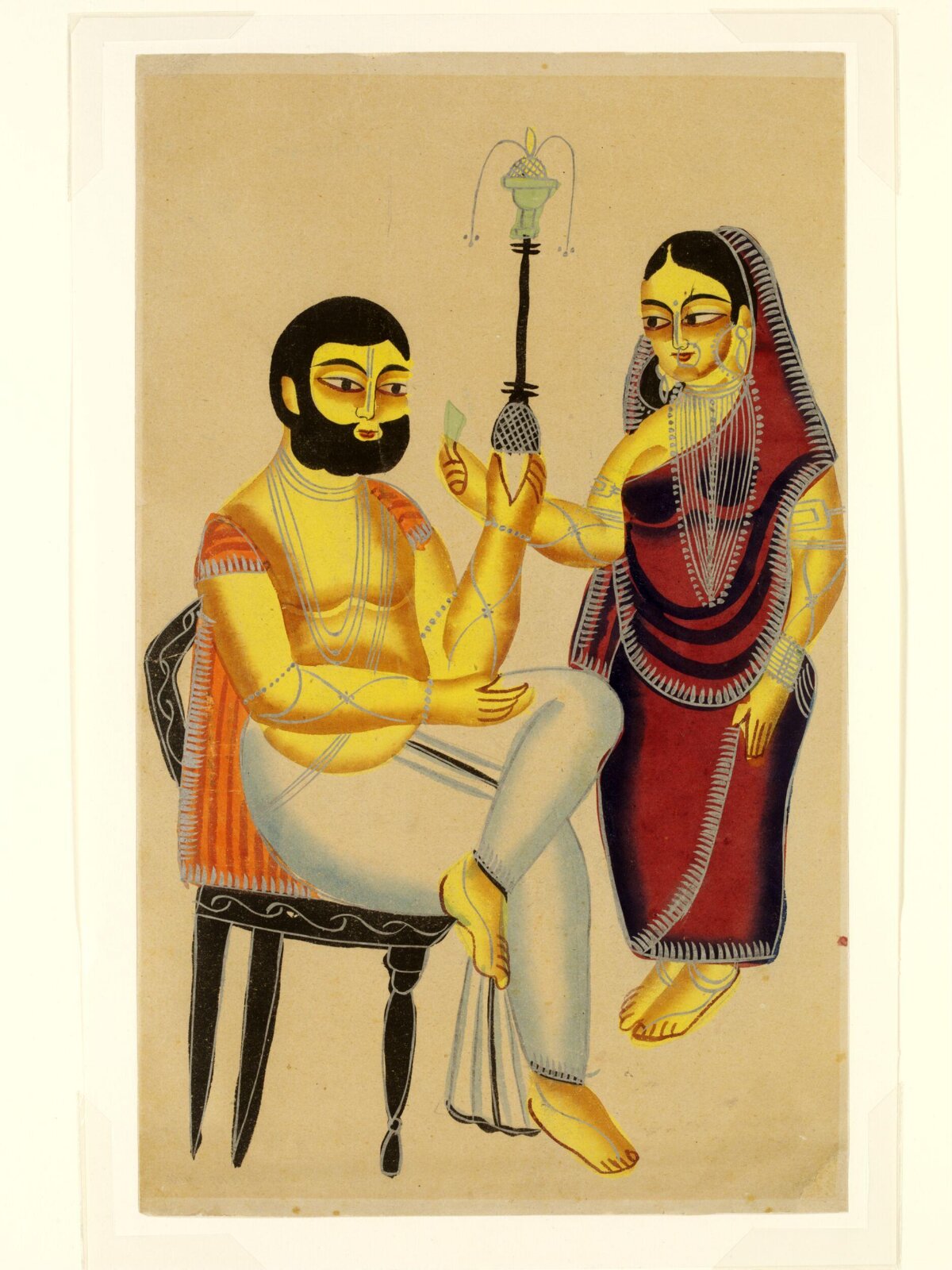
Elokeshi
Peut-on la contempler ?
Elle ne reçoit pas en ce moment

Victoria and Albert Museum
Londres, Royaume-Uni
Elle appartient à la collection, mais n’est pas présentée en ce moment.
- Vérifié
- il y a 7 jours
- Dans cet état depuis
- 25 sept. 2026
- Source
- Les données de collection du musée lui-même
About the painting
This is an example of a Kalighat painting, a type that derives its name from the Kalighat Temple in Calcutta, where such images were created by scroll painters who began to migrate there from rural Bengal in about 1830. The themes depicted were mainly stories from the Hindu epic, the Ramayana, as well as scenes from the life of Krishna and the incarnations of Vishnu, besides traditional themes of musicians and courtesans.
Read on
This picture, however, depicts the scandalous Tarakeshwar Affair of 1873, which concerned the forbidden relationship between a Brahmin priest and Elokeshi, the young wife of the Bengali government employee Nabin Chandra Banerjee, who took his revenge by severing his wife’s head with a fish knife. Here Elokeshi is shown offering betel leaf (an evergreen leaf that is chewed as a stimulant) to the priest, who is holding a huqqa (a hubble-bubble or smoking pipe) while seated on a chair. The priest has the appearance of a 19th-century Bengali Babu – a Hindu gentleman who had adopted aspects of European culture – or an English dandy, while Elokeshi is portrayed as a courtesan.
Victoria and Albert Museum
Notice
- Numéro d’inventaire
- IM.137-1914
What it shows
Au catalogue
Sources
- Victoria and Albert Museum: the museum's own open data · obtenue il y a 7 jours
- Image : Victoria and Albert Museum — © Victoria and Albert Museum, London