ART WIKI32 963 en salle
CarteCollectionArtistesMuséesExpositionsJournal
Connexion

ART WIKI

Où est accroché le chef-d’œuvre, et quand on vous laisse entrer.

Collections : Art Institute of Chicago, Cleveland Museum of Art, Galerie Tretiakov, Hirshhorn Museum and Sculpture Garden, J. Paul Getty Museum, Metropolitan Museum of Art, Minneapolis Institute of Art, Musée de l'Ermitage, Musée des Beaux-Arts Pouchkine, Musée du Louvre, musée national d'art asiatique, Musée russe, Musées d'Art de Harvard, Museum of Modern Art, National Gallery of Art, National Portrait Gallery, Rijksmuseum Amsterdam, Smithsonian American Art Museum, Statens Museum for Kunst, Victoria and Albert Museum, Villa Getty, Whitney Museum of American Art, Catalogue d’État du fonds muséal de Russie (274 musées), Europeana (19 musées), Wikidata (6 musées), Paris Musées (12 musées) et Joconde, la base des musées du ministère de la Culture (495 musées). Les images appartiennent à leurs ayants droit.

Rubriques

  • Carte
  • Recherche
  • Collection
  • Chefs-d’œuvre
  • Exposées en ce moment
  • Artistes

Et aussi

  • Musées et galeries
  • Expositions
  • Journal
  • D’où viennent les données
  • Confidentialité et cookies
AccueilCarteCatalogue
  1. Collection/
  2. Cleveland Museum of Art/
  3. Ecce Homo
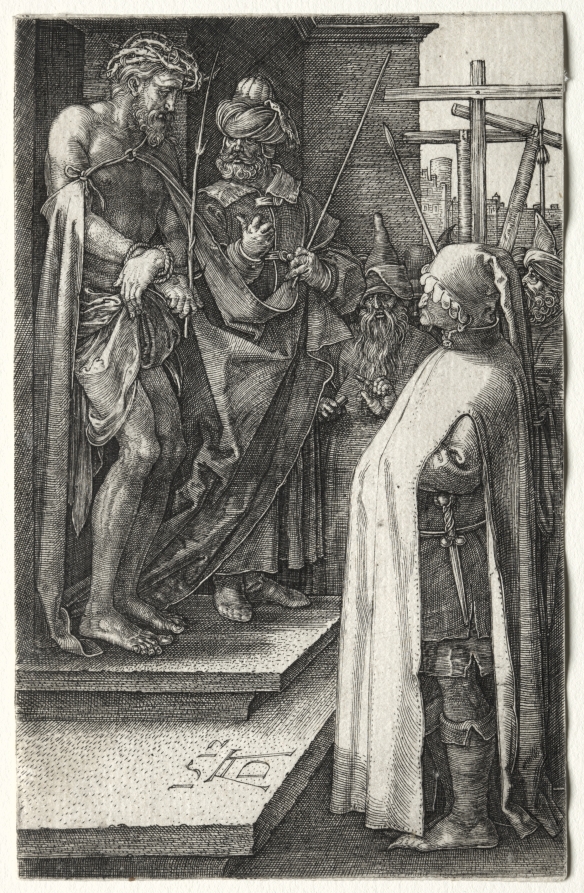
Ecce Homo, Albrecht Dürer, 1515
Albrecht Dürer, portraitAlbrecht DürerAllemagne, 1471–1528

Ecce Homo

1515 · Print

Peut-on la contempler ?

Elle ne reçoit pas en ce moment

Cleveland Museum of Art

Cleveland, États-Unis

Elle appartient à la collection, mais n’est pas présentée en ce moment.

Vérifié
il y a 3 jours
Dans cet état depuis
29 sept. 2026
Source
Le musée
Sur la cartePage du musée

À propos de l’œuvre

This scene of the presentation of Christ to the people, or ecce homo (“behold the man”) from the Engraved Passion series exemplifies Albrecht Dürer’s instinct for the graphic possibilities of the engraved line. Working with a burin on a copperplate, he crossed lines at different angles and varied the thickness of the lines to create dramatic tonal areas and highly descriptive textures. In this closely cropped composition, the focus on Christ’s clenched and pained body as he stands in judgment before a crowd contrasts with the disinterest emanating from the man standing calmly before him.

Cleveland Museum of Art

Notice

1515 · à 44 ans
14711528
Numéro d’inventaire
1921.1168

Ce qu’elle montre

CostumeWeaponsHommeFiguresSoldiers

Au catalogue

EstampesGravure au burinRenaissanceXVIe siècleGermanArt religieuxAllemagne

Allées et venues

  1. Non exposée en ce moment

    Cleveland Museum of Art · 29 sept. 2026 — aujourd’hui · Vérifié

  2. Non exposée en ce moment

    National Gallery of Art · 29 sept. 2026 — 29 sept. 2026 · Vérifié

  3. Non exposée en ce moment

    Cleveland Museum of Art · 28 sept. 2026 — 29 sept. 2026 · Vérifié

  4. Non exposée en ce moment

    National Gallery of Art · 28 sept. 2026 — 28 sept. 2026 · Vérifié

  5. Non exposée en ce moment

    Cleveland Museum of Art · 27 sept. 2026 — 28 sept. 2026 · Vérifié

  6. Non exposée en ce moment

    National Gallery of Art · 26 sept. 2026 — 27 sept. 2026 · Vérifié

  7. Non exposée en ce moment

    Cleveland Museum of Art · 26 sept. 2026 — 26 sept. 2026 · Vérifié

  8. Non exposée en ce moment

    National Gallery of Art · 25 sept. 2026 — 26 sept. 2026 · Vérifié

  9. Non exposée en ce moment

    Cleveland Museum of Art · 19 août 2026 — 25 sept. 2026 · Vérifié

Sources

  • Cleveland Museum of Art
  • Image : Cleveland Museum of Art — Museum open access

Pendant ce temps, chez Albrecht Dürer

La vie entière
  1. 1507–1528 · Lieu de travail

    Nuremberg

  2. 1513–1516

    Three years without painting

    Complaining that painting did not pay enough to justify the time compared with his prints, Dürer produced no paintings from 1513 to 1516.

  3. 1514

    Death of his mother

    In the year of Melencolia I and St Jerome in His Study, the artist's mother, Barbara Holper, died.

  4. 1515

    A life pension from the emperor

    The perpetually cash-strapped Maximilian could not pay on time and offered to exempt the artist from city taxes, which the Nuremberg Council opposed. At Dürer's request the emperor granted him a life pension of 100 guilders a year from the sums Nuremberg paid into the imperial treasury.

  5. 1517

    Joins Nuremberg's circle of reformers

    Dürer joined the circle of Nuremberg reformers led by the Augustinian vicar Johann Staupitz and Wenceslaus Linck. Around 1518 he came to know the writings of Martin Luther, which, he said, had “greatly helped” him.
Autres œuvres : Albrecht Dürer

Toutes les œuvres
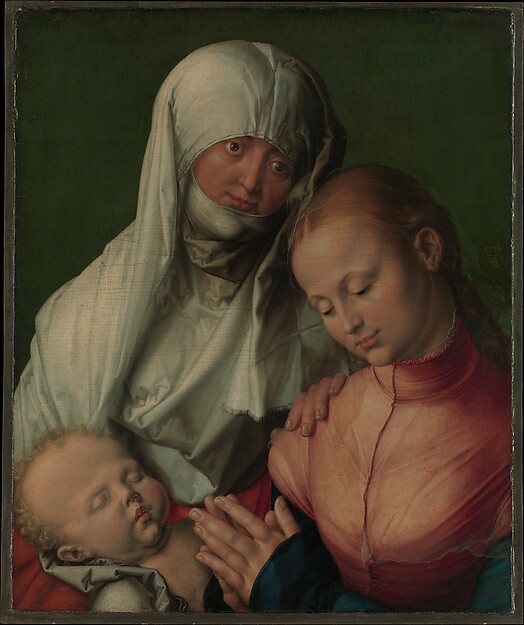
Virgin and Child with Saint Anne, Albrecht Dürer, probably 1519

Virgin and Child with Saint Anne

probably 1519 · Metropolitan Museum of Art

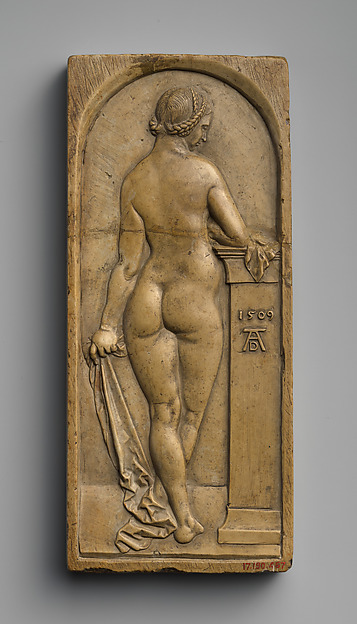
Female Nude Seen from Behind, Albrecht Dürer, early 17th century

Female Nude Seen from Behind

early 17th century · Metropolitan Museum of Art

Madonna and Child [obverse], Albrecht Dürer, c. 1496/1499

Vierge à l'Enfant

c. 1496/1499 · National Gallery of Art

Lot and His Daughters [reverse], Albrecht Dürer, c. 1496/1499

Lot and His Daughters [reverse]

c. 1496/1499 · National Gallery of Art

The Martyrdom of Saint Catherine, Albrecht Dürer, ca. 1498

The Martyrdom of Saint Catherine

ca. 1498 · Metropolitan Museum of Art

Nemesis (The Great Fortune), Albrecht Dürer, c. 1501/1502

Nemesis (The Great Fortune)

c. 1501/1502 · Cleveland Museum of Art

Large Horse, Albrecht Dürer, 1505

Large Horse

1505 · Cleveland Museum of Art

The Lamentation, Albrecht Dürer, 1507

The Lamentation

1507 · Cleveland Museum of Art

Sous le même toit : Cleveland Museum of Art

Page du musée
The Red Kerchief, Claude Monet, c. 1868–73

Claude Monet

The Red Kerchief, c. 1868–73

Melencolia I, Albrecht Dürer, 1514

Albrecht Dürer

Melencolia I, 1514

The Virgin and Child with the Pear, Albrecht Dürer, 1511

Albrecht Dürer

The Virgin and Child with the Pear, 1511

The Nativity, Albrecht Dürer, probably c. 1509/1510

Albrecht Dürer

The Nativity, probably c. 1509/1510

The Virgin and Child on a Crescent with a Starry Crown, Albrecht Dürer, 1508

Albrecht Dürer

The Virgin and Child on a Crescent with a Starry Crown, 1508

The Lamentation, Albrecht Dürer, 1507

Albrecht Dürer

The Lamentation, 1507

Large Horse, Albrecht Dürer, 1505

Albrecht Dürer

Large Horse, 1505

Nemesis (The Great Fortune), Albrecht Dürer, c. 1501/1502

Albrecht Dürer

Nemesis (The Great Fortune), c. 1501/1502

Sur le même thème · Costume

Toutes les œuvres sur ce thème
a) The Last Supper; b) Putti, Vincenzo Tamagni, after Leonardo da Vinci, c. 1515

Leonardo da Vinci

a) The Last Supper; b) Putti, c. 1515

Non exposée · National Gallery of Art

Orphan Man, Standing, Vincent van Gogh, 1882

Vincent van Gogh

Orphan Man, Standing, 1882

Non exposée · National Gallery of Art

Blinded Minotaur Led by a Girl III (Minotaur aveugle guide par une fillette III), Pablo Picasso, 1934

Pablo Picasso

Blinded Minotaur Led by a Girl III (Minotaur aveugle guide par une fillette III), 1934

Non exposée · National Gallery of Art

Rembrandt in a "turban," in "furs," and in the "elephant's eye" (Rembrandt au "turban," aux "fourrures," et à l'oeil d'éléphant"), Pablo Picasso, 1934

Pablo Picasso

Rembrandt in a "turban," in "furs," and in the "elephant's eye" (Rembrandt au "turban," aux "fourrures," et à l'oeil d'éléphant"), 1934

Non exposée · National Gallery of Art

Spartan Envoys (Serment des femmes), Pablo Picasso, 1934

Pablo Picasso

Spartan Envoys (Serment des femmes), 1934

Non exposée · National Gallery of Art

Negotiation between the Athenians and the Spartan Envoys (Accord entre les guerriers de Sparte d'Athenes), Pablo Picasso, 1934

Pablo Picasso

Negotiation between the Athenians and the Spartan Envoys (Accord entre les guerriers de Sparte d'Athenes), 1934

Non exposée · National Gallery of Art

The Reading (La lecture), Pablo Picasso, 1926

Pablo Picasso

The Reading (La lecture), 1926

Non exposée · National Gallery of Art

Acrobat in Repose (Le saltimbanque au repos), Pablo Picasso, 1905, published 1913

Pablo Picasso

Acrobat in Repose (Le saltimbanque au repos), 1905, published 1913

Non exposée · National Gallery of Art