MattaChili, 1911–2002
Drive in the Knife
Peut-on la contempler ?
Oui, elle reçoit

Art Institute of Chicago
Salle397Chicago, États-Unis
Présentée au public. Qui s’en porte garant est indiqué ci-dessous.
- Vérifié
- Dans cet état depuis
- Source
- Le musée
À propos du tableau
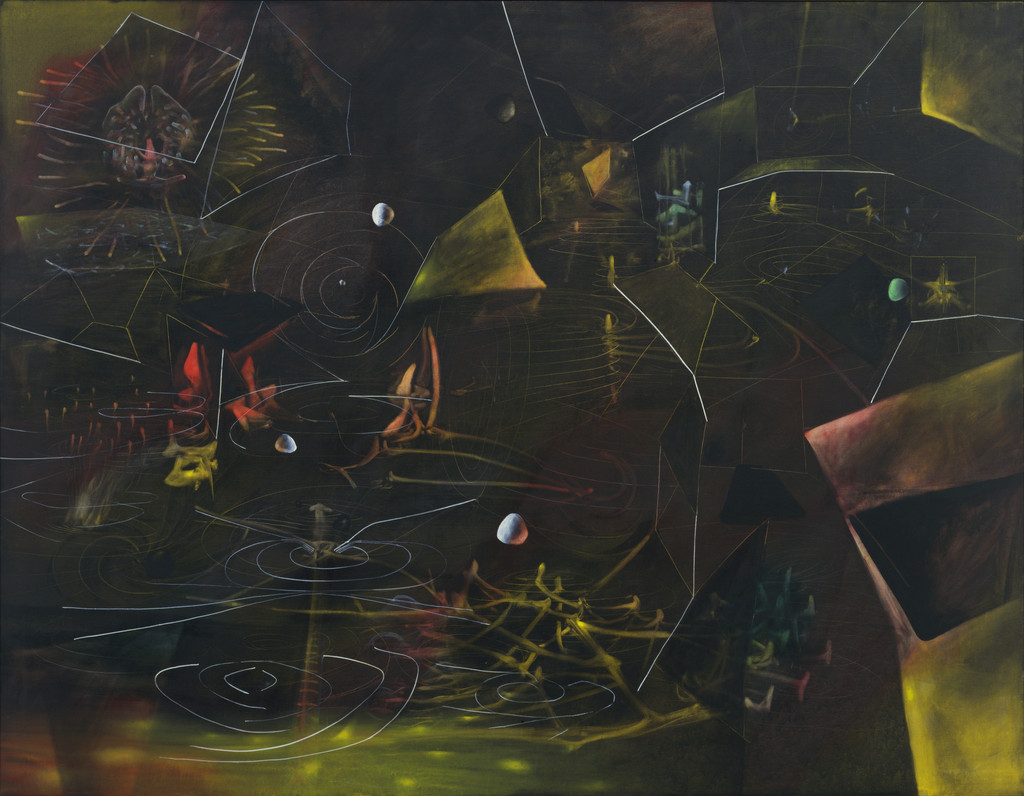
Matta’s idiosyncratic spelling of plenter (for planter), one of the words in the title of this work, is characteristic; he may have had in mind a verbal play on the phrase plenter le drapeau (hoist the flag) as a subversive, antipatriotic gesture. The title otherwise appears to have no direct relation to the image, except to underline its gestural drama, and perhaps to highlight the two solid, axlike shapes that stand out against swirling paint masses and lines.
Lire la suite
This painting can be linked to a series of works, begun in 1942, in which Matta explored the perspectival and spatial ideas in Marcel Duchamp’s great painting on glass, The Bride Stripped Bare by Her Bachelors, Even, also known as The Large Glass (1915–23, Philadelphia Museum of Art; Philadelphia Museum of Art, Handbook of the Collections, 1995, p. 316, ill.). The two artists were particularly close during the World War II period, which they spent, along with other Surrealists, in New York. The Large Glass must lie behind the concept of Les Grands Transparents, the title of Matta’s illustration to Breton’s “Prolegomènes à un troisième manifeste du surréalisme ou non” (VVV 1 [June 1942], pp. 18–26).
In this article Breton spoke of man’s unease in the presence of a cosmic vastness unmediated by the presence of a God, not despairingly but as a salutary recognition of the limits of human rationality and self-importance. In the section subtitled “Les Grands Transparents,” Breton conjured a universe close to Matta’s: “Man is perhaps not the center, the focus of the universe. One may go so far as to believe that there exist above him, on the animal level, beings whose behavior is as alien to him as his own must be to the may-fly or the whale” (ibid., p. 25).
Romy Golan has shown how Matta’s evolving ideas of psychological and metaphorical space during this period draw upon Duchamp’s work (Romy Golan, “Matta Duchamp et le mythe: Un Nouveau Paradigme pour la dernière phase du surréalisme,” in Paris, Musée national d’arte moderne, Matta, 1985, exh. cat., pp. 37–51). The strange, part-human, part-mechanical structure in Duchamp’s 1912 painting Bride (Philadelphia Museum of Art; Pontus Hulten, ed., Marcel Duchamp: Work and Life, Cambridge, Mass., 1993, p. 98, ill.), for instance, may have prompted Matta’s combinations of solid and transparent shapes in paintings of this period. It has also been suggested that the sweeping, weblike lines, prominent in Drive in the Knife, echo the lines of cracks in The Large Glass (Golan, in Paris 1985, p. 42).
This seems a plausible explanation for the odd role of these lines in Matta’s paintings, where they sometimes appear to mimic perspectival marks and at other times appear to wander irrationally in space. This idea of transparency is further emphasized in Drive in the Knife through patches of bare canvas.
— Entry, Dawn Ades, Surrealist Art: The Lindy and Edwin Bergman Collection at the Art Institute of Chicago, 1997, p. 192-93.
Art Institute of ChicagoCC BY 4.0
Notice
- Numéro d’inventaire
- 2018.298
Au catalogue
Sources
- Art Institute of Chicago
- Image : Art Institute of Chicago — © the artist or rights holder