 Winslow HomerÉtats-Unis, 1836–1910
Dressing for the Carnival
Peut-on la voir ?
Oui, exposée actuellement
Où est « Dressing for the Carnival » aujourd’hui ? Metropolitan Museum of Art, Salle 762, New York. Oui, exposée actuellement. Vérifié 29 septembre 2026.

New York, États-Unis
Fermé· ouvre demain à 10:00
Présentée au public.
- Vérifié
- Dans cet état depuis
- Source
- Le musée
À propos du tableau
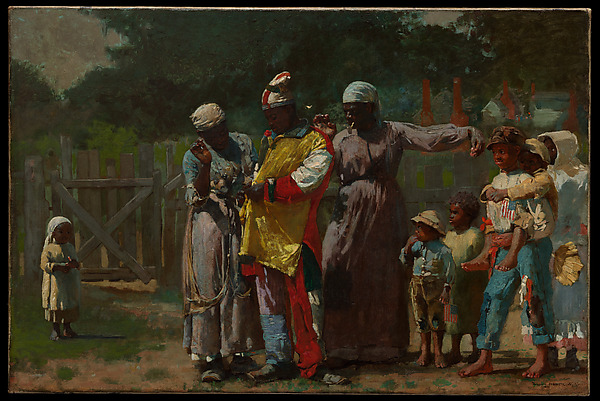
S'habiller pour le carnaval (en anglais, Dressing for The Carnival) est un tableau réalisé en 1877 par le peintre américain Winslow Homer qui y représente des Afro-Américains, et dans laquelle il évite volontairement les stéréotypes dont l’image collective avait été abondamment utilisée pendant la période de la Reconstruction après la guerre de Sécession.
Notice
- Numéro d’inventaire
- 22.220
Ce qu’elle montre
Au catalogue
Sources
- Metropolitan Museum of Art
- Image : Metropolitan Museum of Art — Open Access (CC0)
Dans la vie de Winslow Homer
La vie entière1875
Gives up illustration for painting
In 1875 Homer, after nearly twenty years as an illustrator, quit commercial illustration and vowed to live on his paintings and watercolours alone. Despite his excellent critical reputation, his finances remained precarious.
1876
The Centennial Exposition in Philadelphia
“Snap the Whip” and “Breezing Up” were shown at the Centennial Exposition; the New York Tribune wrote that it could not remember a picture in any exhibition that could be named alongside “Breezing Up”. Henry James confessed that he detested Homer's subjects of the time, yet “to reward his audacity, he has incontestably succeeded”.
c. 1876
Visits to Virginia
Around 1876 Homer visited Petersburg, Virginia (apparently to see what had become of the lives of former slaves), and painted rural African American life, the most unaffected views of it at the time, such as “Dressing for the Carnival” (1877).
1877
First show at the Boston Art Club
In 1877 Homer exhibited at the Boston Art Club for the first time, with the oil painting “An Afternoon Sun”; from then until 1909 he showed there often.
late 1870s
A recluse in Gloucester
In the late 1870s, whether from disappointments with women or some other emotional turmoil, Homer became reclusive, abandoned urban social life and lived instead in Gloucester, for a while even in the secluded Eastern Point Lighthouse with the keeper's family. Watching the fishermen, the sea and the marine weather, he rediscovered his love of the sea and found a rich source of themes in it.
1878
A productive year at Valentine's farm
Homer spent 1878 as the guest of the industrialist Lawson Valentine at Houghton Farm, his property in the Adirondack Mountains, and it proved a particularly productive year. Valentine, whose paint company employed the artist's brother Charles as a chemist, was an early and important collector of Homer's work and later gave him a studio at the farm.