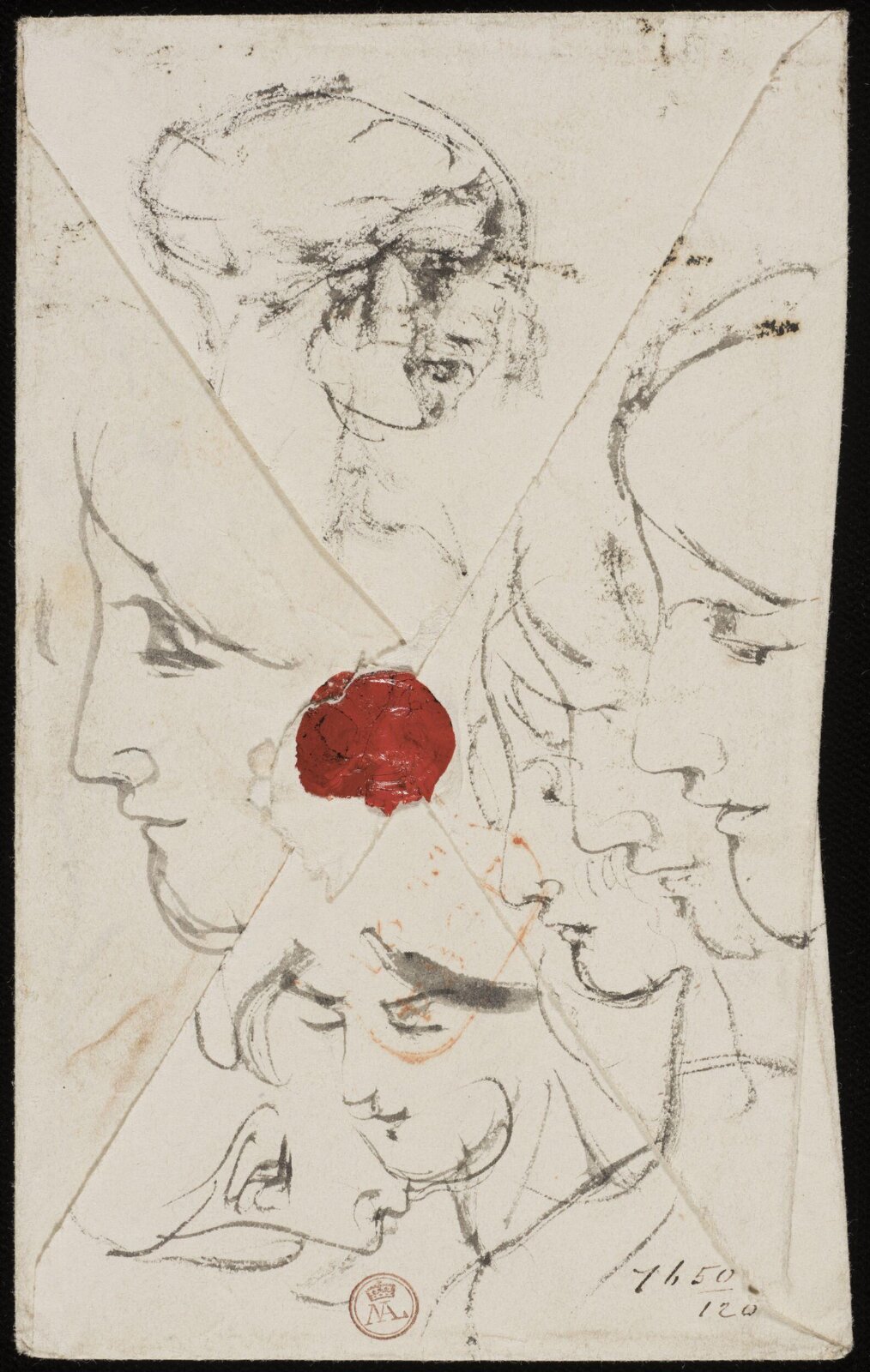
 William EttyRoyaume-Uni, 1787–1849
Drawing
Peut-on la contempler ?
Elle ne reçoit pas en ce moment

Victoria and Albert Museum
Londres, Royaume-Uni
Elle appartient à la collection, mais n’est pas présentée en ce moment.
- Vérifié
- il y a 8 jours
- Dans cet état depuis
- 25 sept. 2026
- Source
- Les données de collection du musée lui-même
Notice
- Numéro d’inventaire
- 7650:120
Au catalogue
Sources
- Victoria and Albert Museum: the museum's own open data · obtenue il y a 8 jours
- Image : Victoria and Albert Museum — © Victoria and Albert Museum, London
Pendant ce temps, chez William Etty
La vie entière1818
Disqualified from an Academy competition
In 1818 Etty entered in an Academy painting competition a copy of Damiano Mazza’s “The Rape of Ganymede”, then thought to be by Titian, and was easily the best entrant, but two other contestants complained that he had briefly removed the painting from Academy premises to work on it at home and that he was technically a professional, and he was disqualified. The quality of the work only raised his prestige; by 1818 he had hired an assistant, George Henry Franklin, though he still lived on gifts from his brother.
1820
Freeling commissions “Cleopatra”
Sir Francis Freeling, who had admired “The Coral Finder” at the exhibition, learned that it was already sold and commissioned from Etty a similar picture on a more ambitious scale for 200 guineas. Etty had for some time been musing on a painting of Cleopatra and based it loosely on the composition of “The Coral Finder”.
early 1822
The Times accuses Etty of indecency
“A Sketch from One of Gray’s Odes”, exhibited in January 1822 with its nude figures on a boat, drew fire, like “Cleopatra”, for Etty’s treatment of the female nude: The Times warned him against a style that could gratify only the most vicious taste. Possibly alarmed by the criticism, Freeling persuaded Etty to paint clothes onto some of the figures in “Cleopatra”, though in 1829 he allowed the picture to be returned to its original state.
23 June 1822
Sets out for Italy with Richard Evans
Remembering the homesickness of his last journey, Etty travelled this time with Richard Evans, who had also studied under Lawrence; despite warnings of the heat, they set out on 23 June 1822 aiming to reach Rome. They crossed to France by the recently developed steamboat, reached Paris on 26 June and spent two weeks visiting Versailles and the galleries; Etty was most impressed by Rubens’s Marie de’ Medici cycle, elements of which he later reused in many of his own works.
10 August 1822
Rome: the Sistine Chapel and Canova
Passing through Dijon, Switzerland, Milan (where they saw Leonardo’s Last Supper and the Brera Gallery) and Florence, Etty and Evans reached Rome on 10 August 1822. Somewhat disappointed by the city, Etty was highly impressed by Michelangelo’s “almost Venetian” colour in the Sistine Chapel and, on Lawrence’s recommendation, met Antonio Canova shortly before the sculptor’s death.
1822–1823
Seven months in Venice
Feeling unsettled in Rome, Etty went to Venice intending to stay ten days, but with a letter of introduction from Charles Lock Eastlake he was taken into the house of Harry D’Orville, the British vice consul, and remained for over seven months. Long convinced that Venice was his spiritual home, he copied paintings in Venetian collections by day and attended the Academy’s life class by night, producing around 50 oil paintings and numerous pencil sketches.