Drawing
Peut-on la contempler ?
Elle ne reçoit pas en ce moment

Victoria and Albert Museum
Londres, Royaume-Uni
Elle appartient à la collection, mais n’est pas présentée en ce moment.
- Vérifié
- il y a 9 jours
- Dans cet état depuis
- 25 sept. 2026
- Source
- Les données de collection du musée lui-même
À propos de l’œuvre
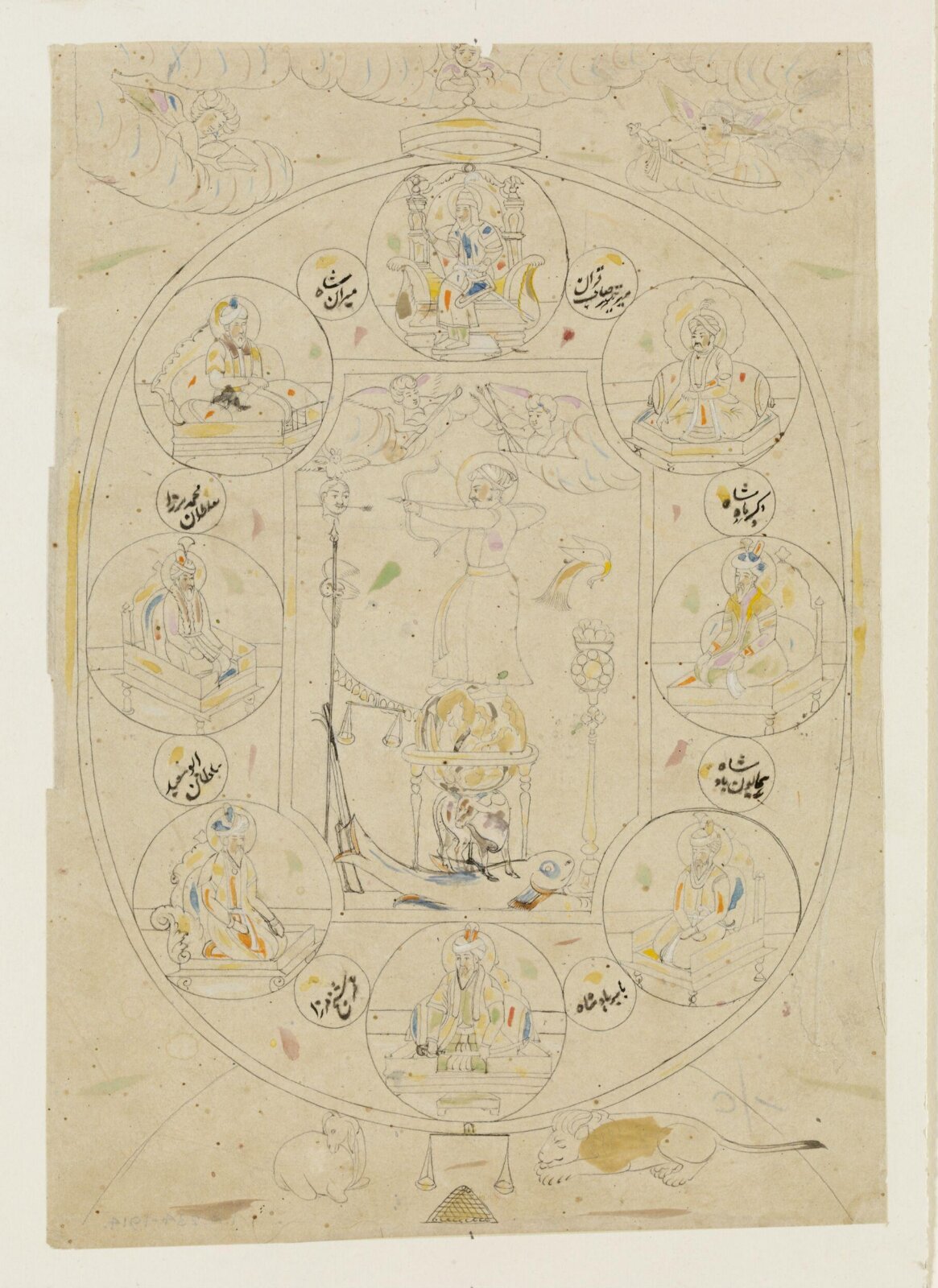
This 19th century Indian drawing is adapted from a painting done for the Mughal emperor Jahangir (r. 1605-1627) between about 1616 and 1620. The original, now in the Chester Beatty Library in Dublin, belongs to a series of allegorical subjects. It represents the emperor shooting an arrow at the head of his major enemy, Malik Ambar. This former slave of African origin had risen to be the effective ruler of the Deccan sultanate of Ahmadnagar. Jahangir was enraged by Malik Ambar's ability to repel the Mughal army, which had made many attacks on this and other sultanates of the Deccan. One of Jahangir's leading artists created a painting in which the emperor symbolically puts an end to his foe, whom neither Jahangir nor the artist had every seen. Every element of the composition has a meaning. The globe on which the emperor stands alludes to his name, which means 'Seizer of the World'.
Read on
The golden chain linking the standard bearing Malik 'Ambar's head to the globe alludes to the 'chain of justice' attached to the palace walls on Jahangir's orders. Those who had been denied justice could, in theory, pull it to attract the attention of the emperor and bring their case before him. In the 19th century version, additional figures in roundels surround the composition. They are identified by Persian inscriptions in black ink, and trace Jahangir's royal lineage back to Timur, the Central Asian ruler. The cherubs hovering above his head hold emblems of royalty. This drawing indicates the colours to be used when the composition has been transferred by pouncing onto a separate sheet. A finished version of the V&A model, painted by Ghulam Ali Khan, is in the San Diego Museum, and is part of the Edwin Binney 3rd collection (1990.409).
Victoria and Albert Museum
Notice
- Numéro d’inventaire
- IM.284-1914
What it shows
Au catalogue
Sources
- Victoria and Albert Museum: the museum's own open data · obtenue il y a 9 jours
- Image : Victoria and Albert Museum — © Victoria and Albert Museum, London