ART WIKI33 040 en salle
CarteCollectionArtistesMuséesExpositionsJournal
Connexion

ART WIKI

Où est accroché le chef-d’œuvre, et quand on vous laisse entrer.

Collections : Art Institute of Chicago, Cleveland Museum of Art, Galerie Tretiakov, Hirshhorn Museum and Sculpture Garden, J. Paul Getty Museum, Metropolitan Museum of Art, Minneapolis Institute of Art, Musée de l'Ermitage, Musée des Beaux-Arts Pouchkine, Musée du Louvre, musée national d'art asiatique, Musée russe, Musées d'Art de Harvard, Museum of Modern Art, National Gallery of Art, National Portrait Gallery, Rijksmuseum Amsterdam, Smithsonian American Art Museum, Statens Museum for Kunst, Victoria and Albert Museum, Villa Getty, Whitney Museum of American Art, Catalogue d’État du fonds muséal de Russie (274 musées), Europeana (19 musées), Wikidata (6 musées), Paris Musées (12 musées) et Joconde, la base des musées du ministère de la Culture (495 musées). Les images appartiennent à leurs ayants droit.

Rubriques

  • Carte
  • Recherche
  • Collection
  • Chefs-d’œuvre
  • Exposées en ce moment
  • Artistes

Et aussi

  • Musées et galeries
  • Expositions
  • Journal
  • D’où viennent les données
  • Confidentialité et cookies
AccueilCarteCatalogue
  1. Collection/
  2. Musée Herzog Anton Ulrich/
  3. Die Sieben Freien Künste
Die Sieben Freien Künste, Cornelis van Haarlem, 1582–1615
Cornelis Cornelisz. van Haarlem, portraitCornelis Cornelisz. van HaarlemPays-Bas, 1562–1638

Die Sieben Freien Künste

1582–1615 · Drawing

Peut-on la contempler ?

Inconnu

Musée Herzog Anton Ulrich

Brunswick, Allemagne

Le propriétaire est connu ; on ignore si l’œuvre est exposée aujourd’hui.

Dans cet état depuis
27 sept. 2026
Source
Le musée
Sur la cartePage du musée

Notice

1582–1615
15621638

Ce qu’elle montre

AllegoryArithmetikLivreKugelRhetorikMusikMusikinstrumentPfeilSchreibende(r)GrammatikZirkelDialektik

Au catalogue

Dessins et aquarellesRenaissanceXVIe siècle

Sources

  • Musée Herzog Anton Ulrich
  • Image : Musée Herzog Anton Ulrich — CC BY-NC-SA 4.0

Pendant ce temps, chez Cornelis Cornelisz. van Haarlem

La vie entière
  1. 1579–1580

    Trip to France

    He tries to train in Rouen and comes under the influence of the French Renaissance painters of the Fontainebleau school, but is forced to leave.

  2. 1581

    With Gillis Coignet in Antwerp

    Having left France, he enters the workshop of Gillis Coignet in Antwerp as an apprentice, according to Karel van Mander’s Book of Painters.

  3. 1583

    First official commission from the city

    He receives his first official commission from the city, a group portrait, “The Banquet of the Haarlem Civic Guard”. He became Haarlem’s city painter and received many official commissions; as a portraitist he had a great influence on Frans Hals.

  4. 1583

    Returns to Haarlem

    He returns to Haarlem, where he stays for the rest of his life, and brings home from Antwerp the drawings of Bartholomeus Spranger, a leading figure of Antwerp Mannerism, under whose influence he works in his first years.

  5. 1587

    Founds an academy of art

    Together with Karel van Mander and Hendrick Goltzius he founds in Haarlem an academy of art, also called the Academy of the Haarlem Mannerists, from which several skilled painters emerged.

  6. c. 1600

    Marries Maritgen Deyman

    He marries Maritgen Deyman, the daughter of the mayor of Haarlem.

Autres œuvres : Cornelis Cornelisz. van Haarlem

Toutes les œuvres
De kindermoord in Bethlehem, Cornelis Cornelisz. van Haarlem, 1590

De kindermoord in Bethlehem

1590 · Rijksmuseum Amsterdam

De zondeval, Cornelis Cornelisz. van Haarlem, 1592

De zondeval

1592 · Rijksmuseum Amsterdam

Bathsheba at her Toilet, Cornelis Cornelisz. van Haarlem, 1594

Bathsheba at her Toilet

1594 · Rijksmuseum Amsterdam

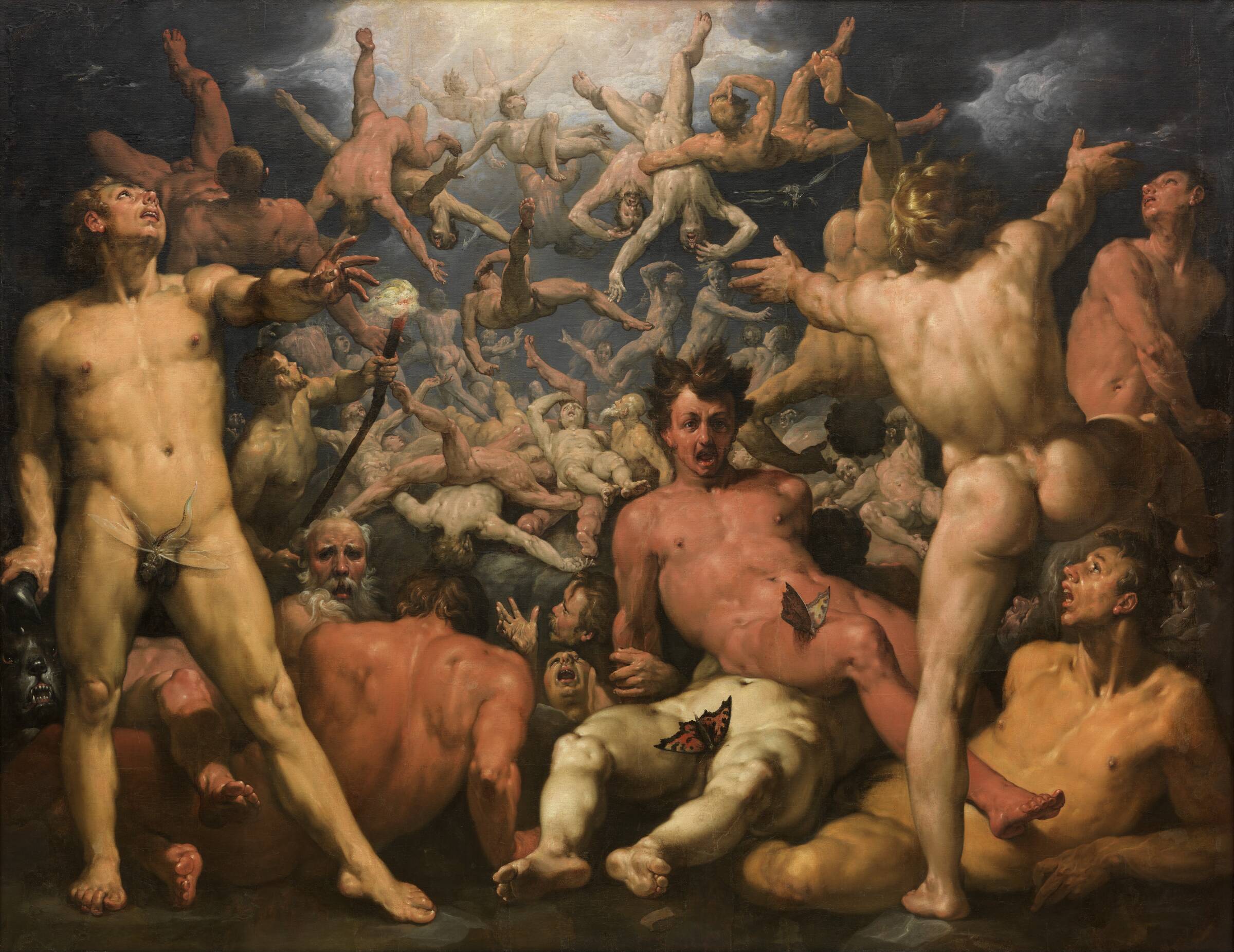
Titanernes fald, Cornelis Cornelisz. van Haarlem, 1588-1590

La Chute des Titans

1588-1590 · Statens Museum for Kunst

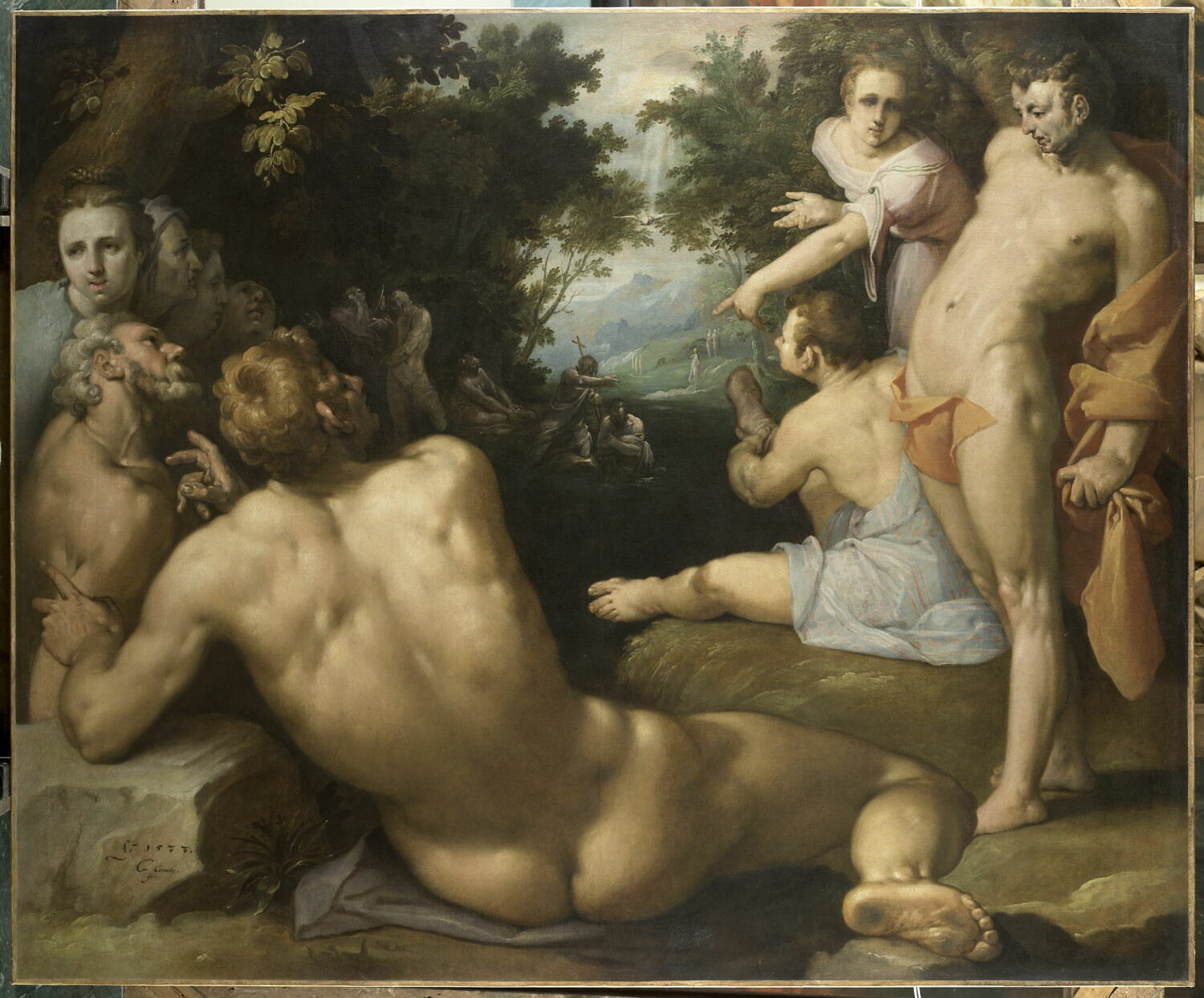
Le Baptême du Christ, 1588, Cornelis, van Haarlem, 4e quart du XVIe siècle (1588)

Le Baptême du Christ, 1588

4e quart du XVIe siècle (1588) · Musée du Louvre

Bacchus and Satyr, Cornelis Cornelisz. van Haarlem, 1618

Bacchus and Satyr

1618 · Musée de l'Ermitage

Staand mannelijk naakt met zwevende draperie, Cornelis Cornelisz. van Haarlem, 1572 - 1638

Staand mannelijk naakt met zwevende draperie

1572 - 1638 · Rijksmuseum Amsterdam

Ein Mönch und eine Begine ("Schwangerschaftsprobe"), Cornelis van Haarlem

Ein Mönch und eine Begine ("Schwangerschaftsprobe")

Kupferstich-Kabinett

De la collection : Musée Herzog Anton Ulrich

Page du musée
Portrait d'Adolphe de Vignacourt Grand Maître de Malthe, Caravaggio, 1704–1755

Caravaggio

Portrait d'Adolphe de Vignacourt Grand Maître de Malthe, 1704–1755

Ecce Homo, Caravaggio, 1674–1684

Caravaggio

Ecce Homo, 1674–1684

Heiliger Hieronymus, Caravaggio

Caravaggio

Heiliger Hieronymus

Bildnis eines Mannes, Rembrandt, 1839–1850

Rembrandt van Rijn

Bildnis eines Mannes, 1839–1850

Bildnis einer Frau, Rembrandt, 1839–1850

Rembrandt van Rijn

Bildnis einer Frau, 1839–1850

Tobias und seine Frau, Rembrandt, 1773

Rembrandt van Rijn

Tobias und seine Frau, 1773

Tobias und seine Frau, Rembrandt, 1773

Rembrandt van Rijn

Tobias und seine Frau, 1773

Lot mit seinen Töchtern, Rembrandt, 1771

Rembrandt van Rijn

Lot mit seinen Töchtern, 1771

Sur le même thème · Allegory

Toutes les œuvres sur ce thème
Blind Minotaur Led by Marie-Thérèse with a Dove in a Starry Night (Minotaure aveugle guidé par Marie-Thérèse au pigeon dans une nuit étoilée), Pablo Picasso, 1934

Pablo Picasso

Blind Minotaur Led by Marie-Thérèse with a Dove in a Starry Night (Minotaure aveugle guidé par Marie-Thérèse au pigeon dans une nuit étoilée), 1934

Non exposée · National Gallery of Art

Blind Minotaur Led by Marie-Thérèse with a Dove in a Starry Night (Minotaure aveugle guidé par Marie-Thérèse au pigeon dans une nuit étoilée), Pablo Picasso, 1934

Pablo Picasso

Blind Minotaur Led by Marie-Thérèse with a Dove in a Starry Night (Minotaure aveugle guidé par Marie-Thérèse au pigeon dans une nuit étoilée), 1934

Non exposée · National Gallery of Art

Blind Minotaur Led by Marie-Thérèse with a Dove in a Starry Night (Minotaure aveugle guidé par Marie-Thérèse au pigeon dans une nuit étoilée), Pablo Picasso, 1934

Pablo Picasso

Blind Minotaur Led by Marie-Thérèse with a Dove in a Starry Night (Minotaure aveugle guidé par Marie-Thérèse au pigeon dans une nuit étoilée), 1934

Non exposée · National Gallery of Art

Blind Minotaur Led by Marie-Thérèse with a Dove in a Starry Night (Minotaure aveugle guidé par Marie-Thérèse au pigeon dans une nuit étoilée), Pablo Picasso, 1934

Pablo Picasso

Blind Minotaur Led by Marie-Thérèse with a Dove in a Starry Night (Minotaure aveugle guidé par Marie-Thérèse au pigeon dans une nuit étoilée), 1934

Non exposée · National Gallery of Art

[Das Schiff des Glücks; The Ship of Fortune; La fortune contraire], Rembrandt, 1633

Rembrandt van Rijn

[Das Schiff des Glücks; The Ship of Fortune; La fortune contraire], 1633

Musée Herzog Anton Ulrich

[Das Schiff des Glücks; The Ship of Fortune; La fortune contraire], Rembrandt, 1633

Rembrandt van Rijn

[Das Schiff des Glücks; The Ship of Fortune; La fortune contraire], 1633

Musée Herzog Anton Ulrich

Diorama Exhibition Poster, Edvard Munch, 1910

Edvard Munch

Diorama Exhibition Poster, 1910

Non exposée · National Gallery of Art

Woman Holding a Balance, Johannes Vermeer, c. 1664

Johannes Vermeer

La Femme à la balance, c. 1664

National Gallery of Art