 Jacques-Louis DavidFrance, 1748–1825
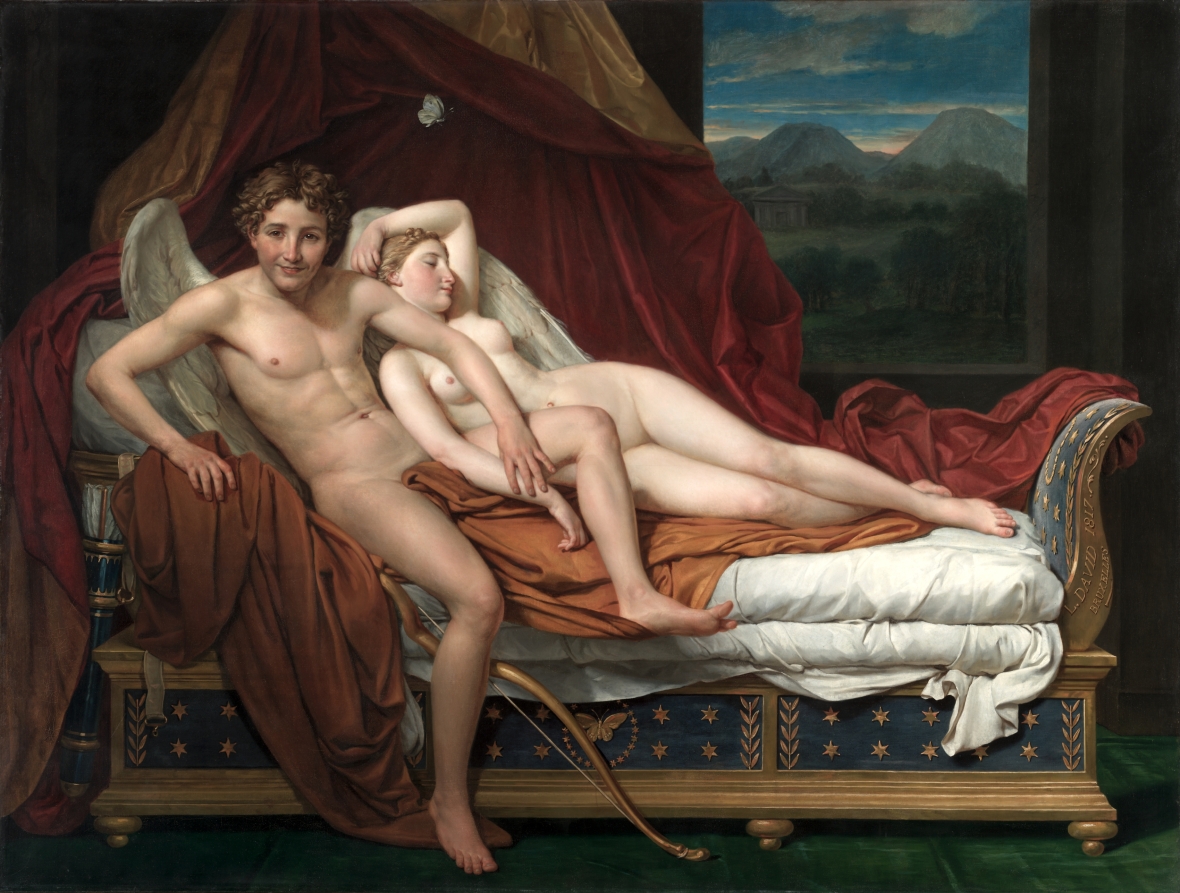
L'Amour et Psyché
Cupid and Psyche
Peut-on la contempler ?
Oui, elle reçoit

Présentée au public.
- Vérifié
- Dans cet état depuis
- Source
- Le musée
À propos du tableau
L'Amour et Psyché (aussi intitulé Cupidon et Psyché) est un tableau peint par Jacques-Louis David en 1817 durant sa période d'exil à Bruxelles. Lors de sa première exposition au musée de Bruxelles, le tableau surprit les contemporains par le traitement réaliste voire trivial de la figure de l'Amour. Peint pour le mécène et collectionneur Gian Battista Sommariva, le tableau fait partie depuis 1962 des collections du Cleveland Museum of Art.
Selon le musée
David used the story of Cupid and Psyche to explore the conflict between idealized love and physical reality. Cupid, lover of the beautiful mortal Psyche, visited her nightly on the condition that she not know his identity. Cupid was usually depicted as an ideal adolescent, but here David presents him as an ungainly teenager smirking at his sexual conquest. David took inspiration from a number of ancient texts, including an obscure, recently published Greek poem by Moschus that describes Cupid as a mean-spirited brat with flashing eyes and curly hair.
Cleveland Museum of Art
Notice
- Numéro d’inventaire
- 1962.37
Au catalogue
Allées et venues
Exposée · 201 Neoclassical Painting & Sculpture
Cleveland Museum of Art · 28 sept. 2026 — aujourd’hui · Vérifié
Était exposée · 201 French Neoclassical Painting & Sculpture
Cleveland Museum of Art · 19 août 2026 — 28 sept. 2026 · Vérifié
Sources
- Cleveland Museum of Art
- Image : Cleveland Museum of Art — Museum open access
Pendant ce temps, chez Jacques-Louis David
La vie entière1815
Flees to Switzerland after Waterloo
After Bonaparte’s defeat at Waterloo and the Bourbon restoration he was forced to flee to Switzerland; in August of the same year he returned to France.
1815
Napoleon visits David during the Hundred Days
During the Hundred Days Napoleon visited the painter and awarded him the commander’s cross of the Legion of Honour.
1816
Exile: moves to Brussels
Exiled from France for his part in the king’s execution, despite the intercession of the police minister Élie Decazes, he settled in Brussels, where he lived for the rest of his life.
1816–1825
The Brussels years: pupils and smaller works
He trained and influenced Brussels artists such as François-Joseph Navez and Ignace Brice, painted “Cupid and Psyche,” smaller mythological scenes, portraits of Brussels citizens and Napoleonic émigrés, and, towards the end of his life, a portrait of his old friend Abbé Sieyès.