ART WIKI32 963 en salle
CarteCollectionArtistesMuséesExpositionsJournal
Connexion

ART WIKI

Où est accroché le chef-d’œuvre, et quand on vous laisse entrer.

Collections : Art Institute of Chicago, Cleveland Museum of Art, Galerie Tretiakov, Hirshhorn Museum and Sculpture Garden, J. Paul Getty Museum, Metropolitan Museum of Art, Minneapolis Institute of Art, Musée de l'Ermitage, Musée des Beaux-Arts Pouchkine, Musée du Louvre, musée national d'art asiatique, Musée russe, Musées d'Art de Harvard, Museum of Modern Art, National Gallery of Art, National Portrait Gallery, Rijksmuseum Amsterdam, Smithsonian American Art Museum, Statens Museum for Kunst, Victoria and Albert Museum, Villa Getty, Whitney Museum of American Art, Catalogue d’État du fonds muséal de Russie (274 musées), Europeana (19 musées), Wikidata (6 musées), Paris Musées (12 musées) et Joconde, la base des musées du ministère de la Culture (495 musées). Les images appartiennent à leurs ayants droit.

Rubriques

  • Carte
  • Recherche
  • Collection
  • Chefs-d’œuvre
  • Exposées en ce moment
  • Artistes

Et aussi

  • Musées et galeries
  • Expositions
  • Journal
  • D’où viennent les données
  • Confidentialité et cookies
AccueilCarteCatalogue
  1. Collection/
  2. J. Paul Getty Museum/
  3. L'Entrée du Christ à Bruxelles
L'Entrée du Christ à Bruxelles, Ensor, James, 1888

L'Entrée du Christ à Bruxelles

Christ's Entry into Brussels in 1889

1888 · Painting · 252.6 × 431 cm

À propos du tableau

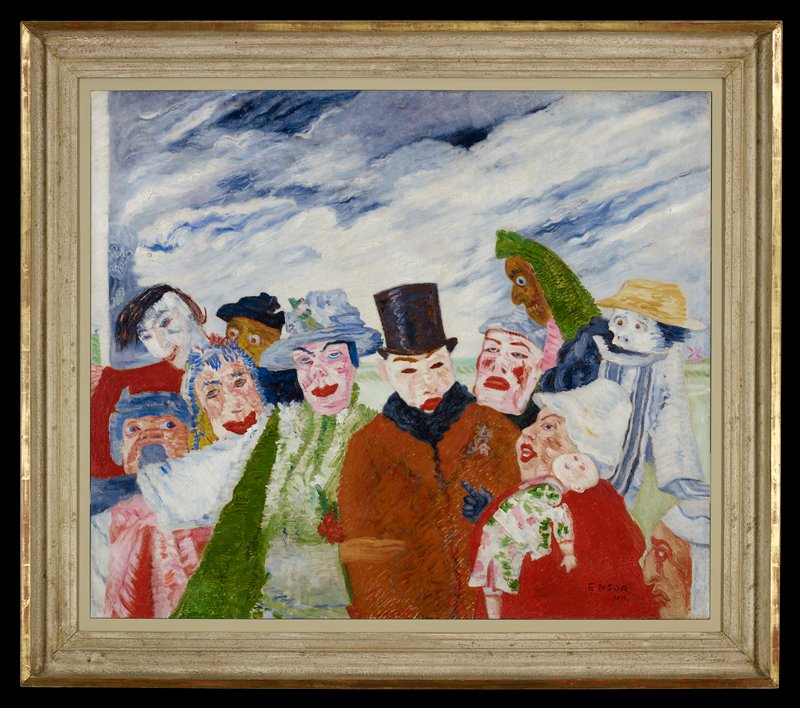
James Ensor took on religion, politics, and art in this scene of Christ entering contemporary Brussels in a Mardi Gras parade. In response to the French pointillist style, Ensor used palette knives, spatulas, and both ends of his brush to put down patches of colors with expressive freedom. He made several preparatory drawings for the painting, including one in the J. Paul Getty Museum's collection. Ensor's society is a mob, threatening to trample the viewer--a crude, ugly, chaotic, dehumanized sea of masks, frauds, clowns, and caricatures. Public, historical, and allegorical figures, along with the artist's family and friends, make up the crowd. The haloed Christ at the center of the turbulence is in part a self-portrait: mostly ignored, a precarious, isolated visionary amidst the herdlike masses of modern society.

Lire la suite

Ensor's Christ functions as a political spokesman for the poor and oppressed--a humble leader of the true religion, in opposition to the atheist social reformer Emile Littré, shown in bishop's garb holding a drum major's baton and leading on the eager, mindless crowd. After rejection by *Les XX,* the artists' association that Ensor had helped to found, the painting was not exhibited publicly until 1929. Ensor displayed *Christ's Entry* prominently in his home and studio throughout his life. With its aggressive, painterly style and merging of the public with the deeply personal, *Christ's Entry* was a forerunner of twentieth-century Expressionism.

Pendant ce temps, chez Ensor, James

La vie entière
  1. 1860–1949 · Lieu de travail

    Ostend

  2. 1880s

    Brief trips to France and the Netherlands

    Ensor travelled very little: in the 1880s, just three brief trips to France and two to the Netherlands.

  3. 1883–1893 · Adhésion

    Les XX

  4. 1887

    Death of his father

    His father, James Frederic Ensor, died — a scion of a wealthy English family who never found his footing in Belgium, mocked by small-town Ostend as a drunkard and failure, yet always supportive of his son's passion for art. Left the only man in the family, James felt a special responsibility for his younger sister Mariette (Mitche).

  5. 1888–1892

    Turning-point years: the Passion of Christ

    Ensor turned to religious themes, most often the torments of Christ, expressing through them his disgust at the inhumanity of the world; an atheist, he identified with Christ as a victim of mockery. At the height of his creative powers, between 1886 and 1891, he made 86 of his 133 etchings.

Autres œuvres : Ensor, James

Toutes les œuvres

Dans la même salle · Museum West Pavilion, Gallery W103, J. Paul Getty Museum

Page du musée
JPG
J. Paul Getty Museum

Notice

1888 · à 28 ans
18601949
Numéro d’inventaire
87.PA.96

Sources

  • J. Paul Getty Museum
  • Image : J. Paul Getty Museum — Open Content
Ensor, James, portraitEnsor, JamesBelgique, 1860–1949

Peut-on la contempler ?

Oui, elle reçoit

JPG
J. Paul Getty Museum

Los Angeles, États-Unis

SalleMuseum West Pavilion, Gallery W103

Présentée au public. Qui s’en porte garant est indiqué ci-dessous.

Vérifié
avant-hier
Dans cet état depuis
5 oct. 2026
Source
Le musée
Sur la cartePage du musée
The Intrigue, James Ensor, 1911

The Intrigue

1911 · Minneapolis Institute of Art

Comical Repast (Feast of the Lean), James Ensor, ca. 1917–18

Comical Repast (Feast of the Lean)

ca. 1917–18 · Metropolitan Museum of Art

Still Life with Fish and Shells, James Ensor, 1898

Still Life with Fish and Shells

1898 · Art Institute of Chicago

The Riding Crop, James Ensor

The Riding Crop

Non exposée · National Gallery of Art

Phantastisches Stillleben, James Ensor

Phantastisches Stillleben

Österreichische Galerie Belvedere

Stillleben mit blauer Flasche und gerupftem Huhn, James Ensor

Stillleben mit blauer Flasche und gerupftem Huhn

Österreichische Galerie Belvedere

Blumenkorb, James Ensor

Blumenkorb

Albertina

Profilbild einer sitzenden Frau, James Ensor

Profilbild einer sitzenden Frau

Albertina

Torso of a Crouching Woman, Camille Claudel, model about 1884–1885; cast by 1913

Camille Claudel

Torso of a Crouching Woman, model about 1884–1885; cast by 1913

Portrait of Nadine Dumas (Madame Alexandre Dumas Fils 1827 - 1875), Jean-Baptiste Carpeaux, 1873–1875

Jean-Baptiste Carpeaux

Portrait of Nadine Dumas (Madame Alexandre Dumas Fils 1827 - 1875), 1873–1875

Bust of Jean Léon Gérôme (1824 - 1904), Jean-Baptiste Carpeaux, 1872–1873

Jean-Baptiste Carpeaux

Bust of Jean Léon Gérôme (1824 - 1904), 1872–1873

Dancer, Paolo Troubetzkoy, model 1909; cast 1912

Prince Paolo Troubetskoy

Dancer, model 1909; cast 1912

Model for a Monument to Alexandre Dumas, père (1802 - 1870), Albert-Ernest Carrier-Belleuse, about 1883

Albert-Ernest Carrier-Belleuse

Model for a Monument to Alexandre Dumas, père (1802 - 1870), about 1883

Head of St. John the Baptist, Jean-Baptiste (called Joanny) Chatigny, 1869

Jean-Baptiste (called Joanny) Chatigny

Head of St. John the Baptist, 1869

Christ and Mary Magdalene, Auguste Rodin, 1908

Auguste Rodin

Christ and Mary Magdalene, 1908

Bust of Christ, Constantin Meunier, 1900

Constantin Meunier

Bust of Christ, 1900

Au catalogue

PeinturesHuileImpressionnismeXIXe siècleBelgique