Arshile GorkyÉtats-Unis, 1904–1948
Carnival
Peut-on la contempler ?
Oui, elle reçoit

Art Institute of Chicago
Salle397Chicago, États-Unis
Présentée au public. Qui s’en porte garant est indiqué ci-dessous.
- Vérifié
- Dans cet état depuis
- Source
- Les données de collection du musée lui-même
À propos de l’œuvre
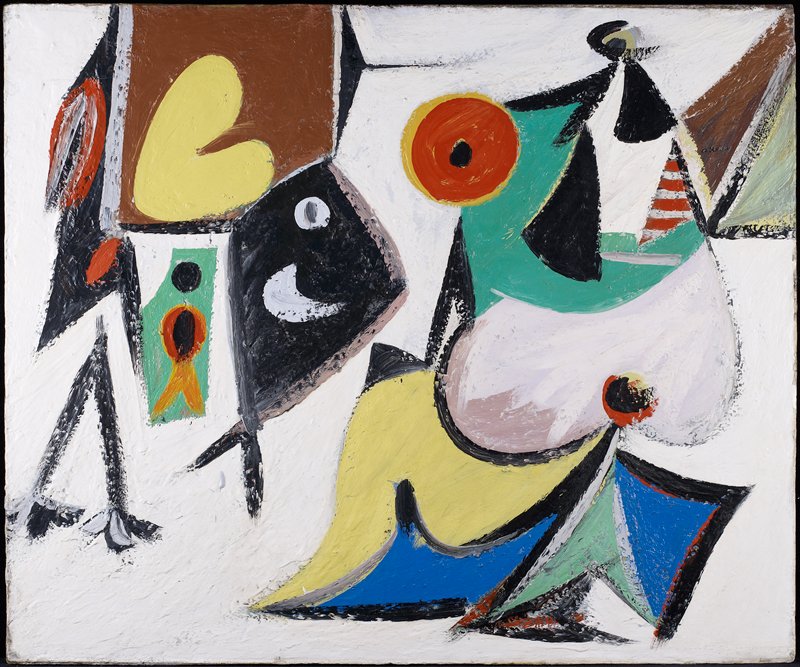
According to Jim Jordan, this drawing was "undoubtly the inspiration" for the painting known as Virginia Landscape, also of 1943 (fig. 2; Jordan and Goldwater 1982, pp. 82-83). It belongs to a moment when, staying on his in-laws' farm in Virginia in 1943, Gorky turned to nature and nature's creative forces as a point of reference. André Breton's 1945 celebration of Gorky contains a still-timely warning, however, against making too literal a reading o a landscape in his work:
Read on
"Those who love easy solutions will find slim pickings here: despite all warnings, they will continue in their attempts to discover still lifes, landscapes, and figurations in these compositions, simply because they do not have the courage to recognize the fact that all human emotions tend to be precipitated in hybird forms. By "hybird" I mean to signify the end result produced by the contemplation of a natural spectacle blended with the flux of childhood and other memories provoked by intense concentration upon this spectacle by an observer endowed with quite exceptional emotional gifts. It should, indeed, be emphasized that Gorky is unique among Surrealists painters in remaining in direct contact with nature by standing in front of it in order to paint.
He is not concerned, however, with translating nature as an end in itself, but rather with extrating from its sensations capable of acting as springboards towards the deepening, in terms of consciousness as much as of enjoyment, of certain spiritual states." (André Breton, "Arshile Gorky," in Surrealism and Painting, tr. by Simon Watson Taylor, New York, 1972, p. 200)
Gorky's interst in Joan Miró is apparent here, though it would not be easy to pin down specific sources for Carnival. Willem de Kooning recalled that Gorky expressed admiration for Miró's Still Life with Old Shoe (1937, New York, The Museum of Modern Art; New York, The Museum of Modern Art, Joan Miró. 1993-94, exh. cat. by Carolyn Lanchner, no. 145, ill.), which was shown by Pierre Matisse in the late 1930s (Jordan and Goldwater 1982 p. 75). Like many works by Gorky, Carnival is a composite of memories, experiences, and associations—both personal and artistic—powered by the tension between precisely outlined bud- and bodylike forms, and free, gestural passages. As Diane Waldman has written, Gorky could be described as "the last Surrealist and the first Abstract Expressionist" (New York 1981-82, p. 60)
— Entry, Dawn Ades, Surrealist Art: The Lindy and Edwin Bergman Collection at the Art Institute of Chicago, 1997, p. 142-143.
Art Institute of ChicagoCC BY 4.0
Notice
- Numéro d’inventaire
- 1999.937
Au catalogue
Sources
- Art Institute of Chicago: the museum's own open data · obtenue il y a 7 jours
- Image : Art Institute of Chicago — © the artist or rights holder
Pendant ce temps, chez Arshile Gorky
La vie entière1941
Begins working in his own style
From 1941 Gorky worked in a style of his own, combining abstract forms with a fluid painterly manner.
1941
Exhibition at the San Francisco Museum of Art
The San Francisco Museum of Art organized an exhibition of Gorky’s work.
1941
Married: Agnes Magruder
1941
Meets Agnes Magruder
Gorky met Agnes Ethel Magruder, daughter of Admiral John Holmes Magruder Jr., and soon nicknamed her “Mougouch”, an Armenian term of endearment.
5 avril 1943
Daughter born: Maro Gorky
1944
Meets André Breton and the Surrealists
Gorky met André Breton and other well-known Surrealists.