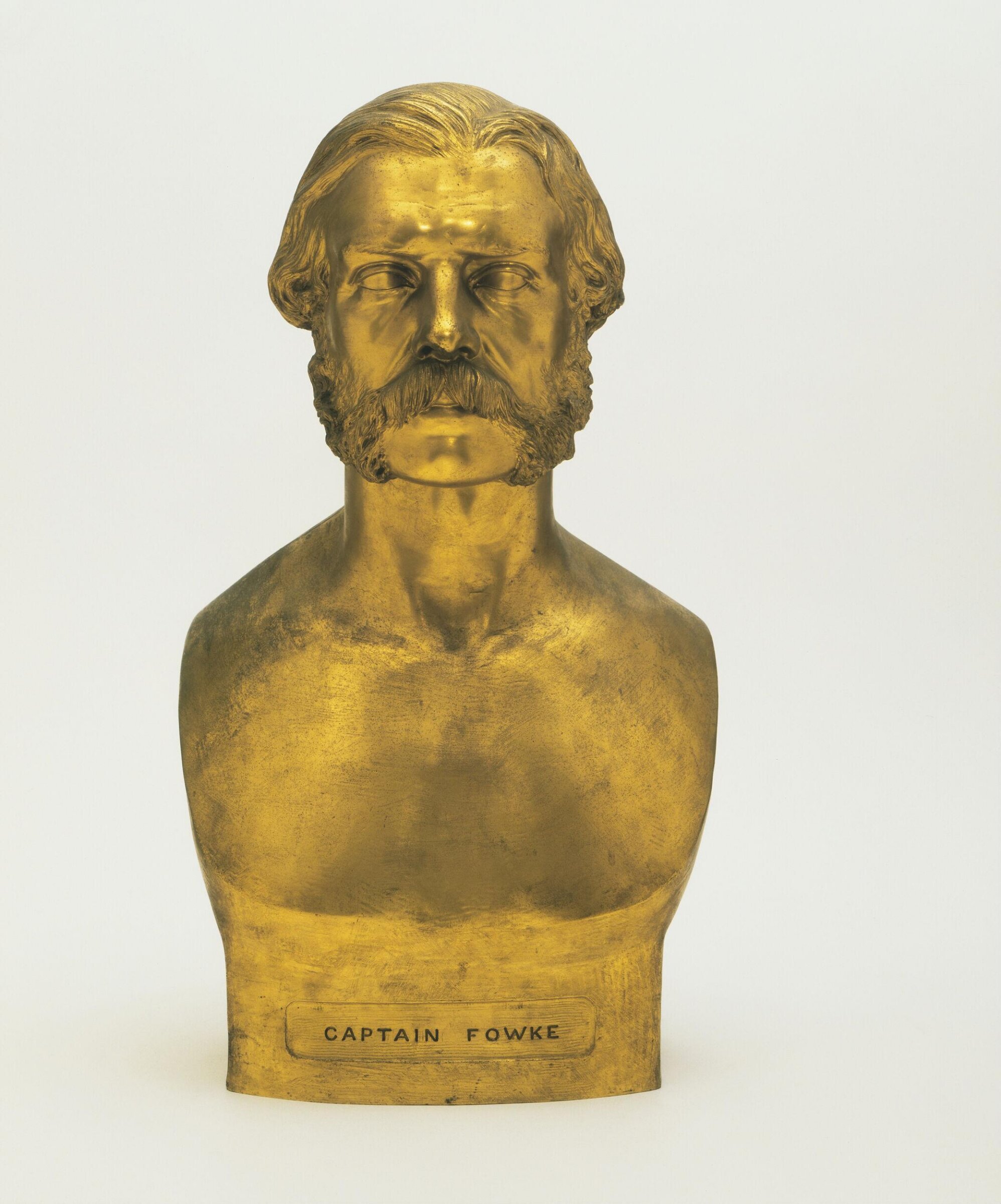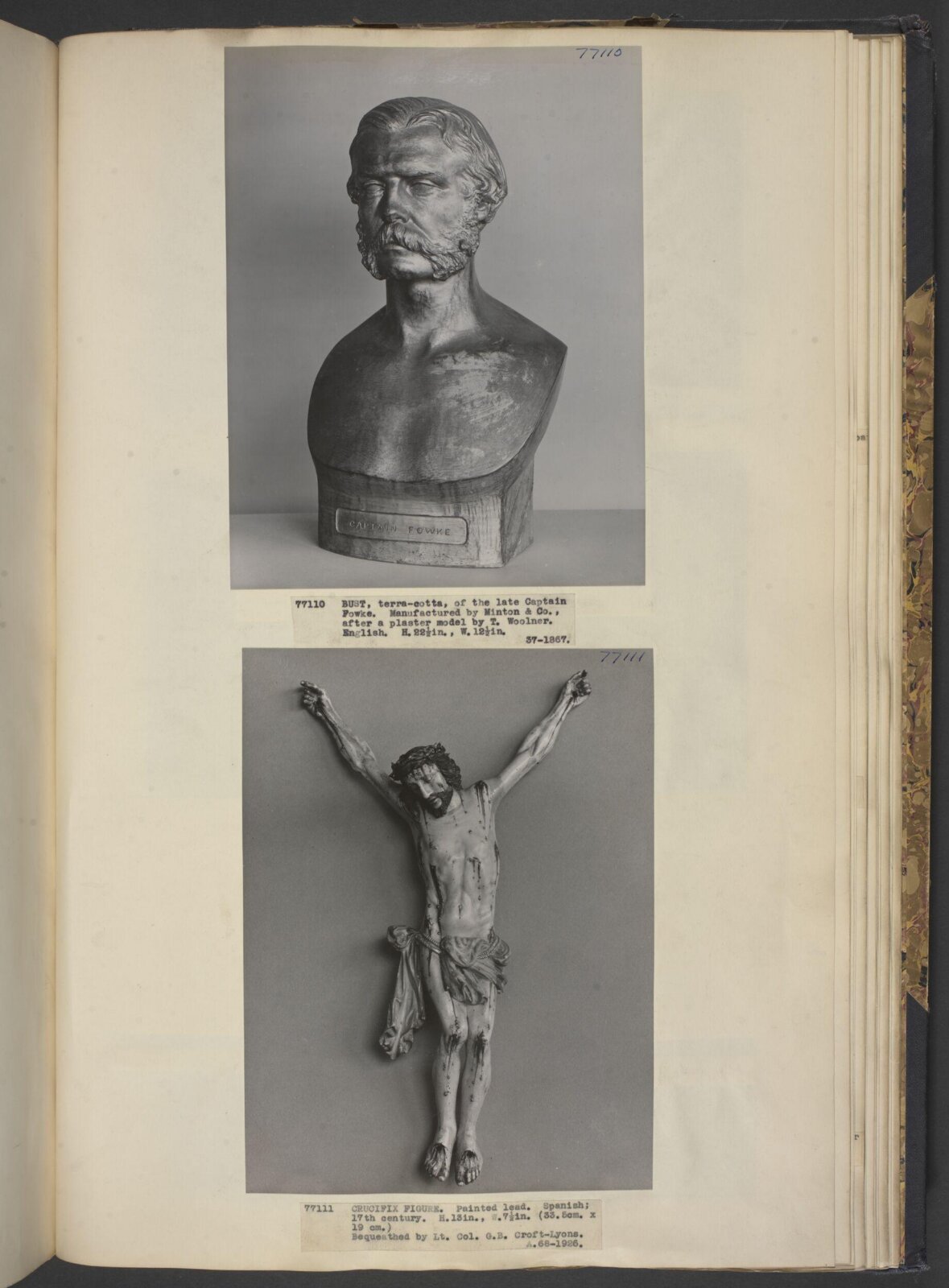
Captain Francis Fowke
Peut-on la contempler ?
Elle ne reçoit pas en ce moment

Londres, Royaume-Uni
Elle appartient à la collection, mais n’est pas présentée en ce moment.
- Vérifié
- Dans cet état depuis
- Source
- Le musée
À propos de la sculpture
This is a terracotta bust made by Minton and Company in England and dated 1866. The bust represents Captain Francis Fowke, R. E. (1823-1865). It is cast from a plaster model produced by Thomas Woolner (1825 - 1892). Captain Fowke of the Royal Engineers, became a distinguished official architect in the middle of the Victorian era, and published a number of related papers. In 1857 he became an inspector in the Science and Art Department in London; in 1860 was added the office of architect and engineer; while in 1862 he was appointed Superintendent of the construction of the South Kensington (now Victoria and Albert) Museum. He designed the new Museum of Science and Art (now the Royal Scottish Museum) Edinburgh, as well as extensions at the National Gallery, Dublin. He planned the buildings for the International Exhibition of 1862.
Lire la suite
Shortly before his death he designed the Royal Albert Hall. Physick records that the premature death of Fowke at the age of 42 was one which affected many, including Queen Victoria. Physick also records that the Board expressed the wish that a commemorative bust of Fowke should be placed in the Museum, and Thomas Woolner was asked to execute this in either marble or terracotta for the V&A.
Woolner was apprenticed to William Behnes and later entered the Royal Academy Schools. In 1843 (aged eighteen and still studying at the RA Schools) he showed his first work in public at the Royal Academy, Eleonora sucking the poison from the wound of Prince Edward. He continued to show ideal works at the Royal Academy and at the British Institution until the end of the 1840s.
Woolner met Holman Hunt and Millais through D.G. Rossetti and became the only sculptor member of the Pre-Raphaelite Brotherhood in 1842. Disillusioned after his failure in the competition for the Westminster Abbey Wordsworth Memorial, Woolner emigrated to Australia in 1852 in search of gold. He did not find gold but work as a sculptor, building up an extensive practice in portrait medallions. After his return to Britain in 1854 he continued to specialise in portraiture: medallions, busts and public statues. His bronze figure of Captain Cook for Hyde Park, Sydney is considered his masterpiece. Woolner was also an acclaimed poet. Woolner was elected ARA in 1871 and a Member in 1874 and was briefly Professor of Sculpure at the Royal Academy (1877-9).
Victoria and Albert Museum
Notice
- Numéro d’inventaire
- 37-1867
Ce qu’elle montre
Au catalogue
Sources
- Victoria and Albert Museum
- Image : Victoria and Albert Museum — © Victoria and Albert Museum, London