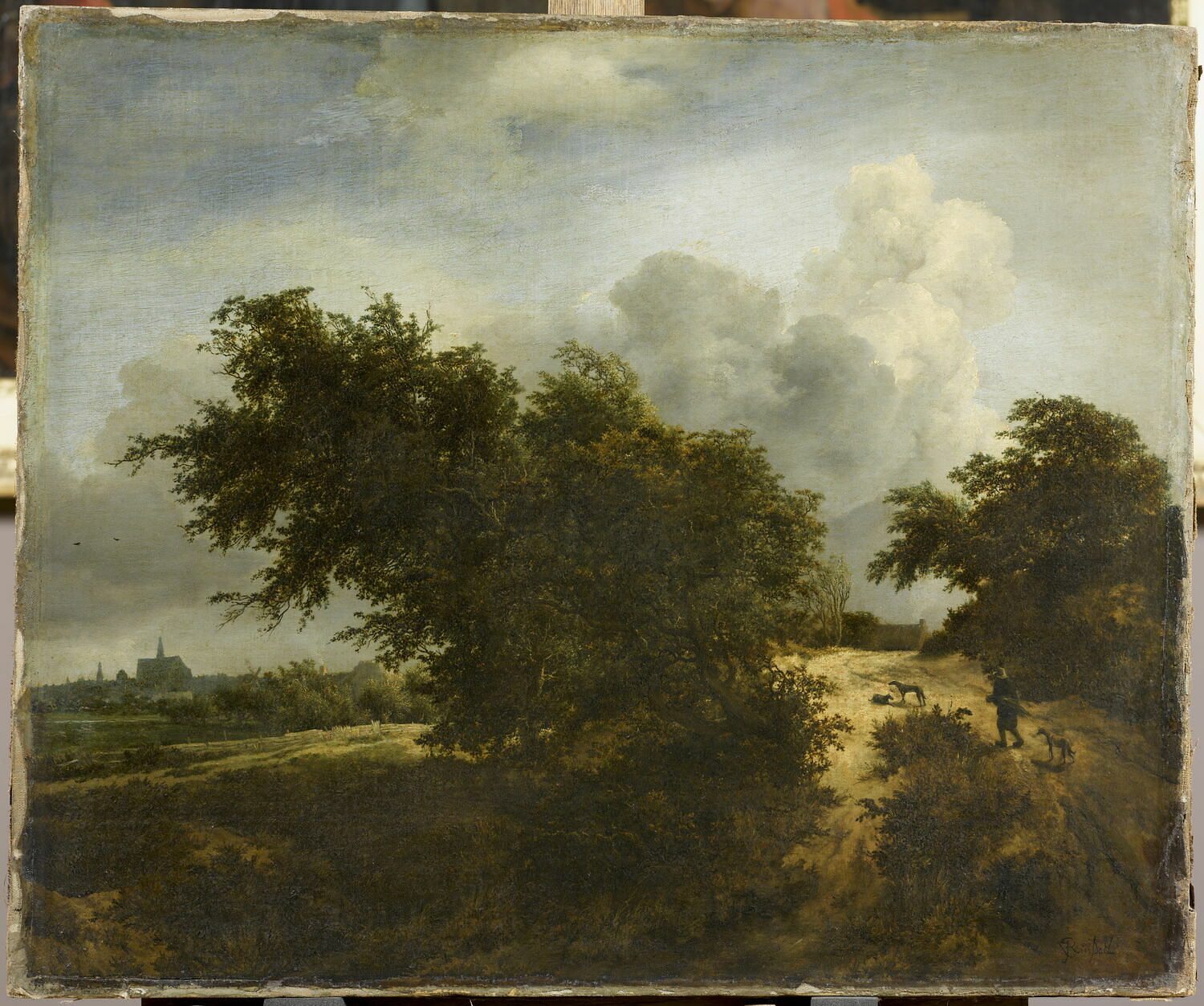
Jacob Isaacksz. van RuisdaelPays-Bas, 1628–1682
Bridge with a Sluice
Peut-on la contempler ?
Oui, elle reçoit
Présentée au public.
- Vérifié
- Dans cet état depuis
- Source
- Le musée
À propos du tableau
Bathed in sunlight breaking through the clouds, a rustic sluice, used to regulate water levels and irrigate farmland, sits above a background of productive pastureland. Jacob van Ruisdael, one of the great Dutch landscape painters of the 1600s, explored a range of landscape motifs in his work, including forest scenes, seascapes, beach scenes, and panoramic landscapes. In *Bridge with a Sluice,* Ruisdael made an ordinary object monumental by making it larger than all the other elements in the painting, thereby calling attention to its use and placement in the countryside. The diagonal movement of the rugged road at the left draws the eye up toward the sluice and then down to the land below. A single figure populates the scene, but the sluice symbolizes the human presence in nature and human attempts to control it.
J. Paul Getty Museum
Notice
- Numéro d’inventaire
- 86.PB.597
Au catalogue
Sources
- J. Paul Getty Museum
- Image : J. Paul Getty Museum — Open Content
Pendant ce temps, chez Jacob Isaacksz. van Ruisdael
La vie entière1640s
Trips to Blaricum, Egmond aan Zee and Rhenen
For a landscape painter Ruisdael travelled little: in the 1640s he visited Blaricum, his grandfather's home village, Egmond aan Zee and Rhenen.
1646
First dated paintings and etchings
The earliest date on Ruisdael's paintings and etchings is 1646; the young man was strongly influenced by the Haarlem landscape painters Cornelis Vroom and Allart van Everdingen. Two years later he was admitted to the Haarlem Guild of St Luke.
1650
Journey to Germany with Nicolaes Berchem
With Nicolaes Berchem, one of the painters who would later add figures to his landscapes, Ruisdael travels to Bentheim and Steinfurt, just across the German border (other accounts date the trip to Westphalia to around 1650). Afterwards his landscapes take on a more heroic character, with larger and more prominent forms.