 Winslow HomerÉtats-Unis, 1836–1910
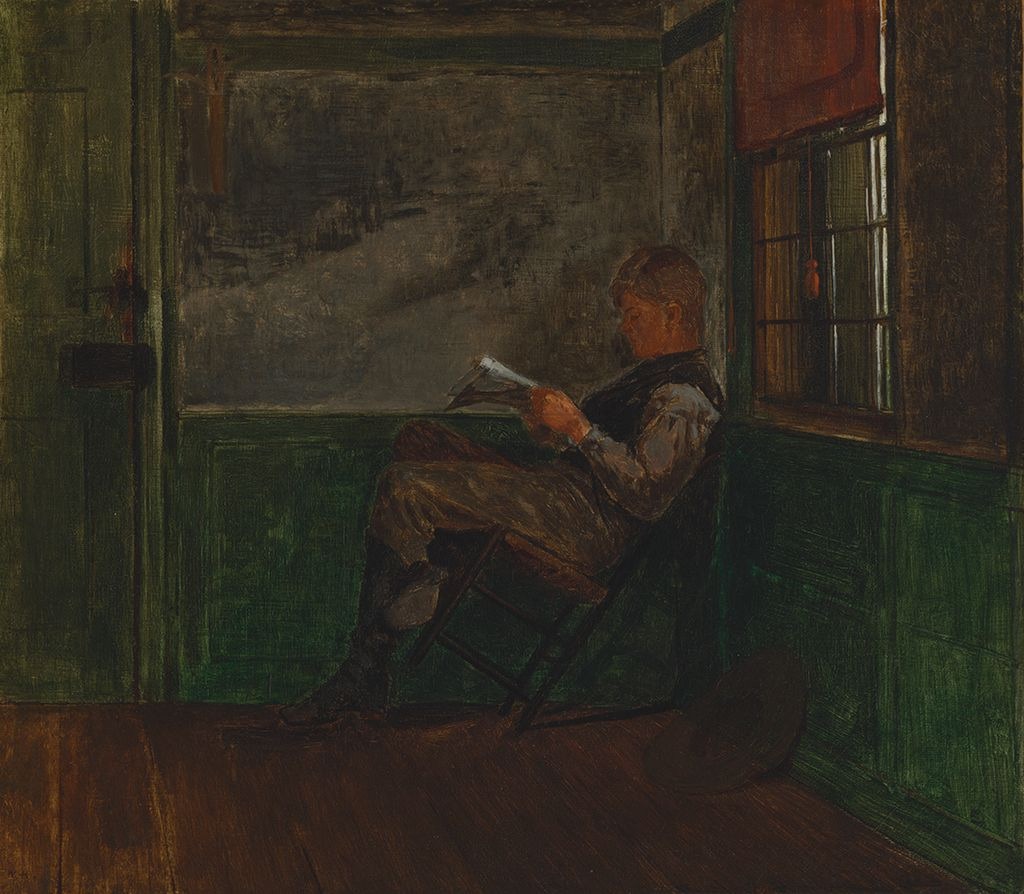
Boy Reading | Young Man Reading
Peut-on la voir ?
Non, volée et recherchée
Où est « Boy Reading | Young Man Reading » aujourd’hui ? Non, volée et recherchée. Vérifié 29 septembre 2026.
Inscrite au fichier national des œuvres volées du FBI, sous le nº 00627.
- Vérifié
- · Signalé
- Dans cet état depuis
- Source
- Un registre des œuvres volées
À propos du tableau
A boy reading; the boy is shown in a reclining position. The overall tone of the painting is dark.
Notice
Au catalogue
Sources
- Le registre des œuvres volées du FBI
- Image : FBI National Stolen Art File
Dans la vie de Winslow Homer
La vie entière24 février 1836
Born
1857
Freelance illustrator: “I have had no master”
By 1857 Homer, having turned down an offer to join the staff of Harper's Weekly, was working as a freelance illustrator, drawing Boston and rural New England life for Ballou's Pictorial and Harper's Weekly, and opened his own studio in Boston. “From the time I took my nose off that lithographic stone,” he later said, “I have had no master, and never shall have any.”
1859
Moves to New York
Until 1859 Homer lived with his family in Belmont, where his uncle's mansion inspired a number of his early illustrations and paintings, including croquet scenes. In 1859 he moved to New York, the artistic and publishing capital of the country, and opened a studio in the Tenth Street Studio Building.
1861
At the front of the Civil War
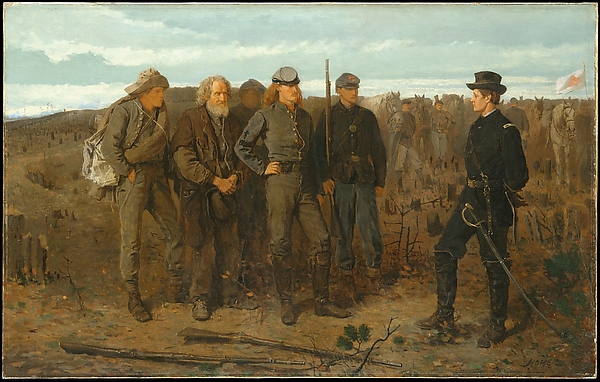
His mother tried to raise family funds to send him to Europe to study, but instead Harper's sent Homer to the front lines of the Civil War; his first sketches were of the camp, commanders and army of General George B. McClellan on the banks of the Potomac in October 1861. The work was dangerous and exhausting, but his drawings of battles and camp life mark his growth from illustrator to painter.
spring 1881 – November 1882
England: the village of Cullercoats
In 1881 Homer set off on his second and last trip abroad, to England, and from the spring of 1881 to November 1882 lived in the village of Cullercoats on the North Sea, depicting the courage of fishermen and above all of women: gutting fish, mending nets, waiting for the men at the water's edge. The period profoundly changed his later work: his palette grew sober and his pictures larger. Of the local women he wrote: “The women are the working bees.”
summer 1883
Moves to Prouts Neck
In the summer of 1883 Homer moved from New York to Prouts Neck, a peninsula ten miles south of Portland, Maine, and lived there for the rest of his life, using solitude to work. He settled on the family estate, in a remodelled carriage house seventy-five feet from the ocean.