ART WIKI32 963 en salle
CarteCollectionArtistesMuséesExpositionsJournal
Connexion

ART WIKI

Où est accroché le chef-d’œuvre, et quand on vous laisse entrer.

Collections : Art Institute of Chicago, Cleveland Museum of Art, Galerie Tretiakov, Hirshhorn Museum and Sculpture Garden, J. Paul Getty Museum, Metropolitan Museum of Art, Minneapolis Institute of Art, Musée de l'Ermitage, Musée des Beaux-Arts Pouchkine, Musée du Louvre, musée national d'art asiatique, Musée russe, Musées d'Art de Harvard, Museum of Modern Art, National Gallery of Art, National Portrait Gallery, Rijksmuseum Amsterdam, Smithsonian American Art Museum, Statens Museum for Kunst, Victoria and Albert Museum, Villa Getty, Whitney Museum of American Art, Catalogue d’État du fonds muséal de Russie (274 musées), Europeana (19 musées), Wikidata (6 musées), Paris Musées (12 musées) et Joconde, la base des musées du ministère de la Culture (495 musées). Les images appartiennent à leurs ayants droit.

Rubriques

  • Carte
  • Recherche
  • Collection
  • Chefs-d’œuvre
  • Exposées en ce moment
  • Artistes

Et aussi

  • Musées et galeries
  • Expositions
  • Journal
  • D’où viennent les données
  • Confidentialité et cookies
AccueilCarteCatalogue
  1. Collection/
  2. Musée d'Orsay/
  3. Au cabaret
Au cabaret, Émile Bernard, 1887
Bernard, Emile, portraitBernard, EmileFrance, 1868–1941

Au cabaret

1887 · Painting · 41.8 × 49.5 cm

Peut-on la contempler ?

Inconnu

Musée d'Orsay

Paris, France

Le propriétaire est connu ; on ignore si l’œuvre est exposée aujourd’hui.

Dans cet état depuis
29 sept. 2026
Source
Le musée
Sur la cartePage du musée

Notice

1887 · à 19 ans
18681941
Numéro d’inventaire
RF 2013 13

Au catalogue

PeinturesPeinture françaiseImpressionnismeXIXe siècle

Sources

  • Wikidata
  • Image : Musée d'Orsay — Émile Bernard · Public domain · Wikimedia Commons

Pendant ce temps, chez Bernard, Emile

La vie entière
  1. 1884–1885 · Lieu de travail

    Paris

  2. 1884–1886

    Cormon's atelier, Anquetin and Toulouse-Lautrec

    After beginning at the École des Arts Décoratifs, Bernard joins Fernand Cormon's atelier, in 1884 by some accounts and in 1886 by others. There he experiments with Impressionism and Pointillism and befriends Louis Anquetin and Toulouse-Lautrec; he also meets van Gogh there.

  3. August 1886

    First meeting with Gauguin in Pont-Aven

    In August 1886 in Pont-Aven Bernard meets Gauguin for the first time; they exchange little about art but look forward to meeting again. Looking back, Bernard said his own talent was already fully developed, and he believed that his style played a considerable part in the development of Gauguin's mature style.

  4. 1887

    Cloisonnism, developed together with Anquetin

    In 1887 Bernard and Louis Anquetin develop cloisonnism — bold forms separated by dark contours; in the spring they “turn against Neo-Impressionism”. Many, however, credit Anquetin with the technique, and Bernard was probably also influenced by the works of Cézanne he had seen.

  5. 1887–1888

    An exhibition in the restaurant on the Avenue de Clichy

    Back in Paris, Bernard attends the Académie Julian and meets van Gogh, who is impressed by his work. He finds a restaurant on the Avenue de Clichy where his work is shown alongside that of van Gogh, Anquetin and Toulouse-Lautrec; van Gogh calls the group the “School of the Petit Boulevard”.

  6. 1888

    On foot to Pont-Aven: friendship with Gauguin

    A year later Bernard again sets out for Pont-Aven on foot and sees Gauguin; their friendship and artistic partnership quickly grow strong. Bernard wants an art of the most extreme simplicity, accessible to all and practised collectively, and Gauguin is impressed by his ability to put his ideas into words. Other accounts have him living in Pont-Aven in 1886–1888 and joining the Pont-Aven group.

Autres œuvres : Bernard, Emile

Toutes les œuvres
Still Life (Cup, Compote Dish, Teapot, and Fruit) 1890, Émile Bernard

Still Life (Cup, Compote Dish, Teapot, and Fruit) 1890

Musée Van-Gogh

Le Repos du berger, Émile Bernard, 1900s

Le Repos du berger

1900s · Musée d'Orsay

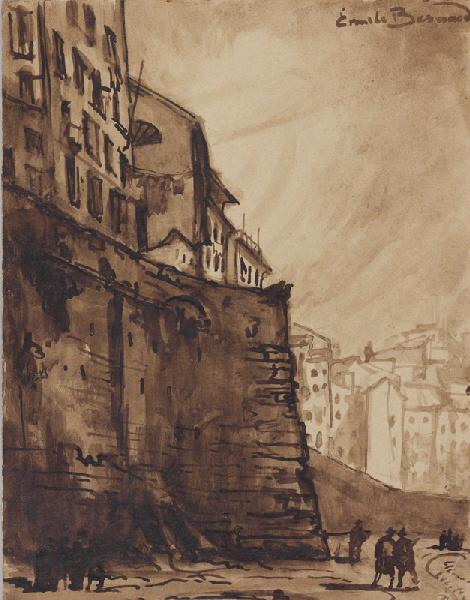
Les remparts, Emile Bernard, 4e quart 19e siècle, 1ère moitié 20e siècle

Les remparts

4e quart 19e siècle, 1ère moitié 20e siècle · Musée des Beaux-Arts de Brest

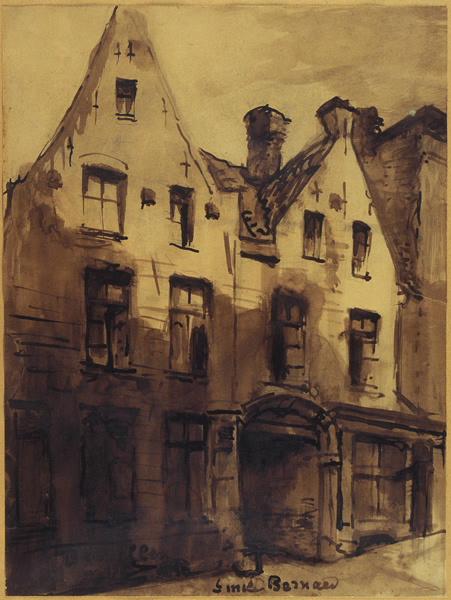
Maisons flamandes, Emile Bernard, 4e quart 19e siècle, 1ère moitié 20e siècle

Maisons flamandes

4e quart 19e siècle, 1ère moitié 20e siècle · Musée des Beaux-Arts de Brest

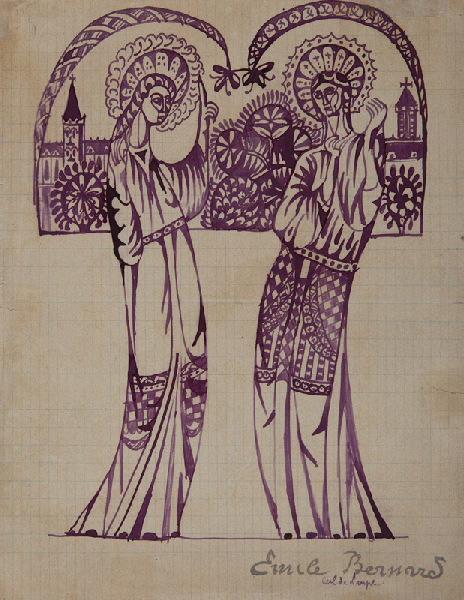
Personnages sur fond d'église, Emile Bernard, 4e quart 19e siècle, 1ère moitié 20e siècle

Personnages sur fond d'église

4e quart 19e siècle, 1ère moitié 20e siècle · Musée des Beaux-Arts de Brest

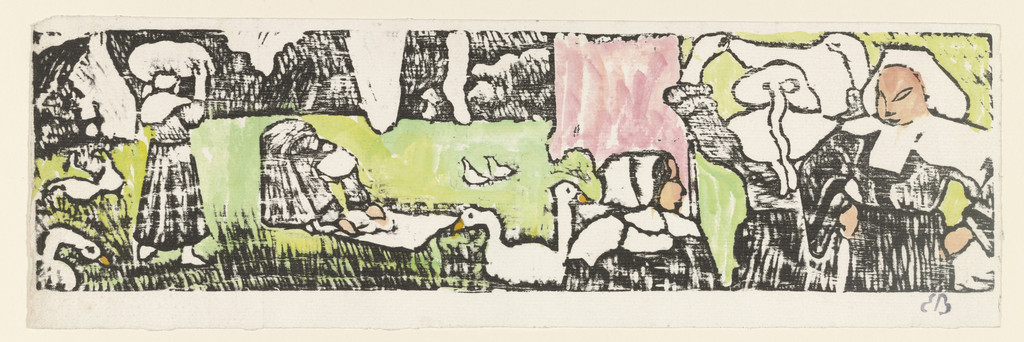
Breton Woman (Les Bretonnes), Émile Bernard, (1883)

Breton Woman (Les Bretonnes)

(1883) · Non exposée · Museum of Modern Art

Fisherman and Boat, Émile Bernard, 1885

Fisherman and Boat

1885 · Musée Van-Gogh

Bretonne walking near a canal, Émile Bernard, 1886

Bretonne walking near a canal

1886 · Musée Van-Gogh

De la collection : Musée d'Orsay

Page du musée
Still Life: Japanese Vase with Roses and Anemones, Vincent van Gogh, 1890

Vincent van Gogh

Still Life: Japanese Vase with Roses and Anemones, 1890

Chaumes de Cordeville, Vincent van Gogh, 1890

Vincent van Gogh

Chaumes de Cordeville, 1890

Doctor Gachet's Garden in Auvers, Vincent van Gogh, 1890

Vincent van Gogh

Doctor Gachet's Garden in Auvers, 1890

Two Children, Vincent van Gogh, 1890

Vincent van Gogh

Two Children, 1890

The siesta (after Millet), Vincent van Gogh, 1890

Vincent van Gogh

La Méridienne, 1890

Marguerite Gachet in the Garden, Vincent van Gogh, 1890

Vincent van Gogh

Marguerite Gachet in the Garden, 1890

The Church at Auvers, Vincent van Gogh, 1890

Vincent van Gogh

L'Église d'Auvers-sur-Oise, 1890

Portrait of Dr. Gachet, Vincent van Gogh, 1890

Vincent van Gogh

Portrait of Dr. Gachet, 1890