Juan GrisEspagne, 1887–1927
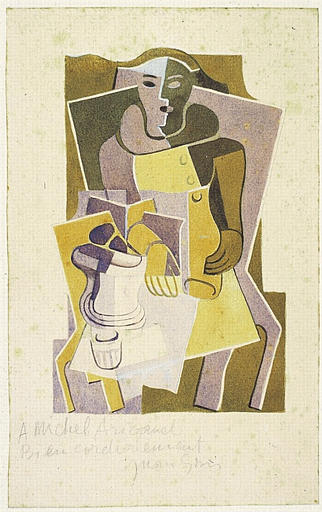
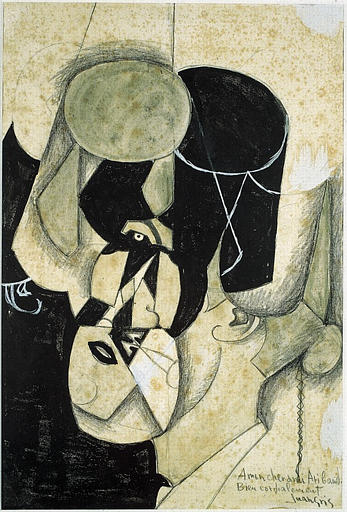
Arlequin
Peut-on la voir ?
Inconnu
Où est « Arlequin » aujourd’hui ? Collection: Musée d'Art moderne de Céret, Céret. Inconnu.
Céret, France
Le propriétaire est connu ; on ignore si l’œuvre est exposée aujourd’hui.
- Dans cet état depuis
- Source
- Le musée
À propos de l’œuvre
Encre noire, crayon bleu, gouache blanche sur papier Velin
Musée d'Art moderne de Céret
Notice
- Numéro d’inventaire
- MAMC 1991-0493
Ce qu’elle montre
Au catalogue
Sources
- Musée d'Art moderne de Céret
- Image : Musée d'Art moderne de Céret — © musée d'art moderne, Céret; Ministère de la Culture (France), base Joconde
Dans la vie de Juan Gris
La vie entière1910s–1920s
The pupil Picasso “wished away”
Gris regarded Picasso as a teacher, but according to Gertrude Stein in The Autobiography of Alice B. Toklas, Picasso treated him with undisguised irritation: Gris was the only person Picasso wished away. At first Gris was spoken of only as Picasso’s follower, but when he became an independent artist and one of the leaders of Cubism, Picasso grew jealous.
1913–1918
From Analytical to Synthetic Cubism
At first Gris painted in the style of Analytical Cubism, a term he himself later coined; after 1913 he converted to Synthetic Cubism, making extensive use of papier collé, or collage, an evolution that ran through 1914–1918. Unlike Picasso and Braque, whose Cubist works were practically monochromatic, he painted in bright harmonious colours in daring, novel combinations, in the manner of his friend Matisse.
1919
His first solo exhibition, in Paris
Gris’s first solo exhibition took place in Paris in 1919.
1919–1920
Critics begin to write about “synthetic” Cubism
In 1919 and particularly 1920, artists and critics began to write conspicuously about this “synthetic” approach and to assert its importance in the overall scheme of advanced Cubism.
1922–1924
Working with Diaghilev and the Ballets Russes
From 1922 to 1924 he worked with Sergei Diaghilev and his ballet company; in 1924 he designed sets and costumes for the Ballets Russes.