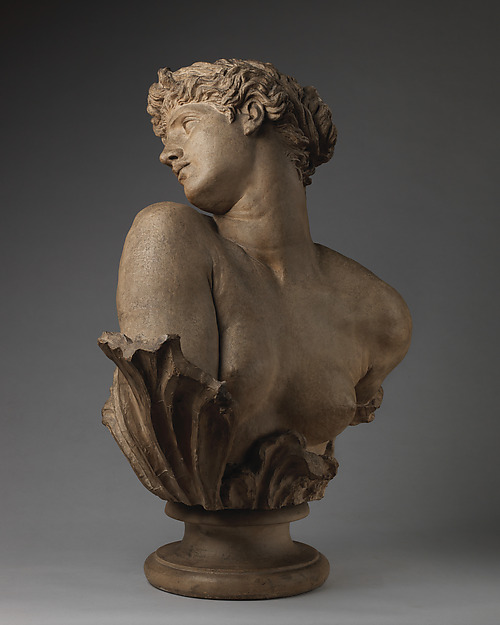
George Frederic WattsRoyaume-Uni, 1817–1904
A Story from Boccaccio
Peut-on la voir ?
Inconnu
Où est « A Story from Boccaccio » aujourd’hui ? Collection: National Gallery, Londres. Inconnu.

Londres, Royaume-Uni
Le propriétaire est connu ; on ignore si l’œuvre est exposée aujourd’hui.
- Dans cet état depuis
- Source
- Le musée
Notice
- Numéro d’inventaire
- NG1913
Au catalogue
Sources
- Wikidata
- Image : National Gallery — George Frederic Watts · Public domain · Wikimedia Commons
Dans la vie de George Frederic Watts
La vie entière1843
First prize in the Parliament murals competition
His drawing “Caractacus”, submitted to the competition for murals in the new Houses of Parliament at Westminster, wins Watts a first prize of £300 and his first public attention. He ends up contributing little to the murals themselves, but the experience gives rise to his vision of a building covered in frescoes about the spiritual and social development of humanity.
1843–1847
A long stay in Italy funded by the prize
The prize money pays for a long stay in Italy, which lasts until April 1847. There he begins to paint landscapes and is inspired by Michelangelo’s Sistine Chapel and Giotto’s Scrovegni Chapel.
1843–1847
Friendship with Lord and Lady Holland
During his Italian stay Watts becomes close to the British ambassador Henry Fox, 4th Baron Holland, and his wife Augusta, visiting their homes, Casa Feroni and the Villa Careggi in Tuscany. For them he paints a portrait of Lady Holland, shown in 1848, and — after experimental studies in the medium — a fresco at the villa.
1847
Second Parliament competition: “Alfred the Great”
While still in Italy, Watts enters a new Parliament competition with the picture “Alfred Inciting the Saxons to Prevent the Landing of the Danes by Encountering Them at Sea” — a patriotic subject treated with an eye to Phidias. The picture wins a first-class prize of £500; the government buys it and hangs it in one of the committee rooms of the House of Commons.
1847
Leaves Florence and stays in London
In April 1847 Watts leaves Florence for what was meant to be a brief return to London, but he ends up staying there.
1849
Exhibits his first allegorical compositions
In 1849 the first two of his allegorical compositions, the most characteristic of his output, are exhibited: “Life’s Illusions”, an elaborate depiction of the vanity of human desires, and “The People That Sat in Darkness”, turning eagerly toward the dawning day.