
 William HogarthAngleterre, 1697–1764
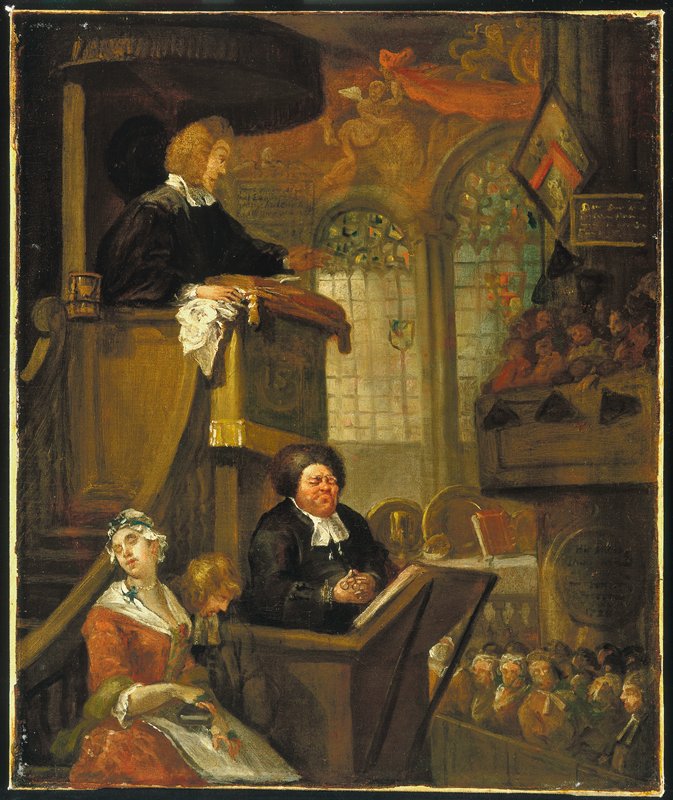
A Scene from The Beggar's Opera
Peut-on la contempler ?
Elle ne reçoit pas en ce moment

Washington, États-Unis
Elle appartient à la collection, mais n’est pas présentée en ce moment.
- Vérifié
- Dans cet état depuis
- Source
- Le musée
Notice
- Numéro d’inventaire
- 1983.1.42
Ce qu’elle montre
Au catalogue
Sources
- National Gallery of Art
- Image : National Gallery of Art — Museum open access
Pendant ce temps, chez William Hogarth
La vie entière1712–1764 · Lieu de travail
London
1727 – 28 May 1728
A lawsuit against the weaver Morris: “an engraver, and no painter”
In 1727 the tapestry worker Joshua Morris commissioned from Hogarth a design for “The Element of Earth”, but on hearing that he was “an engraver, and no painter” refused the finished work. Hogarth sued him in the Westminster court and won: judgment was given in his favour on 28 May 1728.
until 1728
Initiated as a Freemason
Before 1728 Hogarth was initiated as a Freemason in the lodge at the Hand and Apple Tree Tavern in Little Queen Street, and later belonged to the Carrier Stone Lodge and the Grand Stewards’ Lodge; for the latter he designed the “Hogarth Jewel”, the badge of the Lodge’s Master (the original is now in storage and a replica is worn by the present Master). Freemasonry is also a theme of “Night”, the fourth print of the “Four Times of the Day”.
23 March 1729
A secret wedding to Jane Thornhill
Not hoping for Sir James’s consent — he saw the match as unequal, Hogarth being a rather obscure artist then — William and Jane married in secret at Paddington Church. Jane and her mother helped to reconcile him with his father-in-law: they hung the first paintings of “A Harlot’s Progress” in his house, and on learning the artist’s name Sir James admitted that a man who could produce such pictures could also keep a wife without a dowry.



![Ginevra de' Benci [obverse], Leonardo da Vinci, c. 1474/1478](https://api.nga.gov/iiif/8f29e3c9-a289-4d53-abf0-31a66e9e98fa/full/!2400,2400/0/default.jpg)
![Wreath of Laurel, Palm, and Juniper with a Scroll inscribed Virtutem Forma Decorat [reverse], Leonardo da Vinci, c. 1474/1478](https://api.nga.gov/iiif/ff62e8d0-45c4-498f-ad36-6358de827e04/full/!2400,2400/0/default.jpg)


![The Watering Place (Horses Bathing) [L'abreuvoir (chevaux au bain)], Pablo Picasso, 1906](https://api.nga.gov/iiif/bbac782b-88ea-4477-97a5-4369aa47b98a/full/!2400,2400/0/default.jpg)
