ART WIKI33 040 en salle
CarteCollectionArtistesMuséesExpositionsJournal
Connexion

ART WIKI

Où est accroché le chef-d’œuvre, et quand on vous laisse entrer.

Collections : Art Institute of Chicago, Cleveland Museum of Art, Galerie Tretiakov, Hirshhorn Museum and Sculpture Garden, J. Paul Getty Museum, Metropolitan Museum of Art, Minneapolis Institute of Art, Musée de l'Ermitage, Musée des Beaux-Arts Pouchkine, Musée du Louvre, musée national d'art asiatique, Musée russe, Musées d'Art de Harvard, Museum of Modern Art, National Gallery of Art, National Portrait Gallery, Rijksmuseum Amsterdam, Smithsonian American Art Museum, Statens Museum for Kunst, Victoria and Albert Museum, Villa Getty, Whitney Museum of American Art, Catalogue d’État du fonds muséal de Russie (274 musées), Europeana (19 musées), Wikidata (6 musées), Paris Musées (12 musées) et Joconde, la base des musées du ministère de la Culture (495 musées). Les images appartiennent à leurs ayants droit.

Rubriques

  • Carte
  • Recherche
  • Collection
  • Chefs-d’œuvre
  • Exposées en ce moment
  • Artistes

Et aussi

  • Musées et galeries
  • Expositions
  • Journal
  • D’où viennent les données
  • Confidentialité et cookies
AccueilCarteCatalogue
  1. Collection/
  2. National Gallery/
  3. A Roman Triumph
A Roman Triumph, Peter Paul Rubens, c. 1630
Peter Paul Rubens, portraitPeter Paul RubensFlandre, 1577–1640

A Roman Triumph

c. 1630 · Painting · 86.8 × 163.9 cm

Peut-on la contempler ?

Inconnu

National Gallery

Londres, Royaume-Uni

Le propriétaire est connu ; on ignore si l’œuvre est exposée aujourd’hui.

Dans cet état depuis
29 sept. 2026
Source
Le musée
Sur la cartePage du musée

À propos du tableau

Un triomphe romain est un tableau du peintre flamand Pierre Paul Rubens réalisé vers 1630. Cette huile sur toile représente un triomphe romain impliquant de nombreux animaux, parmi lesquels des éléphants. Elle s'inspire fortement des Triomphes de César, par Andrea Mantegna, que l'artiste a vus à Mantoue, en Italie. Elle est conservée à la National Gallery, à Londres, au Royaume-Uni.

Wikipédia · CC BY-SA

Notice

c. 1630
15771640
Numéro d’inventaire
NG278

Au catalogue

PeinturesPeinture flamandeBaroqueXVIIe siècle

Sources

  • Wikidata
  • Image : National Gallery — Peter Paul Rubens · Public domain · Wikimedia Commons

Pendant ce temps, chez Peter Paul Rubens

La vie entière
  1. 1627–1630

    Diplomatic Missions between Spain and England

    Rubens was active as a diplomat, shuttling between the courts of Spain and England in an effort to achieve peace between the Catholic Spanish Netherlands and the Protestant Dutch Republic; he also made several trips to Holland.

  2. 1628–1629

    Eight Months in Madrid, Friendship with Velázquez

    During an eight-month stay in Madrid, Rubens, in addition to diplomatic negotiations, executed important works for Philip IV, studied and copied Titian anew, and became friends with the court painter Diego Velázquez.

  3. 1629 – April 1630

    Diplomatic Journey to London

    After a brief stay in Antwerp, Rubens traveled to London, where he remained until April 1630, continuing the peace negotiations between Spain and England.

  4. 1630

    Marriage to Helena Fourment

    Four years after the death of Isabella Brant, the 53-year-old Rubens married the 16-year-old Helena Fourment; she became the artist's muse and the inspiration for the sensuous figures in many of his paintings of the 1630s, including The Three Graces and The Judgment of Paris.

  5. 1630

    Knighted by Charles I

    King Charles I of England knighted Rubens, adding a heraldic lion to his personal coat of arms; a few months later Philip IV confirmed his knightly status.

  6. 6 décembre 1630

    Married: Helena Fourment
Autres œuvres : Peter Paul Rubens

Toutes les œuvres
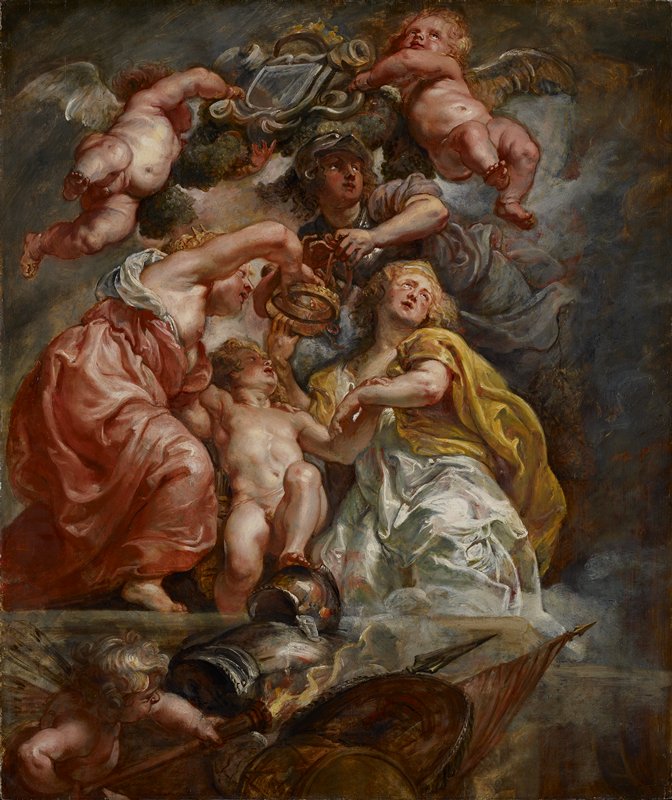
The Union of England and Scotland (Charles I as the Prince of Wales), Peter Paul Rubens, 1633–34

The Union of England and Scotland (Charles I as the Prince of Wales)

1633–34 · Minneapolis Institute of Art

Rubens, Helena Fourment (1614–1673), and Their Son Frans (1633–1678), Peter Paul Rubens, ca. 1635

Rubens, Helena Fourment (1614–1673), and Their Son Frans (1633–1678)

ca. 1635 · Metropolitan Museum of Art

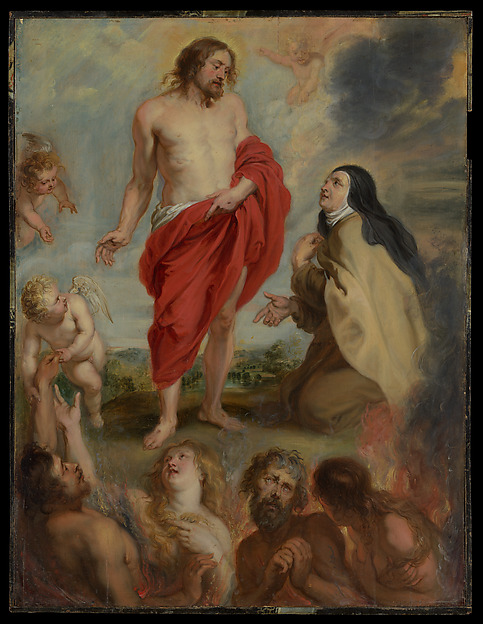
Saint Teresa of Avila Interceding for Souls in Purgatory, Peter Paul Rubens

Saint Teresa of Avila Interceding for Souls in Purgatory

Metropolitan Museum of Art

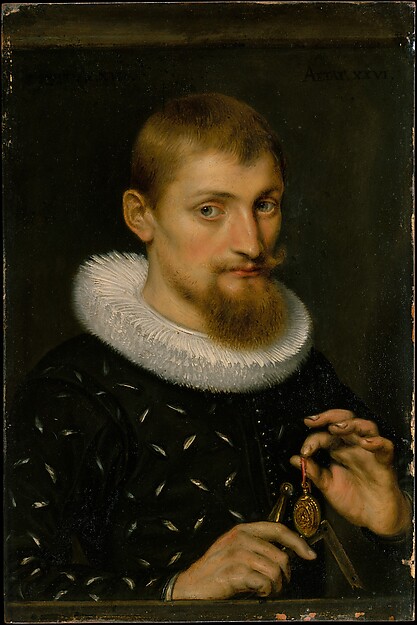
Portrait of a Man, Possibly an Architect or Geographer, Peter Paul Rubens, 1597

Portrait of a Man, Possibly an Architect or Geographer

1597 · Metropolitan Museum of Art

Coronation and Assumption of the Virgin, Peter Paul Rubens, 17th century

Coronation and Assumption of the Virgin

17th century · Musée de l'Ermitage

Feast in the House of Simon the Pharisee, Peter Paul Rubens, 17th century

Feast in the House of Simon the Pharisee

17th century · Musée de l'Ermitage

Lioness and Two Lions, Peter Paul Rubens, first half of the 17th century

Lioness and Two Lions

first half of the 17th century · Musée de l'Ermitage

Resurrection of Christ, Peter Paul Rubens, 17th century

Resurrection of Christ

17th century · Musée de l'Ermitage

De la collection : National Gallery

Page du musée
Virgin of the Rocks, Leonardo da Vinci, 1490s

Leonardo da Vinci

Virgin of the Rocks, 1490s

Long Grass with Butterflies, Vincent van Gogh, 1890

Vincent van Gogh

Long Grass with Butterflies, 1890

Farms near Auvers, Vincent van Gogh, 1890

Vincent van Gogh

Chaumières sur une colline, 1890

A Wheatfield, with Cypresses, Vincent van Gogh, 1889

Vincent van Gogh

A Wheatfield, with Cypresses, 1889

Head of a Peasant Woman, Vincent van Gogh, 1885

Vincent van Gogh

Head of a Peasant Woman, 1885

The Entombment, Michelangelo, c. 1500s

Michelangelo

La Mise au tombeau, c. 1500s

Manchester Madonna, Michelangelo, c. 1494

Michelangelo

Madone de Manchester, c. 1494

Irises, Claude Monet, 1910s

Claude Monet

Irises, 1910s