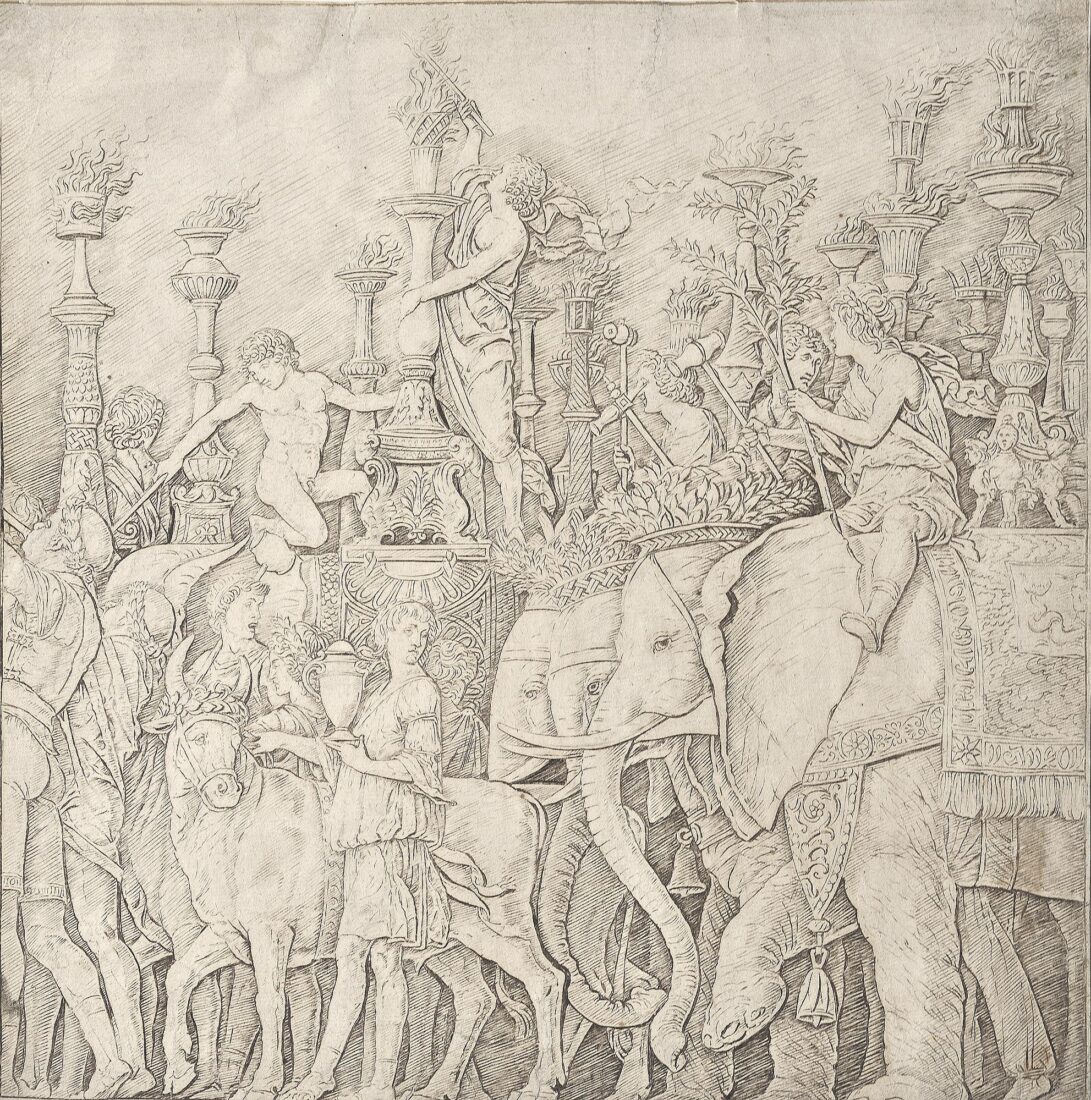
 Andrea MantegnaItalie, 1431–1506
Οι ελέφαντες
Peut-on la contempler ?
Nous l’ignorons : le musée garde le silence

Pinacothèque nationale d'Athènes
Athènes, Grèce
Le propriétaire est connu. Si elle est exposée aujourd’hui, le musée ne le dit pas, et l’on ne nous a pas appris à deviner.
- Dans cet état depuis
- Source
- Les données de collection du musée lui-même
Notice
What it shows
Au catalogue
Sources
- Pinacothèque nationale d'Athènes: the museum's own open data · obtenue il y a 6 jours
- Image : Pinacothèque nationale d'Athènes — CC BY-NC-ND 4.0
Pendant ce temps, chez Andrea Mantegna
La vie entière1460–1506
Post: court painter
1466–1468
A trip to Tuscany: Florence and Pisa
In 1466–1467 Mantegna visited Tuscany: in 1467 he made a short trip to Florence and in 1468 one to Pisa, to become acquainted with new trends in the development of art.
1468
Post: court painter
1488–1490
Rome: frescoes for Pope Innocent VIII
In 1488–1490 in Rome Mantegna, at the request of Pope Innocent VIII, decorated with frescoes the pope’s chapel in the Vatican Belvedere (later destroyed).
1490
Back in Mantua and closer to Isabella d’Este
Returning to Mantua in 1490, Mantegna embraced again his more literary and bitter vision of antiquity and entered into a close connection with the new marchesa, the cultured and intelligent Isabella d’Este.
after 1497
Isabella d’Este’s studiolo: mythological subjects
After 1497 Isabella d’Este commissioned Mantegna to turn the mythological themes devised by the court poet Paride Ceresara into paintings for her private apartment (studiolo) in the Palazzo Ducale; he left the “Legend of the God Comus” unfinished, and it was completed by his successor as court painter, Lorenzo Costa. Perugino and Correggio were also commissioned for the studiolo.