
 Joaquín SorollaEspaña, 1863–1923
Toreros
¿Se puede contemplar?
Se desconoce

Madrid, España
Se conoce el propietario; no se sabe si hoy está expuesta.
- En este estado desde
- Fuente
- El museo
Sobre la obra
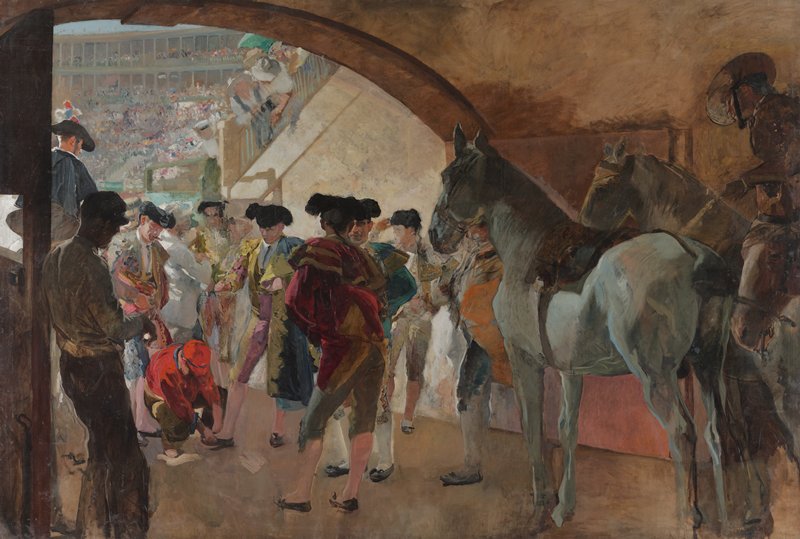
Dos toreros vistos de espaldas, de medio cuerpo, con el capote de paseo sobre el hombro izquierdo y montera a la cabeza. Alrededor otras figuras, muy abocetadas. A la izquierda, línea vertical que indica una puerta o una pared y al fondo línea ligeramente curva, que indica la entrada a la plaza de toros.
Museo Sorolla
Ficha
Lo que muestra
En el catálogo
Fuentes
- Museo Sorolla
- Imagen: Museo Sorolla — In Copyright
Mientras tanto, en la vida de Joaquín Sorolla
La vida entera12 de junio de 1895
Daughter born: Elena Sorolla García
1897
“A Research”: the Prize of Honour in Madrid
Two paintings linking art and science, “Portrait of Dr. Simarro at the Microscope” and “A Research”, won Sorolla the Prize of Honour at the National Exhibition of Fine Arts. He showed his friend Simarro in the laboratory, catching the contrast between the reddish-yellow light of a gas burner and the weak mauvish light from the window.
1900
Grand Prix at the Paris Universal Exposition
“Sad Inheritance”, a huge canvas of crippled children bathing in the sea at Valencia under a monk’s supervision, brought Sorolla his greatest official recognition, the Grand Prix and a medal of honour, and his exhibit as a whole earned him nomination as a Knight of the Legion of Honour. After this picture he never returned to so overtly social a theme.
1901
A medal of honour in Madrid for “Sad Inheritance”
The painting won the medal of honour at the National Exhibition in Madrid. Two of its luminous preparatory oil sketches Sorolla gave as gifts to the American artists John Singer Sargent and William Merritt Chase.
1901 · Distinción
Knight of the Legion of Honour
1902 · Distinción
Grand cross of the Civil Order of Alfonso XII


![Banderillas de fuego [Brennende Banderillas; Banderillas with firecrackers], Francisco Goya, 1816](https://diglib.hab.de/varia/haum/goya-taur-31/max/000001.jpg)
![El diestrísimo estudiante de Falces, embozado burla al toro con sus quiebros [Der äußerst geschickte "Student von Falces" reizt, in seinen Mantel gehüllt, den Stier durch die Wendungen seines Körpers; The very skilfull student of Falces, wrapped in his cape, tricks the bull with the play of his body], Francisco Goya, 1816](https://diglib.hab.de/varia/haum/goya-taur-14/max/000001.jpg)


