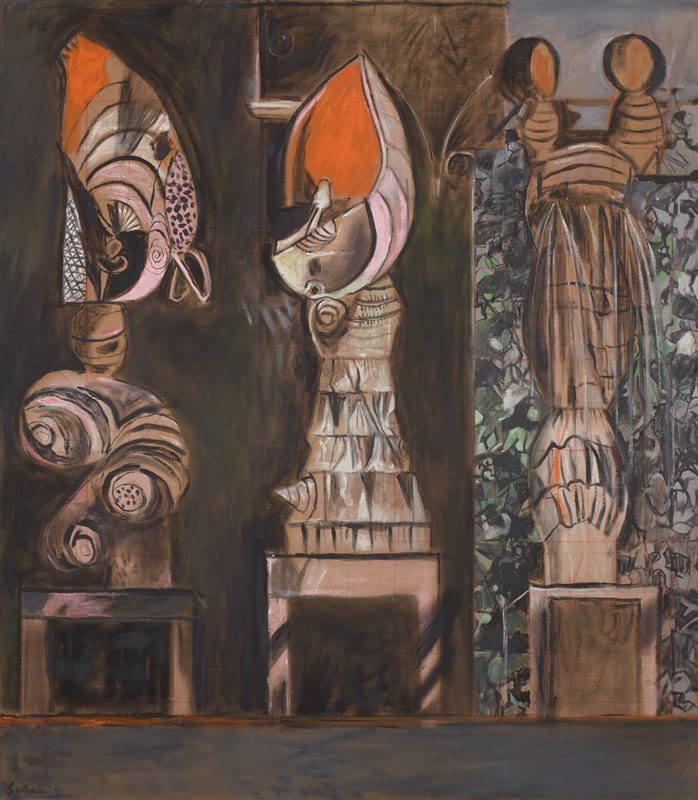
Three Standing Forms
¿Puedo verla?
No expuesta por ahora
¿Dónde está «Three Standing Forms» hoy? Colección: Harvard Art Museums, Cambridge. No expuesta por ahora. Comprobado 16 de noviembre de 2026.

Cambridge, Estados Unidos
Pertenece a la colección, pero ahora mismo no está expuesta.
- Comprobado
- En este estado desde
- Fuente
- El museo
Ficha
- Número de inventario
- G8881
En el catálogo
Fuentes
- Harvard Art Museums
- Imagen: Harvard Art Museums — © President and Fellows of Harvard College
En la vida de Sutherland, Graham
La vida entera24 de agosto de 1903
Born
1919–1921
Leaves an engineering apprenticeship for art
After Epsom College (other accounts say 1918) he becomes an apprentice at the Midland Railway locomotive works in Derby, where relatives had worked before him; a year later (other accounts say three) he persuades his father that engineering is not for him. Having failed to win a place at the Slade School of Art, he enters Goldsmiths in 1921, specialising in engraving and etching.
1931
Demand for prints falls — more time for painting
With demand for prints weak (the print market collapsed in the early 1930s during the Great Depression), he turns to commercial posters, designs for fabrics and ceramics, and glass design, and devotes more and more time to painting. His early landscapes show an affinity with the work of Paul Nash.
1934
First visit to Pembrokeshire
He finds this Welsh county ideal for landscape work and is profoundly inspired by it, returning every year until the Second World War begins. Other accounts date the first visit to 1933 and add that he made hallucinatory illustrations there under the influence of William Blake and Samuel Palmer.
1967
Returns to Pembrokeshire after twenty years
For an Italian television documentary he visits Pembrokeshire for the first time in more than twenty years and finds new inspiration in its landscape, notably the estuaries at Sandy Haven and Picton; until his death he works there regularly. Living abroad had cost him some standing in Britain, and the return to Welsh motifs went some way toward restoring his reputation as a leading British artist.
17 de febrero de 1980
Died