ART WIKI32.979 en sala
MapaColecciónArtistasMuseosExposicionesRevista
Acceder

ART WIKI

Dónde cuelga la obra maestra y cuándo le dejan pasar.

Colecciones: Galería Nacional de Arte, Galería Nacional de Dinamarca, Galería Nacional de Retratos, Galería Tretiakov, Harvard Art Museums, Instituto de Arte de Chicago, Instituto de Artes de Mineápolis, MoMA, Museo de Arte de Cleveland, Museo de Victoria y Alberto, Museo del Hermitage, Museo del Louvre, Museo Estatal Ruso, Museo Hirshhorn y Jardín de Esculturas, Museo J. Paul Getty, Museo Metropolitano de Arte, Museo Pushkin, Museo Smithsoniano de Arte Americano, Museo Whitney de Arte Estadounidense, National Museum of Asian Art, Rijksmuseum, Villa Getty, Catálogo Estatal del Fondo Museístico de Rusia (274 museos), Europeana (19 museos), Wikidata (6 museos), Paris Musées (12 museos) y Joconde, la base de museos del Ministerio de Cultura de Francia (495 museos). Las imágenes pertenecen a sus titulares de derechos.

Secciones

  • Mapa
  • Búsqueda
  • Colección
  • Obras maestras
  • Expuestas ahora
  • Artistas

Más

  • Museos y galerías
  • Exposiciones
  • Revista
  • De dónde salen los datos
  • Privacidad y cookies
InicioMapaCatálogo
  1. Colección/
  2. Harvard Art Museums/
  3. The Prodigal Son
The Prodigal Son, Gustave Moreau, c. 1882
Gustave Moreau, retratoGustave MoreauFrancia, 1826–1898

The Prodigal Son

c. 1882 · Drawing

¿Se puede contemplar?

Por ahora no recibe

Harvard Art Museums

Cambridge, Estados Unidos

Pertenece a la colección, pero ahora mismo no está expuesta.

Comprobado
hace 3 días
En este estado desde
27 sept 2026
Fuente
El museo
En el mapaPágina del museo

Ficha

c. 1882
18261898
Número de inventario
1943.391

En el catálogo

Dibujos y acuarelasAcuarelaImpresionismoSiglo XIXFrancia

Fuentes

  • Harvard Art Museums
  • Imagen: Harvard Art Museums — © President and Fellows of Harvard College

Mientras tanto, en la vida de Gustave Moreau

La vida entera
  1. 1859–1888 · Lugar de trabajo

    Paris

  2. 1880

    His last exhibition: “Helen” and “Galatea”

    In 1880 Moreau took part in an exhibition for the last time, showing “Helen at the Walls of Troy”, in which the woman appears as a depraved creature guilty of war and the death of men, and “Galatea”, whose heroine is an object of desire on which the huge eye of the cyclops in love is vainly fixed.

  3. 1881

    The Fables watercolours at the Cercle des Aquarellistes

    In 1881 all the commissioned works were exhibited together at the Cercle des Aquarellistes in Paris. The critics celebrated the show: Moreau’s work (he completed 25 pieces, more than anyone else) was judged far superior to most of the others, and he alone was commissioned to continue the series.

  4. 1881–1898

    An increasingly reclusive life

    In his later years Moreau withdrew increasingly from society: he did not exhibit at the Salon, refused to exhibit abroad, rarely let visitors into his studio and turned down prestigious offers, including the Les XX exhibition in Brussels (1887) and decorations for the Sorbonne (1891). He was exceptionally erudite, with a personal library of over 1,600 volumes, and lived fairly modestly; Degas described him as a hermit who knows what time the trains leave.

  5. 1884

    The death of his mother

    In 1884 Moreau’s mother died at the age of 82. They had been very close: she lost her hearing in her later years, and Gustave communicated with her by writing notes, often giving his thoughts on the paintings he was working on. Her death threw him into deep despair; for a while he could not spend nights alone in the family house and took refuge in Alexandrine Dureux’s apartment, and the room where his mother died was left unchanged, a shrine he never entered.

  6. 1884

    Huysmans praises Moreau in “Against Nature”

    In his famous novel “Against Nature” (À rebours, 1884) the writer Joris-Karl Huysmans called Moreau a unique artist with neither real predecessors nor possible successors.
Más obras de Gustave Moreau

Todas las obras
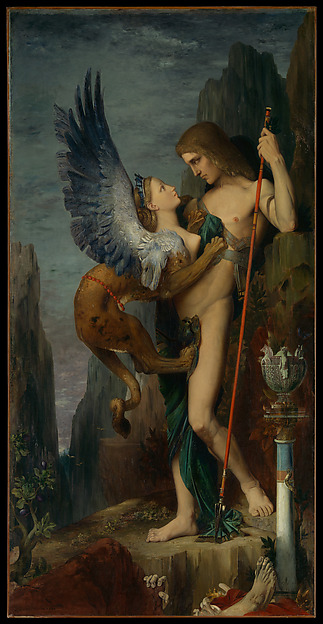
Oedipus and the Sphinx, Gustave Moreau, 1864

Edipo y la esfinge

1864 · Museo Metropolitano de Arte

Dejanira (Autumn), Gustave Moreau, about 1872–1873

Dejanira (Autumn)

about 1872–1873 · Museo J. Paul Getty

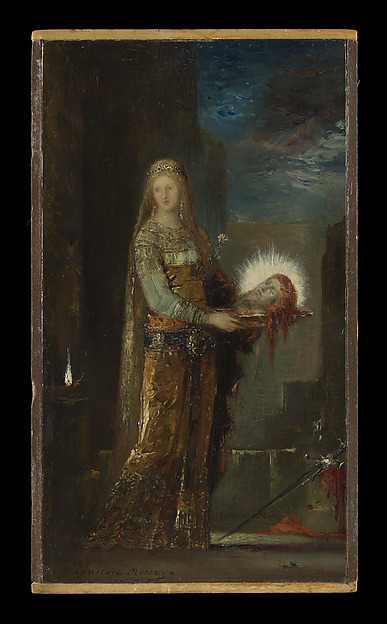
Salome with the Head of John the Baptist, Gustave Moreau, ca. 1876

Salome with the Head of John the Baptist

ca. 1876 · Museo Metropolitano de Arte

Hercules and the Lernaean Hydra, Gustave Moreau, 1875–76

Hercules and the Lernaean Hydra

1875–76 · Instituto de Arte de Chicago

Jacob and the Angel, Gustave Moreau, 1874-1878

Jacob and the Angel

1874-1878 · Harvard Art Museums

The Infant Moses, Gustave Moreau, c. 1876-c. 1878

The Infant Moses

c. 1876-c. 1878 · Harvard Art Museums

The Apparition, Gustave Moreau, 1876-1877

The Apparition

1876-1877 · Harvard Art Museums

The Sirens, Gustave Moreau, 1882

The Sirens

1882 · Harvard Art Museums

Bajo el mismo techo: Harvard Art Museums

Página del museo
Glück auf in Deutschland (N:4), Pınar Öğrenci, 2024

Pınar Öğrenci

Glück auf in Deutschland (N:4), 2024

Glück auf in Deutschland (N:10), Pınar Öğrenci, 2024

Pınar Öğrenci

Glück auf in Deutschland (N:10), 2024

Glück auf in Deutschland (N:7b), Pınar Öğrenci, 2024

Pınar Öğrenci

Glück auf in Deutschland (N:7b), 2024

Glück auf in Deutschland (N:6), Pınar Öğrenci, 2024

Pınar Öğrenci

Glück auf in Deutschland (N:6), 2024

Glück auf in Deutschland (N:11), Pınar Öğrenci, 2024

Pınar Öğrenci

Glück auf in Deutschland (N:11), 2024

Dwarpalika (Temple Guardian), Sneha Shrestha, 2023

Sneha Shrestha

Dwarpalika (Temple Guardian), 2023

The Eternal Pond of the Universe, Bingyi 冰逸, 2022-2024

Bingyi 冰逸

The Eternal Pond of the Universe, 2022-2024

Triangle Constellation, Carlos Amorales, 2015

Carlos Amorales

Triangle Constellation, 2015