Gustave CourbetFrancia, 1819–1877
El taller del pintor
The Painter's Studio
¿Se puede contemplar?
Se desconoce

Museo de Orsay
París, Francia
Se conoce el propietario; no se sabe si hoy está expuesta.
- En este estado desde
- Fuente
- El museo
Sobre el cuadro
El taller del pintor (en francés, L'Atelier du peintre) es un cuadro del pintor francés Gustave Courbet. Está realizado al óleo sobre lienzo. Mide 359 cm de alto y 598 cm de ancho. Fue pintado en 1855, encontrándose actualmente en el Museo de Orsay, de París, Francia. Su título completo en francés es: L’Atelier du peintre. Allégorie Réelle déterminant une phase de sept années de ma vie artistique (et morale), esto es, El taller del pintor, alegoría real, determinante de una fase de siete años de mi vida artística (y moral).
También recibe los nombres de Alegoría real o El estudio. Este monumental cuadro es el más emblemático, considerado una alegoría real de su entorno político, artístico y cultural.
Ficha
- Número de inventario
- RF 2257
En el catálogo
Fuentes
- Wikidata
- Imagen: Museo de Orsay — Gustave Courbet · Public domain · Wikimedia Commons
Mientras tanto, en la vida de Gustave Courbet
La vida entera1855
Stages the “Pavilion of Realism”
Refusing to accept the jury's decision, Courbet asked museums and private owners to lend his paintings, had a separate building erected and showed about forty canvases there, without state permission, under the Second Empire. The public was baffled and laughed at the “crude art”, and the critics mocked him; the paintings were appreciated by Delacroix and Baudelaire.
1855
The “Realist Manifesto” in the exhibition catalogue
The catalogue of the Pavilion of Realism opened with a manifesto in which Courbet claimed the right to artistic freedom and the right to show his works to the public on his own. He defined his aim as conveying the customs, ideas and appearance of his time, to be not only a painter but a man as well: to “create living art”.
1855
The Exposition Universelle jury turns down three paintings
Courbet submitted fourteen paintings to the Salon of 1855, part of the Exposition Universelle; three were rejected “for lack of space”, among them the monumental “A Burial at Ornans” and “The Artist's Studio”.
1855
Empress Eugénie before “The Bathers”
According to Proudhon's recollection, Empress Eugénie, visiting the Pavilion of Realism, stopped before Courbet's “Bathers”, with its robustly peasant-like nude body shown without the usual idealization, and exclaimed, “Is this a Percheron too?” She had just been looking at Rosa Bonheur's “Horse Fair”.
1857
Salon of 1857: “Young Ladies on the Banks of the Seine”
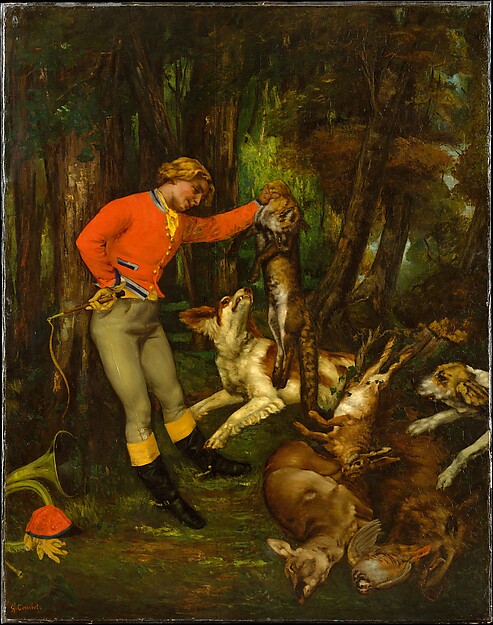
At the Salon of 1857 Courbet showed six paintings, among them “Young Ladies on the Banks of the Seine (Summer)”, painted the year before, and the first of his many hunting scenes. Modern women casually displaying their undergarments caused a scandal; pairing sensational works with hunting scenes secured Courbet both notoriety and sales.