Edgar DegasFrancia, 1834–1917
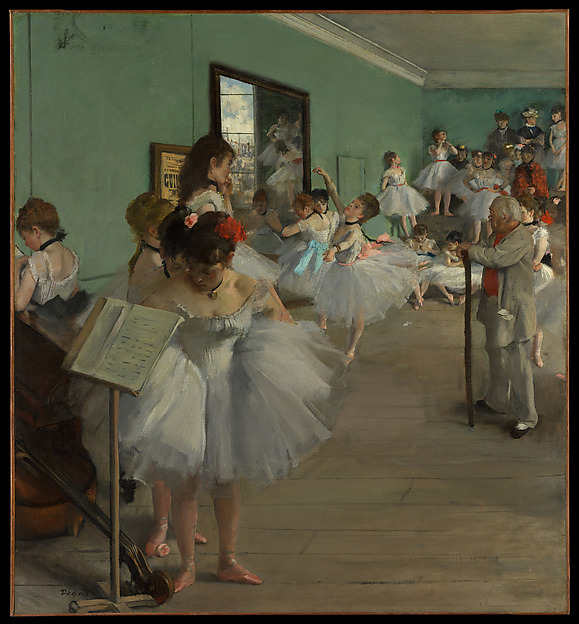
Clase de ballet
The Ballet Class
¿Se puede contemplar?
Se desconoce: el museo guarda silencio

Museo de Orsay
París, Francia
Se sabe quién es el propietario. Si hoy está expuesta, el museo no lo dice, y a adivinar no nos enseñaron.
- En este estado desde
- Fuente
- Los datos de colección del propio museo
About the painting
La clase de danza o La clase de ballet es una pintura del pintor francés impresionista Edgar Degas, pintada en 1873-1876, al óleo sobre lienzo, y con 85,5 x 75 centímetros. Muestra a las bailarinas del cuerpo de la Ópera de París, esperando la evaluación de su maestro Jules Perrot (1810-1892). El conde Isaac de Camondo, un destacado coleccionista de arte impresionista, legó la pintura al Museo del Louvre en 1911. Está en el Museo de Orsay de París desde 1986. Una variante de la pintura se exhibe en el Museo Metropolitano de Arte de Nueva York.
Ficha
- Número de inventario
- RF 1976
En el catálogo
Fuentes
- Wikidata · obtenido hace 6 días
- Imagen: Museo de Orsay — Edgar Degas · Public domain · Wikimedia Commons
Mientras tanto, en la vida de Edgar Degas
La vida enteralate 1860s
The turn to modern life: racecourses, milliners, laundresses
By the late 1860s Degas had moved from history painting to an original observation of contemporary life: racecourse scenes let him paint horses and riders in a modern setting, and then he turned to women at work — milliners and laundresses.
late 1860s
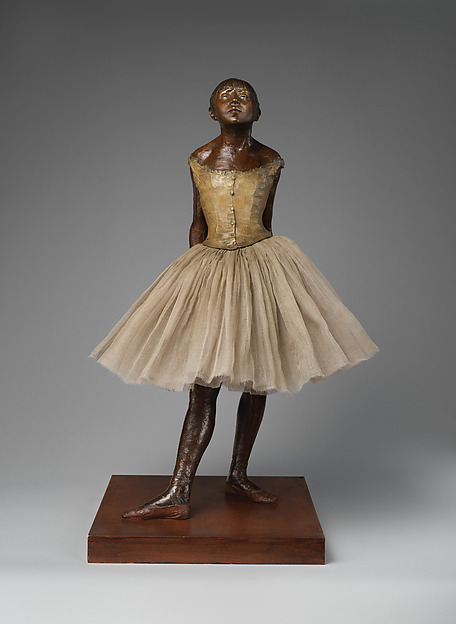
Begins modelling in wax
Degas modelled small wax figures of dancers, bathers and jockeys for himself, in place of studies. He never worked in bronze or stone; he valued wax for its changeability, and his sculptor friend Bartholomé encouraged him.
1870
A volunteer in the war; a flaw in his eyesight
When the Franco-Prussian War broke out Degas volunteered; at the first shooting practice it turned out that he saw poorly with his right eye. It was the first sign of the macular degeneration that left him almost blind at the end of his life; he was transferred to the artillery and served there to the end of the war.
early 1870s
Meets Durand-Ruel
Degas met the dealer Durand-Ruel, later the most prominent of the trusted dealers with whom he planned his strategy at auctions.
octubre de 1872 – marzo de 1873 · Residencia
New Orleans
1873–1874
His brother's debts: he sells his house and collection
After his father's death Degas learned that his brother René had run up enormous business debts. To save the family's reputation he sold his house and an inherited art collection and for the first time in his life depended on sales of his own work.