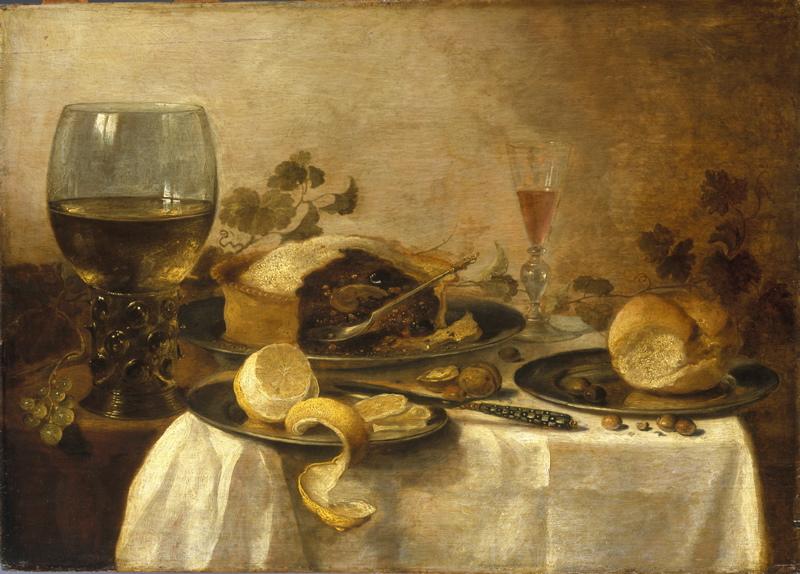
Still Life with Assorted Fruit
¿Puedo verla?
Sí, expuesta ahora
¿Dónde está «Still Life with Assorted Fruit» hoy? Museo J. Paul Getty, Museum East Pavilion, Gallery E203, Los Ángeles. Sí, expuesta ahora. Comprobado 5 de octubre de 2026.
Cerrado· abre a las 10:00
Expuesta al público.
- Comprobado
- En este estado desde
- Fuente
- El museo
Sobre el cuadro
In this small painting Pieter Claesz presents the viewer with an array of perfectly ripe fruits, a few nuts, and a luminous glass of white wine on a freshy pressed plain-damask tablecloth. *Still Life with Assorted Fruit* is one of the earliest examples of a still life focused primarily on assorted fruits (known as a *fruijtagie*) and a key painting in Claesz’s early career. Instead of the more traditional wide and high bird’s-eye viewpoint, Claesz employed a compact composition and a more direct, frontal vantage, an integrated arrangement of fruit and vessels. Intense light from the upper left illuminates the vivid hues of the assembled foodstuffs, reflecting off smooth surfaces, casting shadows, and refracting the casement window of the room through the delicate greenish glass of the *berkemeyer*.
Leer más
An elegant knife diagonally balanced on the edge of the table connects the array with the viewer and establishes the illusion of the still life. Along with a thorny branch of golden gooseberries, the overturned silver spoon with a finial in the form of a figure of a Roman centurion direct the eye into the composition. All the fruits and nuts depicted by Claesz were readily available in the early seventeenth-century Netherlands. Delicate strawberries (left) and vibrant red cherries are displayed in imported blue and white Chinese porcelain dishes (sometimes referred to as *kraak* porcelain, a product from the reign of the Chinese emperor Wanli (1573-1619)). The polished pewter platter reflects the deep hues of white and red grapes and two golden apples. A pair of brown medlars, the fruit of a shrub in the rose family that was only edible once rotten, lie close to the front edge of the table. Scattered across its surface are whole and broken hazelnuts, and at the center a single walnut, wavy brushstrokes describing its shell, leans against the platter.
Museo J. Paul Getty
Ficha
- Número de inventario
- 2026.2
En el catálogo
Fuentes
- Museo J. Paul Getty
- Imagen: Museo J. Paul Getty — Open Content